Smell the potassium: Surprising find in study of sex- and aggression-triggering vomeronasal organ
July 29, 2012 in Neuroscience

Smell the potassium

Enlarge

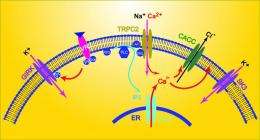
In an unexpected finding, Ron Yu and his team revealed that potassium channels contribute to the primary activation of the vomeronasal organ, which detects pheromones. Credit: Illustration: Courtesy of Dr. Ron Yu, Stowers Institute for Medical Research

The vomeronasal organ (VNO) is one of evolution's most direct enforcers. From its niche within the nose in most land-based vertebrates, it detects pheromones and triggers corresponding basic-instinct behaviors, from compulsive mating to male-on-male death matches. A new study from the Stowers Institute for Medical Research, published online in Nature Neuroscience on July 29, 2012, extends the scientific understanding of how pheromones activate the VNO, and has implications for sensory transduction experiments in other fields.

"We found two new ion channels—both of them —through which VNO are activated in mice," says Associate Investigator C. Ron Yu, Ph.D., senior author of the study. "This is quite unusual; potassium channels normally don't play a direct role in the activation of sensory neurons."

Humans have shrunken, seemingly vestigial VNOs, but still exhibit instinctive, pre-programmed behaviors relating to reproduction and aggression. Scientists hope that an understanding of how the VNO works in mice and other lower mammals will provide clues to how these innate behaviors are triggered in humans.

The VNO works in much the same way as the main olfactory organ that provides the sense of smell. Its neurons and their input stalks, known as dendrites, are studded with specialized receptors that can be activated by contact with specific messenger-chemicals called pheromones, found mostly in body fluids. When activated, VNO receptors cause adjacent ion channels to open or close allowing ions to flood into or out of a neuron. These inflows and outflows of electric charge create voltage surges that can activate a VNO neuron, so that it signals to the brain to turn on a specific behavior.

In 2002, as a postdoctoral researcher at Columbia University, Yu was a member of one of the first teams to find that VNO receptors rely heavily on a calcium channel called TRPC2. But there were hints that VNO neurons use other ion channels too; and in a study reported last November in Nature Communications, Yu's team at Stowers, including first author SangSeong Kim, Ph.D., a postdoctoral researcher, found evidence for the role of a chloride-specific channel, CACC.

In the new study, Yu, Kim and their colleagues looked for VNO potassium channels, which admit positively charged . They began by setting up whole-cell patch clamp tests, in which tiny electrodes measure the net flow of charged ions through the membranes of neurons in a slice of mouse VNO tissue. To determine the contribution of potassium ions to these currents, they replaced the potassium ions in the neurons with chemically similar cesium ions, which cannot get through potassium channels. When these potassium-depleted VNO neurons were exposed to pheromone-containing mouse urine, the usual net inward flow of positive charge was significantly greater than it had been when the neurons contained potassium.

That and other experiments with the VNO tissue slices suggested that potassium ions normally flow out of VNO neurons through potassium channels when a VNO receptor is activated. This was not completely unexpected; neurons typically have a greater concentration of potassium ions inside than outside, leading to an outward flow when potassium channels are opened. The outward flow originates mostly from the main bodies of neurons and helps reset neurons to a resting state voltage. However, in the VNO neurons a strong outward flow of potassium also occurred within the dendrites, directly countering the inward flow of positive ions that would activate the neurons. "It seemed a bit bizarre that such an important system would work against itself in this way," Yu says.

The team was able to zero in on the two potassium channels responsible, which are known as SK3 and GIRK. But when they set up experiments to evaluate these channels not in VNO tissue slices but "in vivo"—in the working VNOs of live mice—they found a very different result: On balance the potassium channels now sent potassium ions in the inward direction. In fact, these two newly discovered channels seemed to account for more than half of the VNO-activating current.

This inflowing-potassium phenomenon is known to occur in another type of sensory neuron, the sound-sensitive cochlear hair cell, whose external environment contains relatively high levels of potassium. "This made us wonder whether the VNO also has a high level of potassium in the fluid surrounding its dendrites," says Kim.

It does. It turns out that the standard preparation of tissue slices for the initial patch-clamp experiments had washed away that naturally high concentration. The resulting low concentration had misleadingly caused potassium ions to be sucked out of VNO neuron dendrites when the SK3 and GIRK potassium channels were opened. "It's a cautionary tale that shows the importance of doing in vivo experiments," Yu says.

The finding that potassium channels contribute to the primary activation of the VNO could be a clue to the origins of the organ. "We speculate that the VNO may have evolved to have a high extracellular concentration of ions, as well as multiple , so that it remains functional even when it comes into contact with various ion-rich bodily fluids," Yu says. "The diversity of signaling pathways perhaps make it more robust in triggering innate behaviors."

Journal reference: Nature Neuroscience search and more info website Nature Communications search and more info website

Provided by Stowers Institute for Medical Research search and more info website

4.5 /5 (10 votes)  

Filter


Move the slider to adjust rank threshold, so that you can hide some of the comments.


Display comments: newest first

JVK
Jul 29, 2012

Rank: 5 / 5 (1)
Whether receptor-mediated signal transduction occurs via a VNO and AOS or through the main olfactory system (MOS) it is the molecular biology common to all species which assures us that olfaction and odor receptors provide a clear evolutionary trail that can be followed from unicellular organisms to insects to humans. The adaptive evolution of a common response to food odors and mammalian pheromones, including human pheromones, is the GnRH-directed luteinizing hormone (LH) response that links the epigenetic effects of human pheromones and food odors directly to the socioaffective nature of evolved behaviors, as detailed in: Kohl, J.V. (2012) Human pheromones and food odors: epigenetic influences on the socioaffective nature of evolved behaviors. Socioaffective Neuroscience & Psychology, 2: 17338.
http://dx.doi.org...i0.17338
Osiris1
Jul 29, 2012

Rank: not rated yet
Next all the fourteen years old boys will be asking how to "activate" the VNO's in their girlfriends.
JVK
Jul 29, 2012

Rank: not rated yet
There is no functional human VNO, which means it is obviously not required for the response to human pheromones that can be measured in assays of luteinizing hormone (LH).
JVK
Jul 29, 2012

Rank: not rated yet
A mixture of androstenol and androsterone appears to alter the LH response in women and increases their ovulatory phase observed flirtatious behavior, and self-reported level of attraction. See for example: Human pheromones, epigenetics, physiology, and the development of animal behavior http://posters.f1000.com/P1387
Rank 4.5 /5 (10 votes)
Relevant PhysicsForums posts

More news stories

New neuron formation could increase capacity for new learning, at the expense of old memories

New research presented today shows that formation of new neurons in the hippocampus - a brain region known for its importance in learning and remembering - could cause forgetting of old memories by causing a reorganization ...

Neuroscience created May 24, 2013 | popularity 4 / 5 (4) | comments 0

Help at hand for people with schizophrenia

How can healthy people who hear voices help schizophrenics? Finding the answer for this is at the centre of research conducted at the University of Bergen.

Neuroscience created May 24, 2013 | popularity 4 / 5 (2) | comments 2

Japanese research organizations contribute to Human Brain Project

One of the major frontiers of modern science is a comprehensive understanding of the human brain and its functions to guide the development of new technologies in information and communication. In a major announcement for ...

Neuroscience created May 24, 2013 | popularity 3.7 / 5 (3) | comments 0

Controlling mood through the motions of mitochondria

(Medical Xpress)—Regulating the distribution of power in neurons is done by a system that makes the national electric grid look simple by comparison. Each neuron has several thousand mitochondria confined ...

Neuroscience created May 23, 2013 | popularity 4.9 / 5 (9) | comments 0 | with audio podcast report

Brain uses internal 'average voice' prototype to identify who is talking

(Medical Xpress)—The human brain is able to identify individuals' voices by comparing them against an internal 'average voice' prototype, according to neuroscientists.

Neuroscience created May 23, 2013 | popularity 3.7 / 5 (3) | comments 3 | with audio podcast


First drug to improve heart failure mortality in over a decade

Coenzyme Q10 decreases all cause mortality by half, according to the results of a multicentre randomised double blind trial presented today at Heart Failure 2013 congress. It is the first drug to improve heart failure mortality ...

Heart failure accelerates male 'menopause'

Heart failure accelerates the aging process and brings on early andropausal syndrome (AS), according to research presented today at the Heart Failure Congress 2013. AS, also referred to as male 'menopause', was four times ...

Hormone levels may provide key to understanding psychological disorders in women

Women at a particular stage in their monthly menstrual cycle may be more vulnerable to some of the psychological side-effects associated with stressful experiences, according to a study from UCL.

Researchers identify first drug targets in childhood genetic tumor disorder

Two mutations central to the development of infantile myofibromatosis (IM)—a disorder characterized by multiple tumors involving the skin, bone, and soft tissue—may provide new therapeutic targets, according to researchers ...

Feds fight morning-after pill age ruling in NY

(AP)—Department of Justice lawyers have again asked a federal appeals court in New York to delay lifting age restrictions and prescription requirements on an emergency contraceptive popularly known as the morning-after ...

Death highest in heart failure patients admitted in January, on Friday, and overnight

Mortality and length of stay are highest in heart failure patients admitted in January, on Friday, and overnight, according to research presented today at the Heart Failure Congress 2013. The analysis of nearly 1 million ...