Starr collaboration illuminates mysterious pathway to immortality in cancer cells
July 25, 2012 By Joseph Bonner in Cancer
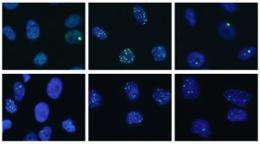
Cell lines lacking ALT (top row) showed a nearly complete disappearance of the irradiation-induced DNA damage after 24 hours (far right column). In contrast, 11 out of 12 ALT cell lines (bottom row) retained a significant fraction of the induced DNA damage foci after a day. Cells in the left hand column were not irradiated; the center column shows DNA damage one hour after irradiation.
(Medical Xpress) -- Cancer cells are immortal because they circumvent failsafe mechanisms that stop out-of-control cell proliferation. One of these mechanisms the progressive shortening of chromosomes is prevented by replenishment of telomeres, the protective elements at the ends of chromosomes. Most cancer cells do this with an enzyme called telomerase, but approximately 10 to 15 percent of human cancers use a different pathway called ALT (alternative lengthening of telomeres). Whether or not a tumor has ALT makes a difference. For example, people with glioblastoma live twice as long if the tumor uses ALT.
With support from the Starr Cancer Consortium, a team of scientists from The Rockefeller University, The Broad Institute of MIT and Harvard, Memorial Sloan-Kettering Cancer Center and Weill Cornell Medical College set out to demystify ALT. The team carried out a detailed analysis of a large panel of ALT cell lines for their genetic and cell biological features. How ALT is activated was not known but recent data pointed the finger at an enzyme called ATRX. ATRX changes the way DNA wraps around proteins in chromosomes.
In an article published online July 19 in PLoS Genetics the team shows that loss of ATRX is a common event in the genesis of ALT lines. They also show that ALT cell lines frequently undergo chromosomal changes and are impaired in their ability to detect and repair damage in their DNA.
These hallmarks of ALT are expected to help the detection of ALT-type tumors in the clinic and may lead to ALT-specific treatments, says Titia de Lange, Leon Hess Professor and head of the Laboratory of Cell Biology and Genetics at Rockefeller University, team leader and co-author of the paper. They may also help explain differential survival benefit of ALT tumors.
This work represents a remarkable collaborative effort among five laboratories at four different institutions, says John Petrini, a member of Memorial Sloan-Ketterings Molecular Biology Program, team member and co-author of the paper. Each of us brought our specific expertise to bear on this intriguing and important problem.
It exemplifies the power of collaboration, says William Hahn, a senior associate member of the Broad Institute, team member and co-author of the paper.
More information: www.starrcancer.org/
Journal reference:
PLoS Genetics
Provided by
Rockefeller University
-
Alternate ending -- living on without telomerase
Nov 03, 2011 |
not rated yet |
0
-
Researchers report new understanding of role of telomeres in tumor growth
Sep 01, 2011 |
not rated yet |
0
-
Scientists open new window into how cancers override cellular growth controls
Mar 21, 2012 |
not rated yet |
0
-
A new ending to an old 'tail'
Apr 21, 2011 |
not rated yet |
0
-
Genetic controller prepares immune system for diverse threats
Sep 11, 2011 |
not rated yet |
0
-
Motion perception revisited: High Phi effect challenges established motion perception assumptions
Apr 23, 2013 |
3 / 5 (2) |
2
-
Anything you can do I can do better: Neuromolecular foundations of the superiority illusion (Update)
Apr 02, 2013 |
4.5 / 5 (11) |
5
-
The visual system as economist: Neural resource allocation in visual adaptation
Mar 30, 2013 |
5 / 5 (2) |
9
-
Separate lives: Neuronal and organismal lifespans decoupled
Mar 27, 2013 |
4.9 / 5 (8) |
0
-
Sizing things up: The evolutionary neurobiology of scale invariance
Feb 28, 2013 |
4.8 / 5 (10) |
14
-
How can there be villous adenoma in colon, if there are no villi there
18 hours ago
-
How can there be a term called "intestinal metaplasia" of stomach
May 21, 2013
-
Pressure-volume curve: Elastic Recoil Pressure don't make sense
May 18, 2013
-
If you became brain-dead, would you want them to pull the plug?
May 17, 2013
-
MRI bill question
May 15, 2013
-
Ratio of Hydrogen of Oxygen in Dessicated Animal Protein
May 13, 2013
- More from Physics Forums - Medical Sciences
More news stories
American cancer society celebrates 100 years of progress
(HealthDay)—The American Cancer Society, which is celebrating on Wednesday a century of fighting a disease once viewed as a death sentence, is making a pledge to put itself out of business.
Cancer
8 hours ago |
not rated yet |
0
CT detects twice as many lung cancers as X-ray at initial screening exam
National Lung Screening Trial (NLST) investigators also conclude that the 20 percent reduction in lung cancer mortality with low-dose computed tomography (LDCT) versus chest X-ray (CXR) screening previously reported in the ...
Cancer
9 hours ago |
not rated yet |
0
Research offers promising new approach to treatment of lung cancer
Researchers have developed a new drug delivery system that allows inhalation of chemotherapeutic drugs to help treat lung cancer, and in laboratory and animal tests it appears to reduce the systemic damage ...
Cancer
12 hours ago |
not rated yet |
0
|
Study details genes that control whether tumors adapt or die when faced with p53 activating drugs
When turned on, the gene p53 turns off cancer. However, when existing drugs boost p53, only a few tumors die – the rest resist the challenge. A study published in the journal Cell Reports shows how: tumors that live even i ...
Cancer
12 hours ago |
not rated yet |
0
|
Small increase in cancer risk following CT scans in childhood and adolescence
Study leader, Professor John Mathews from the University of Melbourne said this small increase in cancer risk must be weighed against the undoubted benefits from CT scans in diagnosing and monitoring disease.
Cancer
16 hours ago |
not rated yet |
0
Rate of bicycle-related fatalities significantly lower in states with helmet laws
Existing research shows that bicyclists who wear helmets have an 88 percent lower risk of brain injury, but researchers at Boston Children's Hospital found that simply having bicycle helmet laws in place showed a 20 percent ...
Slowing the aging process—only with antibiotics
Swiss scientists reveal the mechanism responsible for aging hidden deep within mitochondria—and dramatically slow it down in worms by administering antibiotics to the young.
Researchers complete largest genetic sequencing study of human disease
Researchers from Queen Mary, University of London have led the largest sequencing study of human disease to date, investigating the genetic basis of six autoimmune diseases.
Brain can be trained in compassion, study shows
Until now, little was scientifically known about the human potential to cultivate compassion—the emotional state of caring for people who are suffering in a way that motivates altruistic behavior.
Having both migraines, depression may mean smaller brain
(HealthDay)—Migraines and depression can each cause a great deal of suffering, but new research indicates the combination of the two may be linked to something else entirely—a smaller brain.
Novel approach for influenza vaccination shows promise in early animal testing
A new approach for immunizing against influenza elicited a more potent immune response and broader protection than the currently licensed seasonal influenza vaccines when tested in mice and ferrets. The vaccine ...