A step forward for stem cell therapy
July 11, 2012 in Medical research

A step forward for stem cell therapy

Enlarge

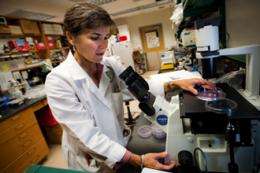
Aline Betancourt, research associate professor with the Tulane Center for Stem Cell Research and Regenerative Medicine, developed a technique to produce standardized stem cells that will turn off the body’s inflammatory response. Credit: Paula Burch-Celentano

(Medical Xpress) -- A new study shows the potential of a method to prepare stem cells that may provide relief from a painful diabetes complication. Aline Betancourt of the Tulane University Center for Stem Cell Research and Regenerative Medicine, with colleagues at Tulane and the Ochsner Clinic Foundation, developed a new treatment using modified stem cells to control inflammation.

The study results released on Monday (July 9) in the journal Translational Medicine suggest that the use of stem cells specially prepared to turn off the body’s inflammatory response represent a promising new therapeutic strategy for diabetic peripheral neuropathy that should be further investigated.

About 70 percent of diabetics have neuropathy (nerve damage) resulting from the disease, according to the National Institutes of Health. Severe peripheral neuropathy causes excruciating pain in the toes, feet, legs, hands or arms. Even a tiny amount of external pressure can be excruciating. is considered a major culprit.

Previous studies have proven mesenchymal stem cells (MSCs) are safe and effective in treating inflammatory diseases. MSCs, which are taken from adult donors, can give rise to a large number of tissue types such as bone, fat and cartilage.

“The problem,” Betancourt explains, “is that the current methods for preparing these cells yield a mixed pool of undefined cells that aren’t consistently effective in the clinic. Our laboratory developed a new method that results in a consistent, uniform MSC population and optimizes their anti-inflammatory effects. We call these cells MSC2s.”

When the researchers tested the MSC2 cells on mice with peripheral neuropathy, they saw a significant improvement in inflammation and other symptoms — as much as 40 percent for the MSC2 group over the mice that received no treatment. At best, there was only 14 percent improvement in those administered conventional MSCs.

Provided by Tulane University search and more info website

5 /5 (1 vote)  

Rank 5 /5 (1 vote)
Related Stories
Relevant PhysicsForums posts

More news stories

Study reveals new mechanism for estrogen suppression of liver lipid synthesis

By discovering the new mechanism by which estrogen suppresses lipid synthesis in the liver, UC Irvine endocrinologists have revealed a potential new approach toward treating certain liver diseases.

Medical research created May 23, 2013 | popularity not rated yet | comments 0 | with audio podcast

MRI-based measurement helps predict vascular disease in the brain

Aortic arch pulse wave velocity, a measure of arterial stiffness, is a strong independent predictor of disease of the vessels that supply blood to the brain, according to a new study published in the June issue the journal ...

Medical research created May 23, 2013 | popularity not rated yet | comments 0

Antibiotics: A new understanding of sulfonamide nervous system side effects

Since the discovery of Prontosil in 1932, sulfonamide antibiotics have been used to combat a wide spectrum of bacterial infections, from acne to chlamydia and pneumonia. However, their side effects can include serious neurological ...

Medical research created May 23, 2013 | popularity not rated yet | comments 0 | with audio podcast

Scientists discover molecule triggers sensation of itch

Scientists at the National Institutes of Health report they have discovered in mouse studies that a small molecule released in the spinal cord triggers a process that is later experienced in the brain as ...

Medical research created May 23, 2013 | popularity 5 / 5 (3) | comments 0 | with audio podcast

Discarded immune cells induce the relocation of stem cells

Spanish researchers have discovered that the daily clearance of neutrophils from the body stimulates the release of hematopoietic stem cells from the bone marrow into the bloodstream, according to a report published today ...

Medical research created May 23, 2013 | popularity 5 / 5 (2) | comments 0


Engineered cytomegalovirus protects monkeys from HIV equivalent

(Medical Xpress)—A new study by researchers in the US has shown that an ancient virus can be modified to help in the fight against the simian immunodeficiency virus SIV, which is the equivalent in monkeys ...

Hormone levels may provide key to understanding psychological disorders in women

Women at a particular stage in their monthly menstrual cycle may be more vulnerable to some of the psychological side-effects associated with stressful experiences, according to a study from UCL.

Going live: Immune cell activation in multiple sclerosis

Biological processes are generally based on events at the molecular and cellular level. To understand what happens in the course of infections, diseases or normal bodily functions, scientists would need to ...

Researchers identify first drug targets in childhood genetic tumor disorder

Two mutations central to the development of infantile myofibromatosis (IM)—a disorder characterized by multiple tumors involving the skin, bone, and soft tissue—may provide new therapeutic targets, according to researchers ...

Driving and hands-free talking lead to spike in errors, study shows

Talking on a hands-free device while behind the wheel can lead to a sharp increase in errors that could imperil other drivers on the road, according to new research from the University of Alberta.

Depression raises diabetics' risk of severe low blood sugar episodes

(Medical Xpress)—Patients with diabetes who are depressed are much more likely to develop episodes of dangerously low blood sugars, or hypoglycemia, than are those who are not depressed, a new study has ...