New technology helps patients suffering joint damage
July 2, 2012 By Steve Delgado in Surgery
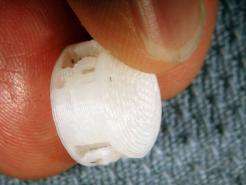
Cartilage scaffold designs like this have an interior pattern that encourages fast anchoring of the scaffold and allows cartilage to form on the top surface. Credit: UA biomedical engineering department/UA Orthopaedic Research Lab, department of orthopaedic surgery
Biomedical engineering researchers say better implantable sensors and cartilage-growing techniques are making engineered cartilage a clinical reality for patients suffering from joint damage.
Biomedical engineering researchers have cited recent advances in implantable sensor technology and cartilage scaffolding systems as major developments in the use of engineered cartilage for bone and joint repair.
These advances could mean help for the vast number of patients suffering from damaged joints and osteoarthritis the most common form of arthritis that affects millions of people worldwide.
Newer, smaller sensing devices that more accurately measure stress loads on joints are giving researchers testing newly grown engineered cartilage within a joint a better understanding of the healing process. Armed with these data, doctors could advise patients on safer, more beneficial levels of activity following joint surgery.
The sensors also transmit their measurements wirelessly, enabling patients undergoing cartilage growth therapy to monitor their own joint stress loads in real time.
The advances appear this month in the Journal of the American Academy of Orthopaedic Surgeons.
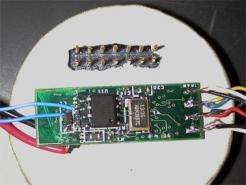
A first-generation transmitter design (white, circular) for measuring and transmitting loads on bone and cartilage in joints is compared to a newer design (green, rectangular) that can be safely implanted into patients. The longer, narrower design is about the length of the diameter of a dime. Credit: UA biomedical engineering department/UA Orthopaedic Research Lab, department of orthopaedic surgery
The article, "Implantable Sensor Technology: From Research to Clinical Practice," by Eric Ledet, Darryl D'Lima, Peter Westerhoff, John Szivek, Rebecca Wachs and Georg Bergmann, appears in the June 2012 issue of the journal, which publishes research focused on improving the care of patients with musculoskeletal disorders. The article is a review that describes advances in the monitoring of implantable sensors for orthopaedic applications.Accurately measuring the loads within a repaired joint helps determine smarter ways to get joints to heal, said article co-author John Szivek, professor in the department of orthopaedic surgery at the University of Arizona and director of the UA Orthopedic Research Laboratory in Tucson, Ariz. Szivek also chairs the UA Biomedical Engineering Graduate Interdisciplinary Program.
Szivek said he's been published with a very elite group of researchers in this particular area of biomedical engineering. "There are only a handful of research groups in the world doing this type of work, and my lab is the only one in the world collecting direct measurements from native tissues," he said.
The group is a collaboration of researchers from four universities. Co-authors Ledet and Wachs are from the department of biomedical engineering at Rensselaer Polytechnic Institute in Troy, N.Y. D'Lima is from the department of molecular and experimental medicine at the Scripps Research Institute in La Jolla, Calif., and Westerhoff and Bergmann are from the Julius Wolff Institut, Charité University of Medicine, Berlin, Germany.
"It's a stroke of genius to combine tissue engineering and improved implant measurement technology," said Jennifer Barton, head of the UA biomedical engineering department. "No one really knew what the specific loads were on these joints before this."
Monitoring and recording the pressures involved in different patient activities decreases rehabilitation time and allows patients to heal more consistently without damaging themselves during rehab or after they have healed.
Szivek said the ultimate goal is to house the transmitters on a single small computer chip about one-third the size of a dime. These new chip-based transmitters would wirelessly transmit patient activity, including reporting the recent history of various loads on a repaired joint. Patients could also monitor their own healing via the sensor's wireless reporting to a smartphone app.
"The idea of having a device that's designed specifically for a patient, tied to a system that provides dynamic feedback directly to that patient, has tremendous possibilities," Barton said.
Another advance in the ability of researchers to successfully use cartilage growth for joint repair is the use of computerized tomography, or CT, scans, which are computer-generated medical images used in the diagnosis of tumors and cancer. The 3-D images produced by CT scans are now being used to create patient-specific implantable scaffold systems that support joint cartilage while the tissue grows and gains strength.
Using a 3-D scan of a patient's joint to custom build an implantable scaffold to support new cartilage growth as well as an implanted sensor that provides real-time activity monitoring for the rehabilitated patient represent major milestones in cartilage tissue engineering.
Said Barton: "This group has developed a methodology for building an implant that's closer to the native tissue than anything that has been made before."
Provided by
University of Arizona
-
Hope for arthritis patients in fat tissue
Sep 03, 2010 |
not rated yet |
0
-
Researchers develop world's first biodegradable joint implant
Feb 28, 2012 |
not rated yet |
0
-
Progress in tissue engineering to repair joint damage in osteoarthritis
Jun 08, 2011 |
not rated yet |
0
-
Tissue engineered scaffolding allows reproduction of cartilage tissue
May 09, 2007 |
not rated yet |
0
-
Stems cells might help repair joints
Feb 07, 2007 |
not rated yet |
0
-
Motion perception revisited: High Phi effect challenges established motion perception assumptions
Apr 23, 2013 |
3 / 5 (2) |
2
-
Anything you can do I can do better: Neuromolecular foundations of the superiority illusion (Update)
Apr 02, 2013 |
4.5 / 5 (11) |
5
-
The visual system as economist: Neural resource allocation in visual adaptation
Mar 30, 2013 |
5 / 5 (2) |
9
-
Separate lives: Neuronal and organismal lifespans decoupled
Mar 27, 2013 |
4.9 / 5 (8) |
0
-
Sizing things up: The evolutionary neurobiology of scale invariance
Feb 28, 2013 |
4.8 / 5 (10) |
14
-
Basic physics understanding. Could someone explain?
39 minutes ago
-
Change in flux of a transformer
1 hour ago
-
Electric field between parallel plate capacitor
1 hour ago
-
Why angle of projectile has 2 solutions?
2 hours ago
-
How much negative charge do I accumulate by touching the earth?
3 hours ago
-
Indeterminism in Classical Physics
9 hours ago
- More from Physics Forums - Classical Physics
More news stories
Researchers rewrite obsolete blood-ordering rules
Johns Hopkins researchers have developed new guidelines—the first in more than 35 years—to govern the amount of blood ordered for surgical patients. The recommendations, based on a lengthy study of blood use at The Johns ...
Surgery
May 22, 2013 |
4 / 5 (1) |
0
Indian medics reconstruct baby's swollen head
Indian doctors said Wednesday they have successfully carried out a first round of reconstructive surgery on the skull of a baby suffering from a rare disorder that caused her head to nearly double in size.
Surgery
May 22, 2013 |
not rated yet |
0
Polish man gets quick face transplant after injury (Update)
A 33-year-old Polish man received a face transplant just three weeks after being disfigured in a workplace accident, in what his doctors said Wednesday is the fastest time frame to date for such an operation. ...
Surgery
May 22, 2013 |
not rated yet |
0
Sexual function in older adults with thoracolumbar-pelvic instrumentation
Surgeons investigated sexual function in 62 patients, 50 years and older, who had received extensive spinal–pelvic instrumentation for spinal deformity at the University of Virginia Health Center. Based on their results, ...
Surgery
May 21, 2013 |
not rated yet |
0
Challenges encountered in surgical management of spine trauma in morbidly obese patients
Physicians at Monash University and The Alfred Hospital in Melbourne, Australia describe the logistic, medical, and societal challenges faced in treating spine trauma in morbidly obese patients. Based on a case series of ...
Surgery
May 21, 2013 |
not rated yet |
0
Driving and hands-free talking lead to spike in errors, study shows
Talking on a hands-free device while behind the wheel can lead to a sharp increase in errors that could imperil other drivers on the road, according to new research from the University of Alberta.
Researchers identify first drug targets in childhood genetic tumor disorder
Two mutations central to the development of infantile myofibromatosis (IM)—a disorder characterized by multiple tumors involving the skin, bone, and soft tissue—may provide new therapeutic targets, according to researchers ...
Engineered cytomegalovirus protects monkeys from HIV equivalent
(Medical Xpress)—A new study by researchers in the US has shown that an ancient virus can be modified to help in the fight against the simian immunodeficiency virus SIV, which is the equivalent in monkeys ...
Hormone levels may provide key to understanding psychological disorders in women
Women at a particular stage in their monthly menstrual cycle may be more vulnerable to some of the psychological side-effects associated with stressful experiences, according to a study from UCL.
Going live: Immune cell activation in multiple sclerosis
Biological processes are generally based on events at the molecular and cellular level. To understand what happens in the course of infections, diseases or normal bodily functions, scientists would need to ...
Controlling mood through the motions of mitochondria
(Medical Xpress)—Regulating the distribution of power in neurons is done by a system that makes the national electric grid look simple by comparison. Each neuron has several thousand mitochondria confined ...
Jul 02, 2012
Rank: not rated yet