Tumor cells' inner workings predict cancer progression
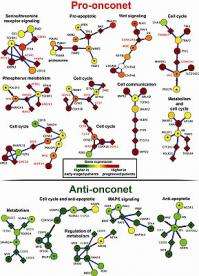
The schematic above depicts some of the subnetworks of interacting proteins that either promote or slow the progression of CLL. Credit: UC San Diego School of Medicine
Using a new assay method to study tumor cells, researchers at the University of California, San Diego School of Medicine and UC San Diego Moores Cancer Center have found evidence of clonal evolution in chronic lymphocytic leukemia (CLL). The assay method distinguishes features of leukemia cells that indicate whether the disease will be aggressive or slow-moving, a key factor in when and how patients are treated.
The findings are published in the July 26, 2012 First Edition online issue of Blood.
The progression of CLL is highly variable, dependent upon the rate and effects of accumulating monoclonal B cells in the blood, marrow, and lymphoid tissues. Some patients are symptom-free for years and do not require treatment, which involves the use of drugs that can cause significant side effects and are not curative. In other patients, however, CLL is relatively aggressive and demands therapeutic intervention soon after diagnosis.
"Our study shows that there may not be a sharp dividing line between the more aggressive and less aggressive forms of CLL," said Thomas J. Kipps, MD, PhD, Evelyn and Edwin Tasch Chair in Cancer Research and senior author of the study. "Instead, it seems that over time the leukemia cells of patients with indolent disease begin to use genes similar to those that are generally used by CLL cells of patients with aggressive disease. In other words, prior to requiring therapy, the patterns of genes expressed by CLL cells appear to converge, regardless of whether or not the patient had aggressive versus indolent disease at diagnosis."
Existing markers for aggressive or indolent disease are mostly fixed and have declining predictive value the longer the patient is from his or her initial diagnosis. When the blood sample is collected, these markers cannot reliably predict whether a CLL patient will need therapy soon, particularly when the patient has had the diagnosis of CLL for many years.
Kipps and colleagues studied thousands of genes, particularly those that code for proteins, in a group of 130 CLL patients with varying risks of disease progression. They identified 38 prognostic subnetworks of interacting genes and proteins that, at the time of sample collection, indicate the relative the aggressiveness of the disease and predict when the patient will require therapy. They confirmed their work using the method on two other, smaller CLL patient cohorts in Germany and Italy.
The subnetworks offer greater predictive value because they are based not on expression levels of individual genes or proteins, but on how they dynamically interact and change over time, influencing the course of the CLL and patient symptoms.
"In a sense, we looked at families rather than individuals," said Kipps. "If you find in an interconnected family where most genes or proteins are expressed at higher levels, it becomes more likely that these genes and proteins have functional significance."
He added that while the subnetworks abound in data, their complexity actually makes them easy to interpret and understand. "It's like when you look out of a window and see the sky, clouds, trees, people, cars. You're getting tremendous amounts of information that individually doesn't tell you much. But when you look at the scene as a whole, you see patterns and networks. This work is similar. We're taking all of the individual gene expression patterns and making sense of them as a whole. We're more able to more clearly see how they control and regulate function."
The findings help define how CLL and perhaps other cancers evolve over time, becoming more aggressive and deadly. "It's as if each tumor has a clock which determines how frequently it may acquire the chance changes that make it behave more aggressively. Although the rates can vary, it appears that tumors march down similar pathways, which converge over time to a point where they become aggressive enough to require therapy."
The study may alter how scientists think about CLL and how clinicians treat the disease: whether it is better to wait for later stages of the disease when tumor cells are more fragile and easier to kill, or treat early-stage indolent tumor cells aggressively, when they are fewer in number but harder to find and more resistant to therapy.
Journal reference:
Blood
Provided by
University of California - San Diego
-
New biomarker may predict prognosis for patients with chronic lymphocytic leukemia
Apr 24, 2012 |
not rated yet |
0
-
Interactive gene 'networks' may predict if leukemia is aggressive or slow-growing
Dec 08, 2008 |
not rated yet |
0
-
Researchers identify factor boosting leukemia's aggressiveness
Oct 22, 2010 |
not rated yet |
0
-
Decoding chronic lymphocytic leukemia
Jun 13, 2011 |
not rated yet |
0
-
Researchers identify potential new drug target for chronic leukemia
Nov 24, 2008 |
not rated yet |
0
-
Motion perception revisited: High Phi effect challenges established motion perception assumptions
Apr 23, 2013 |
3 / 5 (2) |
2
-
Anything you can do I can do better: Neuromolecular foundations of the superiority illusion (Update)
Apr 02, 2013 |
4.5 / 5 (11) |
5
-
The visual system as economist: Neural resource allocation in visual adaptation
Mar 30, 2013 |
5 / 5 (2) |
9
-
Separate lives: Neuronal and organismal lifespans decoupled
Mar 27, 2013 |
4.9 / 5 (8) |
0
-
Sizing things up: The evolutionary neurobiology of scale invariance
Feb 28, 2013 |
4.8 / 5 (10) |
14
-
Why is zone 1 in liver more prone to ischemic injury?
20 hours ago
-
How can there be villous adenoma in colon, if there are no villi there
May 22, 2013
-
How can there be a term called "intestinal metaplasia" of stomach
May 21, 2013
-
Pressure-volume curve: Elastic Recoil Pressure don't make sense
May 18, 2013
-
If you became brain-dead, would you want them to pull the plug?
May 17, 2013
-
MRI bill question
May 15, 2013
- More from Physics Forums - Medical Sciences
More news stories
Research identifies a way to make cancer cells more responsive to chemotherapy
Breast cancer characterized as "triple negative" carries a poor prognosis, with limited treatment options. In some cases, chemotherapy doesn't kill the cancer cells the way it's supposed to. New research from Western University ...
Cancer
6 hours ago |
5 / 5 (2) |
0
Mayo Clinic genomic analysis lends insight to prostate cancer
Mayo Clinic researchers have used next generation genomic analysis to determine that some of the more aggressive prostate cancer tumors have similar genetic origins, which may help in predicting cancer progression. The findings ...
Cancer
6 hours ago |
not rated yet |
0
When oxygen is short, EGFR prevents maturation of cancer-fighting miRNAs
Even while being dragged to its destruction inside a cell, a cancer-promoting growth factor receptor fires away, sending signals that thwart the development of tumor-suppressing microRNAs (miRNAs) before it's dissolved, researchers ...
Cancer
7 hours ago |
not rated yet |
0
|
Improved chemo regimen for childhood leukemia may offer high survival, no added heart toxicity
Treating pediatric leukemia patients with a liposomal formulation of anthracycline-based chemotherapy at a more intense-than-standard dose during initial treatment may result in high survival rates without causing any added ...
Cancer
11 hours ago |
not rated yet |
0
Protein preps cells to survive stress of cancer growth and chemotherapy
Scientists have uncovered a survival mechanism that occurs in breast cells that have just turned premalignant-cells on the cusp between normalcy and cancers-which may lead to new methods of stopping tumors.
Cancer
12 hours ago |
not rated yet |
0
|
ACP issues recommendations for management of high blood glucose in hospitalized patients
High blood glucose is associated with poor outcomes in hospitalized patients, and use of intensive insulin therapy (IIT) to control hyperglycemia is a common practice in hospitals. But the recent evidence does not show a ...
Controlling mood through the motions of mitochondria
(Medical Xpress)—Regulating the distribution of power in neurons is done by a system that makes the national electric grid look simple by comparison. Each neuron has several thousand mitochondria confined ...
Multiple research teams unable to confirm high-profile Alzheimer's study
Teams of highly respected Alzheimer's researchers failed to replicate what appeared to be breakthrough results for the treatment of this brain disease when they were published last year in the journal Science.
Motion quotient: IQ predicted by ability to filter motion (w/ video)
A brief visual task can predict IQ, according to a new study. This surprisingly simple exercise measures the brain's unconscious ability to filter out visual movement. The study shows that individuals whose ...
Scientists discover molecule triggers sensation of itch
Scientists at the National Institutes of Health report they have discovered in mouse studies that a small molecule released in the spinal cord triggers a process that is later experienced in the brain as ...
Researchers find common childhood asthma unconnected to allergens or inflammation
Little is known about why asthma develops, how it constricts the airway or why response to treatments varies between patients. Now, a team of researchers at Weill Cornell Medical College, Columbia University Medical Center ...