Unlocking a major secret of the brain: Researchers uncover crucial link between hippocampus and prefrontal cortex
August 15, 2012 in Neuroscience
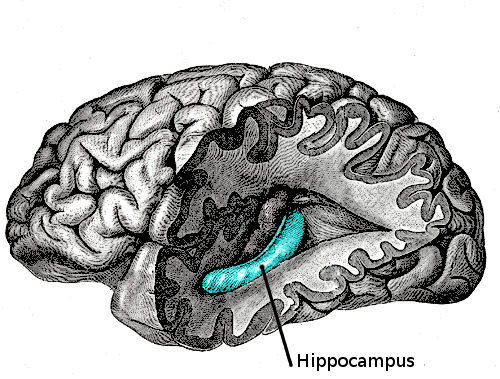
Modified from a scan of a plate of "Posterior and inferior cornua of left lateral ventricle exposed from the side" in Gray's Anatomy. Credit: Wikimedia Commons
(Medical Xpress) -- A clue to understanding certain cognitive and mental disorders may involve two parts of the brain which were previously thought to have independent functions, according to a McGill University team of researchers led by Prof. Yogita Chudasama, of the Laboratory of Brain and Behavior, Department of Psychology. The McGill team discovered a critical interaction between two prominent brain areas: the hippocampus, a well-known memory structure made famous by Dr. Brenda Milners patient H.M., and the prefrontal cortex, which is involved in decision-making and inhibiting inappropriate behaviours.
We had always thought that the hippocampus and the prefrontal cortex functioned independently, says Prof. Chudasama. Our latest study provides the first indication that that is not the case.
The teams finding, just published in the Journal of Neuroscience, reveals a critical interaction between these two brain areas and the control of behavior, and may advance the treatment of some cognitive and mental disorders including schizophrenia, and depression. The interaction between the hippocampus and the prefrontal cortex shows that brain circuits function not just as specific parts of the brain, but are linked together and work as a system.
Although the prefrontal cortex has long been known to be the driving force that steers our behavior, pushing us to make good decisions and withhold improper actions, it turns out that it cant do this unless it interacts with the hippocampus, added Prof. Chudasama. We found that when we prevented these two structures from communicating with each other, like humans with compulsive disorders, rats persisted with behaviours that were not good for them; they didnt correct their errant behaviours and could not control their natural urges.
The ability to control impulsive urges or inhibit our actions allows us to interact normally in personal or social situations, and this type of behaviour depends on the normal interaction of the hippocampus and the prefrontal cortex. This result provides a means for understanding the neural basis for social and cognitive deficits in disorders of brain and behaviour, such as those with frontotemporal dementia, concludes Prof. Chudasama.
More information: www.jneurosci.org/… 2/10915.full
Journal reference:
Journal of Neuroscience
Provided by
McGill University
-
Filters that reduce 'brain clutter' identified
Apr 14, 2011 |
not rated yet |
0
-
How we remember each other
Apr 03, 2007 |
not rated yet |
0
-
Brain imaging can predict how intelligent you are, study finds
Aug 01, 2012 |
not rated yet |
0
-
Have we met before? Scientists show why the brain has the answer
Aug 04, 2011 |
not rated yet |
0
-
Shedding light on memory deficits in schizophrenic patients and healthy aged subjects
Feb 23, 2012 |
not rated yet |
0
-
Motion perception revisited: High Phi effect challenges established motion perception assumptions
Apr 23, 2013 |
3 / 5 (2) |
2
-
Anything you can do I can do better: Neuromolecular foundations of the superiority illusion (Update)
Apr 02, 2013 |
4.5 / 5 (11) |
5
-
The visual system as economist: Neural resource allocation in visual adaptation
Mar 30, 2013 |
5 / 5 (2) |
9
-
Separate lives: Neuronal and organismal lifespans decoupled
Mar 27, 2013 |
4.9 / 5 (8) |
0
-
Sizing things up: The evolutionary neurobiology of scale invariance
Feb 28, 2013 |
4.8 / 5 (10) |
14
-
Pressure-volume curve: Elastic Recoil Pressure don't make sense
1 hour ago
-
If you became brain-dead, would you want them to pull the plug?
17 hours ago
-
MRI bill question
May 15, 2013
-
Ratio of Hydrogen of Oxygen in Dessicated Animal Protein
May 13, 2013
-
Alcohol and acetaminophen
May 13, 2013
-
Marie Curie's leukemia
May 13, 2013
- More from Physics Forums - Medical Sciences
More news stories
For combat veterans suffering from post-traumatic stress disorder, 'fear circuitry' in the brain never rests
Chronic trauma can inflict lasting damage to brain regions associated with fear and anxiety. Previous imaging studies of people with post-traumatic stress disorder, or PTSD, have shown that these brain regions can over-or ...
Neuroscience
3 hours ago |
not rated yet |
0
|
Temporal processing in the olfactory system
The neural machinery underlying our olfactory sense continues to be an enigma for neuroscience. A recent review in Neuron seeks to expand traditional ideas about how neurons in the olfactory bulb might encode information about ...
Neuroscience
14 hours ago |
not rated yet |
0
|
Melon focus headband turns to Kickstarter for rollout plans
(Medical Xpress)—What if the quality of your work depends more on your focus on the piano keys or canvas or laptop than your musical or painting or computing skills? If target users can be convinced, they ...
Neuroscience
14 hours ago |
3.7 / 5 (3) |
0
|
Deep brain stimulation: A fix when the drugs don't work
Neurological disorders can have a devastating impact on the lives of sufferers and their families.
Neuroscience
19 hours ago |
5 / 5 (1) |
0
|
Brain makes call on which ear is used for cell phone
If you're a left-brain thinker, chances are you use your right hand to hold your cell phone up to your right ear, according to a newly published study from Henry Ford Hospital in Detroit.
Neuroscience
May 16, 2013 |
2 / 5 (2) |
0
|
AIDS science at 30: 'Cure' now part of lexicon
Big names in medicine are set to give an upbeat assessment of the war on AIDS on Tuesday, 30 years after French researchers identified the virus that causes the disease.
Now we know why old scizophrenia medicine works on antibiotics-resistant bacteria
In 2008 researchers from the University of Southern Denmark showed that the drug thioridazine, which has previously been used to treat schizophrenia, is also a powerful weapon against antibiotic-resistant bacteria such as ...
Study identifies new approach to improving treatment for MS and other conditions
(Medical Xpress)—Working with lab mice models of multiple sclerosis (MS), UC Davis scientists have detected a novel molecular target for the design of drugs that could be safer and more effective than current FDA-approved ...
College women exceed NIAAA drinking guidelines more frequently than college men
In order to avoid harms associated with alcohol consumption, in 2009 the National Institute on Alcohol Abuse and Alcoholism issued guidelines that define low-risk drinking. These guidelines differ for men and women: no more ...
Individuals who drink heavily and smoke may show 'early aging' of the brain
Treatment for alcohol use disorders works best if the patient actively understands and incorporates the interventions provided in the clinic. Multiple factors can influence both the type and degree of neurocognitive abnormalities ...
Little evidence for prediction rules for low back pain
(HealthDay)—Few randomized clinical trials have been done to assess clinical prediction rules for patients with lower back pain, and the trials that have been done are of low quality and do not provide ...
Aug 16, 2012
Rank: not rated yet