Neuroscientist David Sulzer turns brain waves into music
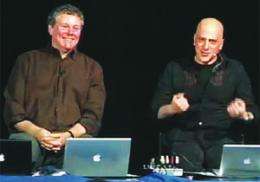
Columbia neurophysiologist David Sulzer took his first piano lessons at the age of 11 and was playing his violin and guitar in bars by age 15. Later he gained a national following as a founder of the Soldier String Quartet and the Thai Elephant Orchestra—an actual orchestra of elephants in northern Thailand—and for playing with the likes of Bo Diddley, the Velvet Underground's John Cale and the jazz great Tony Williams.
It was only after arriving at Columbia, however, that the musician-turned-research-scientist embarked on perhaps his most exotic musical venture—using a computer to translate the spontaneous patterns of his brain waves into music.
With the help of Brad Garton, director of Columbia's Computer Music Center, Sulzer has performed his avant-garde brain wave music in solo recitals and with musical ensembles.
Last spring, Sulzer presented a piece entitled Reading Stephen Colbert at a conference in New York City sponsored by Columbia and the Paris-based IRCAM (Institut de Recherche et Coordination Acoustique/Musique), a global center of musical research.
Sulzer, a professor in the departments of Psychiatry, Neurology and Pharmacology, wore electrodes attached to his scalp to measure voltage fluctuations in his brain as he sat in a chair reading a book by the comedian. Those fluctuations were fed into a computer program created by Garton, which transformed them into musical notes.
"I tried to forget I was in front of people and they could see my brain waves on a screen and listen to the music as I read the book," says Sulzer. "Luckily, the book was funny and I laughed, which changed the music."
The Brainwave Music Project grew out of an invitation in 2008 from the Graduate Center of the City University of New York to lecture on how the brain interprets rhythm. Sulzer, whose main research focus is the chemical transmission of brain signals and the neuroscience of neurological and psychiatric disorders, had heard about measurement of brain waves of drummers playing together using electroencephalography (EEG), a technique that measures electrical activity in the brain. The longer the drummers jammed, the more their brain waves began to synch up. Why not see if the musicians could use their own brain waves to make new music together?
Sulzer asked Garton, who had spent his younger years in New York's downtown music scene and had followed the neuroscientist's previous career with the Soldier String Quartet, if he knew a graduate student who might be interested in helping him develop software for his lecture. Garton volunteered to do it himself.
"I knew the digital synthesis and audio side of things, he had the knowledge of neurotechnology and brain waves—it was the perfect match," Garton says.
When brain cells are active, they communicate with the cells around them by emitting electrical spikes that vary in frequency and amplitude. A single sensory stimulus will cause a series of brain cells to fire, which will excite the cells around them and lead to a chain reaction of cell firings that ripple through the brain like the waves that ripple out from a pebble tossed into a pond.
"I take the signals, digitize them and then turn them into signals in the computer that control the sound," Garton says. "A project where you can make sound just by thinking about it is pretty cool. It's great fun."
Garton and Sulzer have tried a number of ways to make music from these waves. Sometimes they program specific musical notes to play every time the EEG sensors detect brain cells firing at specific frequencies or amplitudes. Other times, they assign an array of prerecorded sounds or notes to specific neural patterns.
Sulzer cautions against taking the project too seriously. It's more of a "didactic tool," he says, that he usually pairs with his pop science lectures on brainwaves and brain function or with Garton's on computerized music.
"Part of it is didactic, part of it is satirical," Sulzer says. "Sometimes I'm making fun of attitudes towards music. For instance, I'll say 'this shows you can be a conscious composer' because you can try to manipulate brain waves. Or you can be an unconscious composer. Reading Stephen Colbert is an example of that."
Sulzer is skeptical the technique will ever result in better music than that which the brain is already capable of producing through the tongue and fingers."Trying to play music using brain waves is like trying to play the piano using boxing gloves," he says. "The level of detail that the current brain scanning technology can pick up is simply too crude."


