Low oxygen boosts stem cell survival in muscular dystrophy therapy
August 21, 2012 in Medical research
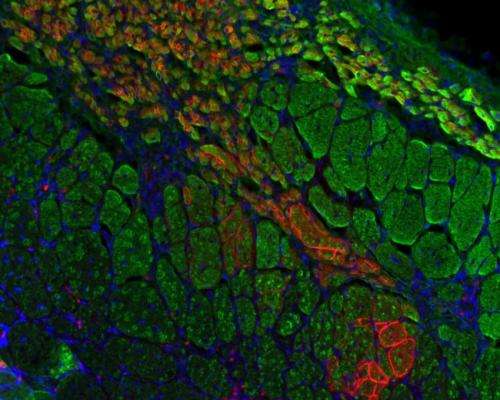
An image of a muscle implanted shows pre-existing muscle fibers (green cells only), along with fibers created by transplanted stem cells (green fiber with red membrane). Blue areas represent cells' nuclei. (Purdue University image/Weiyi Liu and Shihuan Kuang)
(Medical Xpress) -- Controlling the amount of oxygen that stem cells are exposed to can significantly increase the effectiveness of a procedure meant to combat an often fatal form of muscular dystrophy, according to Purdue University research.
A genetic mutation in patients with Duchenne muscular dystrophy causes the constant breakdown of muscles and gradual depletion of stem cells that are responsible for repairing the damage and progressive muscle wasting. A healthy stem cell tends to duplicate in a regular pattern that creates one copy of itself that continues to function as a stem cell, and a differentiated cell, which performs a specific function. In a healthy person, a torn or damaged muscle would be repaired through this process.
Stem cell therapy - implanting healthy stem cells to combat tissue wasting - has shown promise against muscular dystrophy and other neurodegenerative diseases, but few of the implanted stem cells survive the procedure. Shihuan Kuang, a Purdue assistant professor of animal sciences, and Weiyi Liu, a postdoctoral research associate, showed that survival of implanted muscle stem cells could be increased by as much as fivefold in a mouse model if the cells are cultured under oxygen levels similar to those found in human muscles.
"Stem cells survive in a microenvironment in the body that has a low oxygen level," Kuang said. "But when we culture cells, there is a lot of oxygen around the petri dish. We wanted to see if less oxygen could mimic that microenvironment. When we did that, we saw that more stem cells survived the transplant."
Liu thinks that's because the stem cells grown in higher oxygen levels acclimate to their surroundings. When they're injected into muscles with lower oxygen levels, they essentially suffocate.
"By contrast, in our study the cells become used to the host environment when they are conditioned under low oxygen levels prior to transplantation," Liu said.
In the mouse model, Kuang and Liu saw more stem cells survive the transplants, and those stem cells retained their ability to duplicate themselves.
"When we lower the oxygen level, we can also maintain the self-renewal process," Kuang said. "If these stem cells self-renew, they should never be used up and should continue to repair damaged muscle."
The findings, reported in the journal Development, shows promise for increasing the effectiveness of stem cell therapy for patients with Duchenne muscular dystrophy, which affects about one in 3,500 boys starting at about 3-5 years old. The disease, which confines almost all patients to wheelchairs by their 20s, is often fatal as muscles that control the abilities to breathe and eat deteriorate.
Xiaoqi Liu, a Purdue associate professor of biochemistry, and several graduate students contributed to the study.
Kuang's research will now focus on the signaling pathways within stem cells to understand how oxygen levels affect their functions and examining whether human muscle stem cells are similarly regulated by environmental oxygen. The National Institutes of Health, the Muscular Dystrophy Association and the U.S. Department of Agriculture funded the research.
More information: Hypoxia Promotes Satellite Cell Self-renewal and Enhances the Efficiency of Myoblast Transplantation, Development.
ABSTRACT
Microenvironmental oxygen (O2) regulates stem cell activity, and a hypoxic niche with low oxygen levels has been reported in multiple stem cell types. Satellite cells are muscle-resident stem cells that maintain the homeostasis and mediate the regeneration of skeletal muscles. We demonstrate here that hypoxic culture conditions favor the quiescence of satellite cell-derived primary myoblasts by upregulating Pax7, a key regulator of satellite cell self-renewal, and downregulating MyoD and myogenin. During myoblast division, hypoxia promotes asymmetric self-renewal divisions and inhibits asymmetric differentiation divisions without affecting the overall rate of proliferation. Mechanistic studies reveal that hypoxia activates the Notch signaling pathway, which subsequently represses the expression of miR-1 and miR-206 through canonical Hes/Hey proteins, leading to increased levels of Pax7. More importantly, hypoxia conditioning enhances the efficiency of myoblast transplantation and the self-renewal of implanted cells. Given the robust effects of hypoxia on maintaining the quiescence and promoting the self-renewal of cultured myoblasts, we predict that oxygen levels in the satellite cell niche play a central role in precisely balancing quiescence versus activation, and self-renewal versus differentiation, in muscle stem cells in vivo.
Journal reference:
Development
Provided by
Purdue University
-
Stem cell foundation for muscular dystrophy treatment
Jul 14, 2011 |
not rated yet |
0
-
Stem cell breakthrough gives new hope to sufferers of muscle-wasting diseases
Mar 05, 2009 |
not rated yet |
0
-
Successful transplant of patient-derived stem cells into mice with muscular dystrophy
Jun 27, 2012 |
not rated yet |
0
-
Scientists discover new way to enhance stem cells to stimulate muscle regeneration
Jun 04, 2009 |
not rated yet |
0
-
Team identifies stem cells that repair injured muscles
Mar 05, 2009 |
not rated yet |
0
-
Motion perception revisited: High Phi effect challenges established motion perception assumptions
Apr 23, 2013 |
3 / 5 (2) |
2
-
Anything you can do I can do better: Neuromolecular foundations of the superiority illusion (Update)
Apr 02, 2013 |
4.5 / 5 (11) |
5
-
The visual system as economist: Neural resource allocation in visual adaptation
Mar 30, 2013 |
5 / 5 (2) |
9
-
Separate lives: Neuronal and organismal lifespans decoupled
Mar 27, 2013 |
4.9 / 5 (8) |
0
-
Sizing things up: The evolutionary neurobiology of scale invariance
Feb 28, 2013 |
4.8 / 5 (10) |
14
-
Pressure-volume curve: Elastic Recoil Pressure don't make sense
May 18, 2013
-
If you became brain-dead, would you want them to pull the plug?
May 17, 2013
-
MRI bill question
May 15, 2013
-
Ratio of Hydrogen of Oxygen in Dessicated Animal Protein
May 13, 2013
-
Alcohol and acetaminophen
May 13, 2013
-
Marie Curie's leukemia
May 13, 2013
- More from Physics Forums - Medical Sciences
More news stories
Computational tool translates complex data into simplified 2-dimensional images
In their quest to learn more about the variability of cells between and within tissues, biomedical scientists have devised tools capable of simultaneously measuring dozens of characteristics of individual ...
Medical research
4 hours ago |
5 / 5 (1) |
0
|
Now we know why old scizophrenia medicine works on antibiotics-resistant bacteria
In 2008 researchers from the University of Southern Denmark showed that the drug thioridazine, which has previously been used to treat schizophrenia, is also a powerful weapon against antibiotic-resistant bacteria such as ...
Medical research
May 17, 2013 |
3.7 / 5 (3) |
0
|
SUMO wrestling cells reveal new protective mechanism target for stroke
Scientists investigating the interaction of a group of proteins in the brain responsible for protecting nerve cells from damage have identified a new target that could increase cell survival.
Medical research
May 17, 2013 |
5 / 5 (1) |
0
How serotonin receptors can shape drug effects, from LSD to migraine medication
New findings by researchers carrying out experiments at the U.S. Department of Energy Office of Science's Advanced Photon Source (APS) help explain why some drugs that interact with two kinds of human serotonin ...
Medical research
May 17, 2013 |
4 / 5 (1) |
0
|
Preventing blood poisoning
Peptide molecules derived from the body's natural immune system can help boost the body's defence against life-threatening blood poisoning, joint University research has uncovered.
Medical research
May 17, 2013 |
4 / 5 (1) |
0
|
Researchers identify a potential new risk for sleep apnea: Asthma
Researchers at the University of Wisconsin have identified a potential new risk factor for obstructive sleep apnea: asthma. Using data from the National Institutes of Health (Heart, Lung, and Blood Institute)-funded Wisconsin ...
Study finds that sleep apnea and Alzheimer's are linked
A new study looking at sleep-disordered breathing (SDB) and markers for Alzheimer's disease (AD) risk in cerebrospinal fluid (CSF) and neuroimaging adds to the growing body of research linking the two.
'Gap' for HIV vaccine efforts after latest setback
The hunt for an HIV vaccine has gobbled up $8 billion in the past decade, and the failure of the most recent efficacy trial has delivered yet another setback to 26 years of efforts.
New theory on genesis of osteoarthritis comes with successful therapy in mice
Scientists at Johns Hopkins have turned their view of osteoarthritis (OA) inside out. Literally. Instead of seeing the painful degenerative disease as a problem primarily of the cartilage that cushions joints, ...
Alzheimer's leaves bilingual victims stranded in Canada
The devastating effect of Alzheimer's disease on bilingual people has been thrown into focus in Canada, where the sudden loss of a second language can leave sufferers feeling like strangers in their own country.
Ginger compounds may be effective in treating asthma symptoms
Gourmands and foodies everywhere have long recognized ginger as a great way to add a little peppery zing to both sweet and savory dishes; now, a study from researchers at Columbia University shows purified components of the ...