Unsung heroes of antibody production
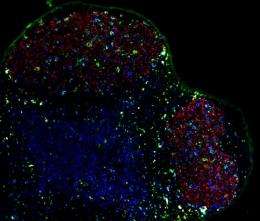
Figure 1: IL-4-secreting Tfh cells (green) reside alongside the B cells of the germinal center (red), and enable them to produce a full spectrum of antibody subtypes. © 2012 Masato Kubo, RIKEN Research Center for Allergy and Immunology
B cells are the body’s antibody factories, standing by to churn out molecules that selectively target foreign threats as a component of the humoral immune response. However, this process also requires T cells to secrete a protein known as interleukin-4 (IL-4), which promotes a mechanism called ‘class switching’ that enables production of functionally specialized antibody subtypes.
It remains unclear exactly which T cells generate the IL-4 signal. Although many scientists favor the Th2 subclass of helper T cells, there are strong arguments against this model as well. “This subset of cells cannot get into the follicles where these B cells are located,” explains Masato Kubo of the RIKEN Research Center for Allergy and Immunology, Yokohama. “Nevertheless, most textbooks say that Th2 cells control the antibody response.”
Kubo and colleagues have now provided strong evidence that a recently discovered class of follicular T (Tfh) cells generates the IL-4 signal that kicks B cells into high gear1. In a previous study, his group identified several stretches of DNA within the gene encoding IL-4 that might regulate its activity2. One candidate sequence, CNS2, had little effect on Th2 production of IL-4, but mice lacking this genomic region nevertheless showed severe defects in class-switching. “We started thinking other T cell subsets might be responsible for IL-4-mediated humoral immune responses,” he says.
By placing a fluorescent gene under the control of CNS2, the researchers showed that this regulatory region is specifically active in Tfh cells. As their name suggests, Tfh cells reside within follicles, in close proximity to the germinal centers where B cells mature. They also actively secrete IL-4 (Fig. 1), albeit by an apparently distinct mechanism from Th2 cells. Kubo’s team found that mutant mice lacking CNS2 can produce mature Tfh cells, but these cells expressed greatly reduced levels of IL-4. By comparison, Th2 cells were only minimally affected. Nevertheless, these genetically modified mice showed striking deficits in their production of several antibody subclasses, including immunoglobulin E (IgE) and G1 (IgG1).
These findings proved surprising at multiple levels. “IL-4 is a critical cytokine for controlling IgG1 and IgE antibody responses, but its expression in Th2 and Tfh cells is independently regulated by distinct elements,” says Kubo. “Furthermore, Tfh and not Th2 cells are the T cell subset responsible for Th2-type humoral immune responses.” He and his colleagues are working to identify the factors that act on CNS2, which could ultimately offer useful drug targets for controlling autoimmune disease by restraining antibody production.
More information: 1. Harada, Y., Tanaka, S., Motomura, Y., Harada, Y., Ohno, S., Ohno, S., Yanagi, Y., Inoue, H. & Kubo, M. The 3 enhancer CNS2 is a critical regulator of interleukin-4-mediated humoral immunity in follicular helper T cells. Immunity 36, 188200 (2012).
2. Tanaka, S., Motomura, Y., Suzuki, Y., Yagi, R., Inoue, H., Miyatake, S. & Kubo, M. The enhancer HS2 critically regulates GATA-3-mediated Il4 transcription in TH2 cells. Nature Immunology 12, 7785 (2011).
Journal reference:
Immunity
Nature Immunology
Provided by
RIKEN
-
Neighboring immune-system genes: Maintaining independence
Jan 31, 2011 |
not rated yet |
0
-
Transcription factor regulates protein that dampens immune responses
Jun 17, 2011 |
not rated yet |
0
-
Bcl6 gene sculpts helper T cell to boost antibody production
Jul 23, 2009 |
not rated yet |
0
-
Finding suggests novel ways to boost vaccination or natural defenses
Jul 07, 2008 |
not rated yet |
0
-
Rewiring DNA circuitry could help treat asthma
Jul 05, 2012 |
not rated yet |
0
-
Motion perception revisited: High Phi effect challenges established motion perception assumptions
Apr 23, 2013 |
3 / 5 (2) |
2
-
Anything you can do I can do better: Neuromolecular foundations of the superiority illusion (Update)
Apr 02, 2013 |
4.5 / 5 (11) |
5
-
The visual system as economist: Neural resource allocation in visual adaptation
Mar 30, 2013 |
5 / 5 (2) |
9
-
Separate lives: Neuronal and organismal lifespans decoupled
Mar 27, 2013 |
4.9 / 5 (8) |
0
-
Sizing things up: The evolutionary neurobiology of scale invariance
Feb 28, 2013 |
4.8 / 5 (10) |
14
-
Calculating on-axis elements of a solenoid
5 hours ago
-
latitude & longitude & air pressure
6 hours ago
-
Differences of Classical Mechanics when learned with Calc vs algebra?
9 hours ago
-
what is the distance traveled
13 hours ago
-
Image of a Convex Lens Cut in Half Horizontally
17 hours ago
-
Ray tracing through optical system of thick lenses
17 hours ago
- More from Physics Forums - Classical Physics
More news stories
New immune system discovered
(Medical Xpress)—A research team, led by Jeremy Barr, a biology post-doctoral fellow, unveils a new immune system that protects humans and animals from infection.
Immunology
May 20, 2013 |
4.8 / 5 (23) |
8
|
Vitamin D could provide new and effective treatments for asthma
(Medical Xpress)—Scientists at King's College London have discovered that Vitamin D has the potential to significantly reduce the symptoms of asthma. The study, led by Professor Catherine Hawrylowicz from ...
Immunology
May 20, 2013 |
5 / 5 (1) |
0
|
Immune protein could stop diabetes in its tracks
Melbourne researchers have identified an immune protein that has the potential to stop or reverse the development of type 1 diabetes in its early stages, before insulin-producing cells have been destroyed.
Immunology
May 20, 2013 |
5 / 5 (5) |
0
|
Stem-cell-based strategy boosts immune system in mice
Raising hopes for cell-based therapies, UC San Francisco researchers have created the first functioning human thymus tissue from embryonic stem cells in the laboratory. The researchers showed that, in mice, ...
Immunology
May 16, 2013 |
4.8 / 5 (5) |
0
|
Resistance to visceral leishmaniasis: New mechanisms involved
Researchers from CNRS, Université Toulouse III - Paul Sabatier and IRD have elucidated new molecular mechanisms involved in resistance to visceral leishmaniasis, a serious parasitic infection. They have shown that dectin-1 ...
Immunology
May 16, 2013 |
not rated yet |
0
Rate of bicycle-related fatalities significantly lower in states with helmet laws
Existing research shows that bicyclists who wear helmets have an 88 percent lower risk of brain injury, but researchers at Boston Children's Hospital found that simply having bicycle helmet laws in place showed a 20 percent ...
Slowing the aging process—only with antibiotics
Swiss scientists reveal the mechanism responsible for aging hidden deep within mitochondria—and dramatically slow it down in worms by administering antibiotics to the young.
Researchers complete largest genetic sequencing study of human disease
Researchers from Queen Mary, University of London have led the largest sequencing study of human disease to date, investigating the genetic basis of six autoimmune diseases.
Brain can be trained in compassion, study shows
Until now, little was scientifically known about the human potential to cultivate compassion—the emotional state of caring for people who are suffering in a way that motivates altruistic behavior.
Having both migraines, depression may mean smaller brain
(HealthDay)—Migraines and depression can each cause a great deal of suffering, but new research indicates the combination of the two may be linked to something else entirely—a smaller brain.
Novel approach for influenza vaccination shows promise in early animal testing
A new approach for immunizing against influenza elicited a more potent immune response and broader protection than the currently licensed seasonal influenza vaccines when tested in mice and ferrets. The vaccine ...