Babies' ability to detect complex rules in language outshines that of adults: study
September 10, 2012 in Psychology & Psychiatry
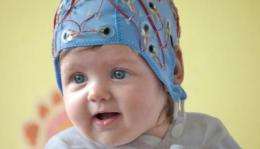
Using electroencephalography, babies' brain responses to spoken language were recorded. Credit: MPI CBS
New research examining auditory mechanisms of language learning in babies has revealed that infants as young as three months of age are able to automatically detect and learn complex dependencies between syllables in spoken language. By contrast, adults only recognised the same dependencies when asked to actively search for them. The study by scientists at the Max Planck Institute for Human Cognitive and Brain Sciences in Leipzig also highlights the important role of basic pitch discrimination abilities for early language development.
The speed and apparent ease with which young infants learn the basics of a language regularly astound parents and scientists alike. Of course, adults are usually assumed to have the edge in sophisticated language learning. However, scientists Jutta Mueller, Angela D. Friederici and Claudia Maennel have now found that when it comes to extracting complex rules from spoken language, a three-month-old outperforms adult learners.
For 20 minutes, the scientists played a stream of syllables to babies while measuring their brain responses using electroencephalography (EEG). Pairs of syllables appeared together, but were separated by a third syllable. Jutta Mueller, first author of the study, stresses that "such dependencies between non-neighbouring elements are typical for natural languages and can be found in many grammatical constructions." For instance, in the sentence "The boy always smiles", the third-person-suffix "s" of the verb is dependent on the noun "boy". In the study, this was reflected in the use of combinations like "le" and "bu" in sequences like "le-wi-bu".
From time to time, however, combinations like "le-wi-to" would appear, in which one of the syllables was out of place. "EEG measurements showed us that the babies recognized this rule violation", Mueller explains. Additionally, the scientists would occasionally change the tone of one syllable to a higher pitch – with an interesting outcome: Only those infants whose brains reacted to pitch changes in a more mature way could detect the syllable dependencies.
When facing the same task as the babies, adults only showed a reaction to the rule violations when asked to explicitly look for dependencies between the syllables. Mueller and her colleagues conclude that, evidently, the automatic recognition ability is lost later on. "What we found particularly interesting is that the small group of adults who did show evidence of rule learning also showed a stronger brain response to the pitch changes."
These findings not only help understand how children manage to learn language so quickly during early development, but also point to a strong link between very basic auditory skills and sophisticated rule learning abilities. In a follow-up study, the scientists are now investigating whether differences the babies showed in response to pitch changes and in rule learning ability have any long-term effects on language development.
More information: Jutta Mueller, Angela D. Friederici and Claudia Maennel Auditory perception at the root of language learning PNAS, September 10, 2012, Early Edition
Journal reference:
Proceedings of the National Academy of Sciences
Provided by
Max Planck Society
-
Italian for beginners: Four-month-olds can detect grammatical rules in new language
Mar 23, 2011 |
not rated yet |
0
-
Study links bilingual babies' vocabulary to early brain differentiation
Aug 29, 2011 |
not rated yet |
0
-
Even before language, babies learn the world through sounds
Jul 11, 2011 |
not rated yet |
0
-
Language learning: Researchers use video games to crack the speech code
May 18, 2011 |
not rated yet |
0
-
Baby talk: The roots of the early vocabulary in infants' learning from speech
Oct 30, 2008 |
not rated yet |
0
-
Motion perception revisited: High Phi effect challenges established motion perception assumptions
Apr 23, 2013 |
3 / 5 (2) |
2
-
Anything you can do I can do better: Neuromolecular foundations of the superiority illusion (Update)
Apr 02, 2013 |
4.5 / 5 (11) |
5
-
The visual system as economist: Neural resource allocation in visual adaptation
Mar 30, 2013 |
5 / 5 (2) |
9
-
Separate lives: Neuronal and organismal lifespans decoupled
Mar 27, 2013 |
4.9 / 5 (8) |
0
-
Sizing things up: The evolutionary neurobiology of scale invariance
Feb 28, 2013 |
4.8 / 5 (10) |
14
-
Why is zone 1 in liver more prone to ischemic injury?
2 hours ago
-
How can there be villous adenoma in colon, if there are no villi there
22 hours ago
-
How can there be a term called "intestinal metaplasia" of stomach
May 21, 2013
-
Pressure-volume curve: Elastic Recoil Pressure don't make sense
May 18, 2013
-
If you became brain-dead, would you want them to pull the plug?
May 17, 2013
-
MRI bill question
May 15, 2013
- More from Physics Forums - Medical Sciences
More news stories
'Boys will be boys' in US, but not in Asia
A new study shows there is a gender gap when it comes to behavior and self-control in American young children – one that does not appear to exist in children in Asia.
Psychology & Psychiatry
12 hours ago |
not rated yet |
0
Brain can be trained in compassion, study shows
Until now, little was scientifically known about the human potential to cultivate compassion—the emotional state of caring for people who are suffering in a way that motivates altruistic behavior.
Psychology & Psychiatry
13 hours ago |
5 / 5 (2) |
2
|
Good marriage can buffer effects of dad's depression on young children
What effect does a father's depression have on his young son or daughter? When fathers report a high level of emotional intimacy in their marriage, their children benefit, said a University of Illinois study.
Psychology & Psychiatry
14 hours ago |
not rated yet |
0
American, Nepalese kids a world apart on social duties
(Medical Xpress)—Preschoolers universally recognize that one's choices are not always free – that our decisions may be constrained by social obligations to be nice to others or follow rules set by parents ...
Psychology & Psychiatry
21 hours ago |
not rated yet |
0
Ethicists' behavior not more moral, study finds
(Medical Xpress)—Do ethicists engage in better moral behavior than other professors? The answer is no. Nor are they more likely than nonethicists to act according to values they espouse, according to researchers from the ...
Psychology & Psychiatry
21 hours ago |
5 / 5 (1) |
0
Slowing the aging process—only with antibiotics
Swiss scientists reveal the mechanism responsible for aging hidden deep within mitochondria—and dramatically slow it down in worms by administering antibiotics to the young.
Researchers complete largest genetic sequencing study of human disease
Researchers from Queen Mary, University of London have led the largest sequencing study of human disease to date, investigating the genetic basis of six autoimmune diseases.
Having both migraines, depression may mean smaller brain
(HealthDay)—Migraines and depression can each cause a great deal of suffering, but new research indicates the combination of the two may be linked to something else entirely—a smaller brain.
Rate of bicycle-related fatalities significantly lower in states with helmet laws
Existing research shows that bicyclists who wear helmets have an 88 percent lower risk of brain injury, but researchers at Boston Children's Hospital found that simply having bicycle helmet laws in place showed a 20 percent ...
Novel approach for influenza vaccination shows promise in early animal testing
A new approach for immunizing against influenza elicited a more potent immune response and broader protection than the currently licensed seasonal influenza vaccines when tested in mice and ferrets. The vaccine ...
Enzyme-activating antibodies revealed as marker for most severe form of rheumatoid arthritis
In a series of lab experiments designed to unravel the workings of a key enzyme widely considered a possible trigger of rheumatoid arthritis, researchers at Johns Hopkins have found that in the most severe ...
Sep 10, 2012
Rank: not rated yet
Recent:
I stressed* the second syllable of a three syllabic word.
The recipient - a monologuist, native speaker, fail to recognize the word.
I placed the stress to the first syllable of a three syllabic word as originally spoken by the recipient. Word recognition resumed.
You can try this experiment anywhere, anytime, with anyone.
The ability to still understand the spoken word regardless where the stress takes place within multi-syllabic words depends on whether the subject is multilingual from birth or taught.
We played this syllabic-stress word game in college with the word 'emergency'. Impossible to recognize for monologuists.
('Stress' in the linguistic sense and use of meaning.)