New drug protects neurons in Parkinson's patients
September 5, 2012 in Parkinson's & Movement disorders
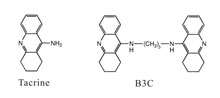
The cognitins consist of two tacrine molecules connected by a flexible chain. Bis-3-cognitin (B3C) can protect neurons from damage in an animal model of Parkinson's.
(Medical Xpress)—Scientists at Emory University School of Medicine have identified a compound that boosts levels of a survival factor in neurons threatened by Parkinson's disease.
The compound, bis-3-cognitin, could be a starting point for finding drugs that delay Parkinson's disease progression. Bis-3-cognitin appears to protect mitochondria, critical sites of vulnerability for neurons affected by Parkinson's.
In a widely used animal model of Parkinson's, bis-3-cognitin could protect neurons from damaging toxins and prevent mice from developing motor problems when it was given together with the toxin. The results were published online August 13 by the Journal of Biological Chemistry.
Zixu Mao, professor of pharmacology and neurology at Emory University School of Medicine, and his colleagues had been studying MEF2D, a protein that is vital for the survival of neurons. The first author of the paper, graduate student Lu Yao, is now at Xi'an Jiaotong University in China. Collaborators include Yifan Han and his colleagues at Hong Kong Polytechnic University.
Mao's previous research had shown that MEF2D is perturbed in the neurons of people with Parkinson's disease. The MEF2D protein is sensitive to cellular changes, such as oxidative stress, which can lead to neuron damage in Parkinson's.
"For years, we had been talking about looking for drugs that enhance MEF2D," Mao says. "The challenge was how to set up a screening system. You can search through a library of small molecules, or you can look through the literature and make a guess."
Bis-3-cognitin appears to have been a good guess, even though it was originally developed for a different purpose. The cognitins are a family of compounds derived from tacrine, the first drug approved by the FDA to treat the symptoms of Alzheimer's disease. Tacrine was eventually discontinued because of liver toxicity and other side effects. The bis-cognitins have two tacrine molecules connected by a flexible chain (see figure).
Bis-3-cognitin could protect cells in culture against damage coming from the toxin MPTP, which mimics the effects of Parkinson's, by increasing MEF2D levels in the cells' nuclei and mitochondria. Tacrine and bis-7-cognitin, which has a longer connecting chain than bis-3-cognitin, did not have the same effects.
MPTP kills dopamine-responsive neurons, which are the same cells affected in Parkinson's. In mice, the scientists gauged the toxin's behavioral effects by measuring how long mice were able to hang on to a rotating rod, and studying their gait. Bis-3-cognitin, when given together with MPTP, could prevent motor impairment in the mice.
"We think MEF2D is not the only target of bis-3-cognitin," Mao says. "It is a potent antioxidant, for example. But MEF2D is required for the neuroprotective activity—we found that if you knock down MEF2D in cell lines, the protective effects are much weaker."
He adds that bis-3-cognitin appears to avoid the acute toxicity problems of tacrine, but more pharmacological studies of bis-3-cognitin's properties and mode of action are needed before human clinical trials.
More information: L. Yao et al. Activation of transcription factor MEF2 by bis(3)-cognitin protects dopaminergic neurons and ameliorates Parkinsonian motor defects. J. Biol Chem. (2012). www.jbc.org/cgi/do… .M112.367540
Journal reference:
Journal of Biological Chemistry
Provided by
Emory University
-
An early step in Parkinson's disease: Problems with mitochondria
Feb 14, 2011 |
not rated yet |
0
-
Toxicity mechanism identified for Parkinson's disease
Jan 02, 2009 |
not rated yet |
0
-
Therapeutic avenues for Parkinson's investigated at UH
Aug 23, 2012 |
not rated yet |
0
-
New hope for eyes damaged by Parkinson's disease
Aug 03, 2012 |
not rated yet |
0
-
Parkinson's disease: Study of live human neurons reveals the disease's genetic origins
Feb 07, 2012 |
not rated yet |
0
-
Motion perception revisited: High Phi effect challenges established motion perception assumptions
Apr 23, 2013 |
3 / 5 (2) |
2
-
Anything you can do I can do better: Neuromolecular foundations of the superiority illusion (Update)
Apr 02, 2013 |
4.5 / 5 (11) |
5
-
The visual system as economist: Neural resource allocation in visual adaptation
Mar 30, 2013 |
5 / 5 (2) |
9
-
Separate lives: Neuronal and organismal lifespans decoupled
Mar 27, 2013 |
4.9 / 5 (8) |
0
-
Sizing things up: The evolutionary neurobiology of scale invariance
Feb 28, 2013 |
4.8 / 5 (10) |
14
-
Why angle of projectile has 2 solutions?
1 hour ago
-
How much negative charge do I accumulate by touching the earth?
2 hours ago
-
Indeterminism in Classical Physics
7 hours ago
-
Current in two wires
8 hours ago
-
understanding the dipole model for Rayleigh scattering
10 hours ago
-
question on coriolis effect with drag force
16 hours ago
- More from Physics Forums - Classical Physics
More news stories
New animal model gives insights into mechanisms of Parkinson's disease pathogenesis
In Parkinson's disease, the protein "alpha-synuclein" aggregates and accumulates within neurons. Specific areas of the brain become progressively affected as the disease develops and advances. The mechanism underlying this ...
Parkinson's & Movement disorders
2 hours ago |
not rated yet |
0
Defective cellular waste removal explains why Gaucher patients often develop Parkinson's disease
Gaucher disease causes debilitating and sometimes fatal neurodegeneration in early childhood. Recent studies have uncovered a link between the mutations responsible for Gaucher disease and an increased risk ...
Parkinson's & Movement disorders
May 23, 2013 |
5 / 5 (1) |
0
|
Diabetes drug tested in Parkinson's disease patients
Parkinson's disease (PD) is a degenerative neurological disorder marked by a progressive loss of motor control. Despite intensive research, there are currently no approved therapies that have been demonstrated to alter the ...
Parkinson's & Movement disorders
May 20, 2013 |
not rated yet |
0
Faulty energy production in brain cells leads to disorders ranging from Parkinson's to intellectual disability
Neuroscientist Patrik Verstreken of VIB (Flanders Institute for Biotechnology) and KU Leuven has shown for the first time that dysfunctional mitochondria in brain cells can lead to learning disabilities. The link between ...
Parkinson's & Movement disorders
May 17, 2013 |
4 / 5 (2) |
0
Unleashing the watchdog protein
McGill University researchers have unlocked a new door to developing drugs to slow the progression of Parkinson's disease. Collaborating teams led by Dr. Edward A. Fon at the Montreal Neurological Institute and Hospital -The ...
Parkinson's & Movement disorders
May 09, 2013 |
5 / 5 (1) |
0
|
Comorbidities common with alopecia areata
(HealthDay)—Comorbid conditions often accompany alopecia areata, according to a study published online May 22 in JAMA Dermatology.
Pollen count apps for smartphones are nothing to sneeze at
Kate O'Reilly's spring allergy survival kit includes the usual stuff - nasal sprays, allergy pills and a box of tissues. This season, she's added a new weapon to her line of defense: an app on her smartphone.
Hormone levels may provide key to understanding psychological disorders in women
Women at a particular stage in their monthly menstrual cycle may be more vulnerable to some of the psychological side-effects associated with stressful experiences, according to a study from UCL.
Engineered cytomegalovirus protects monkeys from HIV equivalent
(Medical Xpress)—A new study by researchers in the US has shown that an ancient virus can be modified to help in the fight against the simian immunodeficiency virus SIV, which is the equivalent in monkeys ...
Going live: Immune cell activation in multiple sclerosis
Biological processes are generally based on events at the molecular and cellular level. To understand what happens in the course of infections, diseases or normal bodily functions, scientists would need to ...
About one in four uninsured could be excluded from ACA
(HealthDay)—More than one in four of those eligible for new premium assistance tax credits under the Affordable Care Act (ACA) do not have a checking account and will not be able to receive premiums from ...