Quitting driving: Families key but docs have role
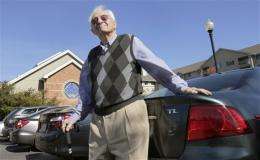
(AP)—Families may have to watch for dents in the car and plead with an older driver to give up the keys—but there is new evidence that doctors could have more of an influence on one of the most wrenching decisions facing a rapidly aging population.
A large study from Canada found that when doctors warn patients, and tell driving authorities, that the older folks may be medically unfit to be on the road, there is a drop in serious crash injuries among those drivers.
The study, in Thursday's New England Journal of Medicine, couldn't tell if the improvement was because those patients drove less, or drove more carefully once the doctors pointed out the risk.
But as the number of older drivers surges, it raises the question of how families and doctors could be working together to determine if and when age-related health problems—from arthritis to frailty to Alzheimer's disease—are bad enough to impair driving.
Often, families are making that tough choice between safety and independence on their own.
"It's very scary," said Pat Sneller who talked her husband, Lee, into quitting about a year after he was diagnosed with early-stage Alzheimer's disease.
The couple had recently moved from California, one of the few U.S. states that require doctors to report drivers with worrisome health conditions to licensing authorities. Pat Sneller was stunned to learn Texas does not require that doctor involvement, and health workers advised her to ride with her husband and judge his abilities for herself.
Eventually her husband called home in a panic, lost while driving in unfamiliar Dallas for volunteer work. A long scrape on the car that he could not explain was the final straw. In 2010, she persuaded him to quit driving, although the now-72-year-old's license remains good until 2014.
"He still says occasionally, 'I can still drive, you know,'" Pat Sneller said.
By one U.S. estimate, about 600,000 older drivers a year quit because of health conditions. The problem: There are no clear-cut guidelines to tell who really needs to—and given the lack of transportation options in much of the country, quitting too soon can be detrimental for someone who might have functioned well for several more years.
It's never an easy discussion.
"It did not go over so well," Benjamin Benson recalls of the time when his sons told the 87-year-old they feared his reflexes had slowed too much for safe driving.
"I've never had an accident," he said. His family's response: "Well, do you want to wait for the first one?"
The retired accountant was not ready to quit then, but he quietly began to analyze what would happen to him and his wife, who does not drive, if he did.
His longtime doctor would not advise one way or the other. So over a few months, the couple tried online grocery shopping. They took a taxi to the dentist, not cheap at $38 round-trip. But Benson calculated that maintaining and insuring the car was expensive, too, when he drove only 3,000 miles (4,800 kilometers) a year.
A few weeks ago, Benson surprised his family by giving away the car, and he says he's faring fine so far.
"Most people in our age group know that it's inevitable and play around with the idea that it's going to come and the only question is when," Benson said. "I didn't want to be pushed into it."
Unlike in most of the U.S., doctors in much of Canada are supposed to report to licensing authorities patients with certain health conditions that may impair driving. Ontario in 2006 began paying doctors a small fee to further encourage that step—and researchers used the payments to track 100,075 patients who received those warnings between April of that year and December 2009 (out of the province's more than 9 million licensed drivers).
They compared the group's overall rate of crashes severe enough to send the driver to the emergency room, before the warnings began and afterward, and found a 45 percent drop, reported lead researcher Dr. Donald Redelmeier, a University of Toronto professor.
While the study included adult drivers of all ages—for conditions ranging from epilepsy to sleep disorders, alcoholism to dementia—most were over age 60. A small percentage of the province's licensed drivers have received warnings, Redelmeier stressed, and licenses are suspended by authorities between 10 percent and 30 percent of the time.
His study highlighted one reason physicians don't like to get involved: About 1 in 5 of the patients who were warned changed doctors. There also was an uptick in reports of depression.
Doctors aren't trained to evaluate driving ability, and the study couldn't tell if some drivers were targeted needlessly, noted Dr. Matthew Rizzo of the University of Iowa. Yet he called the research valuable.
"The message from this paper is that doctors have some wisdom in knowing when to restrict drivers," said Rizzo. His own research shows some cognitive tests might help them better identify who's at risk, such as by measuring "useful field of view," essentially how much your brain gleans at a glance—important for safety in intersections.
Today, the American Medical Association recommends that doctors administer a few simple tests in advising older drivers. Among them:
—Walk 10 feet down the hallway, turn around and come back. Taking longer than 9 seconds is linked to driving problems.
—On a page with the letters A to L and the numbers 1 to 13 randomly arranged, see how quickly and accurately you draw a line from 1 to A, then to 2, then to B and so on. This so-called trail-making test measures memory, spatial processing and other brain skills, and doing poorly has been linked to at-fault crashes.
—Check if people can turn their necks far enough to change lanes, and have the strength to slam on brakes.
Dr. Gary Kennedy, geriatric psychiatry chief at New York's Montefiore Medical Center, often adds another question: Are his patients allowed to drive their grandchildren?
"If the answer to that is no, that's telling me the people who know the patient best have made a decision that they're not safe," said Kennedy, who offers "to be the bad cop" for families or primary care physicians having trouble delivering the news.
There are no statistics on how often doctors do these kinds of assessment.
"It's this touchy subject that nobody wants to talk about," said Dr. Marian Betz of the University of Colorado, whose surveys show most senior drivers don't think their doctors know whether they drive. She is testing if an advance directive would help get older adults talking with their doctors about how to keep watch on their driving fitness before trouble arises.
More objective measures are needed—and to help find them, hundreds of older drivers are letting scientists install video cameras, GPS systems and other gadgets in their cars as part of massive studies of everyday driving behavior.
Identifying who needs to quit should be a last resort, said Jon Antin of the Virginia Tech Transportation Institute. He helps oversee data collection for a study that's enrolling 3,000 participants, including hundreds of seniors, in Florida, Indiana, New York, North Carolina, Pennsylvania and Washington. The drivers undergo a battery of medical checks before their driving patterns are recorded for 12 to 24 months.
"If you identify people at risk, maybe you can intervene to prolong the safe driving period," agreed Dr. Shawn Marshall of the Ottawa Hospital Research Institute. He helps lead Canada's CanDrive II, a project that's tracking 928 drivers in their 70s for five years, to see how their driving changes as they get older.
Copyright 2012 The Associated Press. All rights reserved. This material may not be published, broadcast, rewritten or redistributed.


