Researchers use magnetic pulses to brain to reduce overly optimistic tendencies
September 25, 2012 by Bob Yirka in Neuroscience report

Researchers use magnetic pulses to brain to reduce overly optimistic tendencies

Enlarge

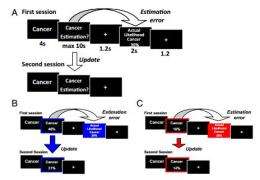
Fig. 1. (A) In each trial participants were presented with a short description of one of 40 adverse life events and asked to estimate how likely this event was to occur to them. They were then presented with the average probability of that event occurring to a person living in the same sociocultural environment. The second session was the same as the first session, except that the average probability of the event to occur was not presented again. (B and C) Examples of trials for which the participant’s estimate was (B) higher or (C) lower than the average probability. Here, for illustration purposes only, the blue and red frames denote the participant’s response (either an overestimation or underestimation, respectively) and the blue and red filled boxes denote information that calls for an adjustment in a (B) favorable (good news) or (C) unfavorable (bad news) direction. Credit: (c) PNAS, doi: 10.1073/pnas.1205828109

(Medical Xpress)—Scientists have known for many years that human beings, as a general rule, are an overly optimistic bunch. We close our eyes to statistics suggesting our eating habits may be killing us, ignore warnings about texting while driving and almost always believe things will come out all right in the end if we'll just hang in there, despite sometimes obvious indications to the contrary. Research has suggested that two specific symmetrically opposite parts of the brain influence our optimism or pessimism, but until now haven't been able to offer direct proof. Now however, new research by a group of neuroscientists has found, as they describe in their paper published in the Proceedings of the National Academy of Sciences, that turning off one of these areas via magnetic pulses dramatically reduces overly optimistic tendencies.

The has two areas in the brain known as the left and right inferior frontal gyrus (IFG) which are believed to at least partly control our feelings of optimism and pessimism. More specifically, the left IFG has been suspected of being the side involved in processing "good" information, while the right does the same with "bad." Interestingly, the right IFG doesn't seem to be as good at its job as the left, which has led to some theories regarding while we're all so darned optimistic about things.

To gain more evidence regarding the true role of both IFGs, the research team used transcranial (TMS), which is a way to focus onto specific to cause them to go to sleep for a little while. Thirty volunteers were enlisted, some of which had the TMS trained on their left IFG, others on the right, and still others on a placebo area of the brain. Afterwards, each volunteer was asked to rate the likelihood of several bad things on a list happening to them. After answering, each volunteer was then read the real likelihood of each of those things happening to them based on actual evidence. The volunteers were then once again asked to rate the likelihood of the same things happing to them to see if hearing the real odds had made any impact. The only change noted was for those that had had the TIMS directed onto their left IFG; they became noticeably more logical and less likely to paint a rosier picture of the evidence just presented to them.

While the study offers clear evidence that the left IFG is most certainly involved in our generally overly optimistic outlook, it doesn't explain how it does so, or why, though the researchers suggest it might be a trait we've evolved to make us more likely to overlook some dangers so that we'll seek out and explore new environments, increasing the likelihood of our survival overall by populating more areas.

More information: Selectively altering belief formation in the human brain, PNAS, Published online before print September 24, 2012, doi: 10.1073/pnas.1205828109

Abstract
Humans form beliefs asymmetrically; we tend to discount bad news but embrace good news. This reduced impact of unfavorable information on belief updating may have important societal implications, including the generation of financial market bubbles, ill preparedness in the face of natural disasters, and overly aggressive medical decisions. Here, we selectively improved people's tendency to incorporate bad news into their beliefs by disrupting the function of the left (but not right) inferior frontal gyrus using transcranial magnetic stimulation, thereby eliminating the engrained "good news/bad news effect." Our results provide an instance of how selective disruption of regional human brain function paradoxically enhances the ability to incorporate unfavorable information into beliefs of vulnerability.

Journal reference: Proceedings of the National Academy of Sciences search and more info website

© 2012 Medical Xpress

4.3 /5 (3 votes)  

Filter


Move the slider to adjust rank threshold, so that you can hide some of the comments.


Display comments: newest first

Tausch
Sep 25, 2012

Rank: 1 / 5 (1)
...The only change noted was for those that had had the TIMS directed onto their left IFG; they became noticeably more logical and less likely to paint a rosier picture of the evidence just presented to them...


Color TV was 'bad news' for black and white TV. Or, if you will:
'Selectively altering belief formation in the human brain'.
thingumbobesquire
Sep 26, 2012

Rank: 3 / 5 (2)
Hmm...This stuff would come in handy for the global warming deniers. Also for those weirdos who believe in human progress. Yes, now we can return to worship of Gaia. Prometheus deserved what he got!
Sinister1811
Sep 26, 2012

Rank: not rated yet
I wonder if this would also work for those who are overly pessimistic.
theskepticalpsychic
Sep 26, 2012

Rank: 5 / 5 (1)
Great. As a chronic depressive who has always tended to see the glass as half-empty (except when besotted with a hopeless love interest), it's comforting to know that there is at last a cure for unreasonable optimism.
Rank 4.3 /5 (3 votes)
Relevant PhysicsForums posts

More news stories

For combat veterans suffering from post-traumatic stress disorder, 'fear circuitry' in the brain never rests

Chronic trauma can inflict lasting damage to brain regions associated with fear and anxiety. Previous imaging studies of people with post-traumatic stress disorder, or PTSD, have shown that these brain regions can over-or ...

Neuroscience created 12 hours ago | popularity 5 / 5 (1) | comments 0 | with audio podcast

Temporal processing in the olfactory system

The neural machinery underlying our olfactory sense continues to be an enigma for neuroscience. A recent review in Neuron seeks to expand traditional ideas about how neurons in the olfactory bulb might encode information about ...

Neuroscience created 23 hours ago | popularity not rated yet | comments 0 | with audio podcast report

Melon focus headband turns to Kickstarter for rollout plans

(Medical Xpress)—What if the quality of your work depends more on your focus on the piano keys or canvas or laptop than your musical or painting or computing skills? If target users can be convinced, they ...

Neuroscience created 23 hours ago | popularity 3.7 / 5 (3) | comments 0 | with audio podcast weblog

Deep brain stimulation: A fix when the drugs don't work

Neurological disorders can have a devastating impact on the lives of sufferers and their families.

Neuroscience created May 17, 2013 | popularity 5 / 5 (1) | comments 0 | with audio podcast

Brain makes call on which ear is used for cell phone

If you're a left-brain thinker, chances are you use your right hand to hold your cell phone up to your right ear, according to a newly published study from Henry Ford Hospital in Detroit.

Neuroscience created May 16, 2013 | popularity 2 / 5 (2) | comments 0 | with audio podcast


US psychiatry gets makeover in new manual

The latest makeover to a massive psychiatric tome honored by some, reviled by others and even called the "Bible" of mental disorders is being released Saturday with a host of new changes.

New case of SARS-like virus in Saudi: ministry

A new case of the deadly coronavirus has been detected in Saudi Arabia where 15 people have already died after contracting it, the health ministry announced on Saturday on its Internet website.

New research identifies risks, interventions for children's GI health

An increasing number of U.S. children are experiencing gastrointestinal issues that require interventions to resolve, according to research presented at Digestive Disease Week (DDW).

New colonoscope provides ground-breaking view of colon

A ground-breaking advance in colonoscopy technology signals the future of colorectal care, according to research presented today at Digestive Disease Week(DDW). Additional research focuses on optimizing the minimal withdrawal ...

AIDS science at 30: 'Cure' now part of lexicon

Big names in medicine are set to give an upbeat assessment of the war on AIDS on Tuesday, 30 years after French researchers identified the virus that causes the disease.

Now we know why old scizophrenia medicine works on antibiotics-resistant bacteria

In 2008 researchers from the University of Southern Denmark showed that the drug thioridazine, which has previously been used to treat schizophrenia, is also a powerful weapon against antibiotic-resistant bacteria such as ...