Non-caloric beverages can help teens avoid excessive weight gain, study shows
September 24, 2012 in Overweight and Obesity
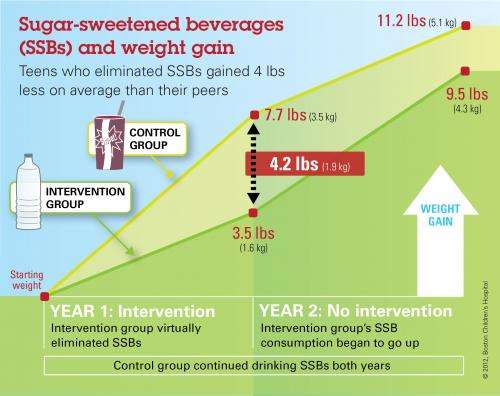
A new study published today in the New England Journal of Medicine shows that adolescents who eliminated sugar-sweetened beverages for one year gained less weight than those who didn't, shedding light on an effective intervention to help combat adolescent obesity.
This is one of the first high-quality randomized control trials to examine the link between the consumption of sugar-sweetened beverages and their direct impact on weight and body mass index (BMI), as well as how a teen's home environment impacts sugar-sweetened beverage consumption in general.
The study, led by Cara Ebbeling, PhD (associate director) and David Ludwig, MD, PhD (director), both from the New Balance Foundation Obesity Prevention Center Boston Children's Hospital, found that adolescents who received deliveries of non-caloric beverages for one year gained an average of 4 fewer pounds than their peers who continued to drink sugar-sweetened beverages. Within the two-year study, the one-year intervention also included motivational calls with parents, check-in visits with participants and written intervention messages to stop drinking sugar-sweetened beverages.
The 224 study participants were overweight or obese 9th or 10th graders who regularly drank sugary beverages. The study intervention was designed to reduce consumption of these beverages. Researchers used a novel method of intervention: delivering non-caloric beverages to participants' homes for participants and their families.
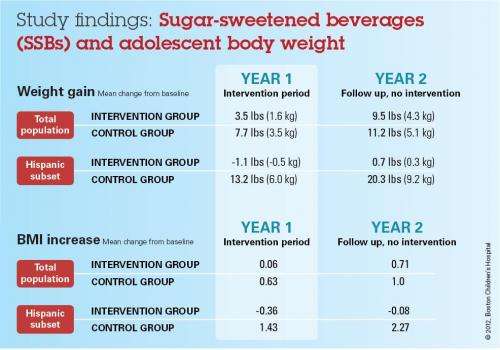
During the year-long intervention, the experimental group of adolescents—who virtually eliminated consumption of sugary beverages—gained 4 fewer pounds and had essentially no BMI increase compared to the control group, which continued to drink sugar-sweetened beverages regularly (although at reduced levels possibly due to local public health efforts). In addition, Hispanic adolescents showed the greatest benefit—gaining 14 fewer pounds than the control group. "No other single food product has been shown to change body weight by this amount over a year simply through its reduction," says Ludwig.
The two-year study consisted of one year of intervention and one year of follow up. While the one-year mark showed a significant difference in weight between the intervention group and the control group, the groups did not differ after the second year—which did not include an intervention. These findings suggest that teens are more likely to make healthier choices (drinking non-caloric beverages) when they are more easily available to them.
This study underscores the need for healthy choices to be more easily available to adolescents, as well as the need for more research into effective interventions among minority populations with particularly high obesity rates. "Our findings suggest that both access to non-caloric beverages and clear messages for consumers may be at the heart of behavior change. Adolescents can make healthful dietary changes with adequate support and understandable messages," says Ebbeling.
The study is part of a series in the New England Journal of Medicine that looks at the association between sugar-sweetened beverages and obesity.
The Center recently published another study in the Journal of the American Medical Association by the New Balance Foundation Obesity Prevention Center Boston Children's Hospital suggesting that conventional low-fat diets may not be the best for weight-loss maintenance, and that reducing intake of refined carbohydrates (so called, low-glycemic diets) provide metabolic benefits and reduced risk of heart disease.
More information: www.nejm.org/doi/f… red_home#Top
Journal reference:
New England Journal of Medicine
Journal of the American Medical Association
Provided by
Children's Hospital Boston
-
Banning sugar-sweetened beverages in schools does not reduce consumption: study
Nov 07, 2011 |
not rated yet |
0
-
Teens choose water when calorie count of sugary beverages is easier to understand
Dec 15, 2011 |
not rated yet |
0
-
Weight gain in children has no association with sugar-sweetened beverage consumption
Jun 13, 2008 |
not rated yet |
0
-
Taxing sugar-sweetened beverages could yield sweet results
May 13, 2011 |
not rated yet |
0
-
Sugar-sweetened drinks are not replacing milk in kid's diets
Jul 18, 2012 |
not rated yet |
0
-
Motion perception revisited: High Phi effect challenges established motion perception assumptions
Apr 23, 2013 |
3 / 5 (2) |
2
-
Anything you can do I can do better: Neuromolecular foundations of the superiority illusion (Update)
Apr 02, 2013 |
4.5 / 5 (11) |
5
-
The visual system as economist: Neural resource allocation in visual adaptation
Mar 30, 2013 |
5 / 5 (2) |
9
-
Separate lives: Neuronal and organismal lifespans decoupled
Mar 27, 2013 |
4.9 / 5 (8) |
0
-
Sizing things up: The evolutionary neurobiology of scale invariance
Feb 28, 2013 |
4.8 / 5 (10) |
14
-
Solvability of a circuit
3 hours ago
-
Question about perception of colors around light sources
7 hours ago
-
Does a charged particle rotate when traveling through a static Bf?
8 hours ago
-
Find a link between physics and assignment problems
10 hours ago
-
Light as a source of electricity
10 hours ago
-
A question about the energy stored in a capacitor.
10 hours ago
- More from Physics Forums - Classical Physics
More news stories
Young children appear to reject story characters who are obese
(Medical Xpress)—Research by the University of Leeds has shown that very young children appear to reject story book characters who are overweight, but not those who are disabled.
Overweight and Obesity
May 16, 2013 |
3 / 5 (1) |
2
Gene variations may explain weight gain among men, women
(HealthDay)—Weight gain in men and women is predicted by two different genetic variations—so-called polymorphisms, according to a new study from the Netherlands.
Overweight and Obesity
May 15, 2013 |
5 / 5 (1) |
0
|
ECO: Distilled water doesn't up resting energy expenditure
(HealthDay)—Drinking 500 ml of purified water is not associated with increases in resting energy expenditure (REE), according to a study presented at the annual meeting of the European Congress on Obesity, ...
Overweight and Obesity
May 14, 2013 |
2 / 5 (2) |
1
ECO: Industry-funded reviews query sweet drink, obesity tie
(HealthDay)—Reviews that are funded by industry tend to find the evidence weak for a causal link between sugar-sweetened beverages (SSBs) and the increasing prevalence of obesity, while other reviews consider ...
Overweight and Obesity
May 14, 2013 |
not rated yet |
0
The smart phone app that helps weight loss
Researchers at the University of Liverpool have developed a smart phone app that helps users lose weight by carefully recording their food consumption.
Overweight and Obesity
May 13, 2013 |
5 / 5 (1) |
0
Researchers identify a potential new risk for sleep apnea: Asthma
Researchers at the University of Wisconsin have identified a potential new risk factor for obstructive sleep apnea: asthma. Using data from the National Institutes of Health (Heart, Lung, and Blood Institute)-funded Wisconsin ...
Computational tool translates complex data into simplified 2-dimensional images
In their quest to learn more about the variability of cells between and within tissues, biomedical scientists have devised tools capable of simultaneously measuring dozens of characteristics of individual ...
New theory on genesis of osteoarthritis comes with successful therapy in mice
Scientists at Johns Hopkins have turned their view of osteoarthritis (OA) inside out. Literally. Instead of seeing the painful degenerative disease as a problem primarily of the cartilage that cushions joints, ...
Study finds that sleep apnea and Alzheimer's are linked
A new study looking at sleep-disordered breathing (SDB) and markers for Alzheimer's disease (AD) risk in cerebrospinal fluid (CSF) and neuroimaging adds to the growing body of research linking the two.
'Gap' for HIV vaccine efforts after latest setback
The hunt for an HIV vaccine has gobbled up $8 billion in the past decade, and the failure of the most recent efficacy trial has delivered yet another setback to 26 years of efforts.
Ginger compounds may be effective in treating asthma symptoms
Gourmands and foodies everywhere have long recognized ginger as a great way to add a little peppery zing to both sweet and savory dishes; now, a study from researchers at Columbia University shows purified components of the ...
