Using precisely-targeted lasers, researchers manipulate neurons in worms' brains, take control of their behavior
September 24, 2012 in Neuroscience
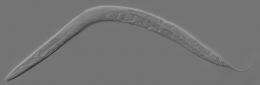
Caenorhabditis elegans. Image: Wikipedia.
In the quest to understand how the brain turns sensory input into behavior, Harvard scientists have crossed a major threshold. Using precisely-targeted lasers, researchers have been able to take over an animal's brain, instruct it to turn in any direction they choose, and even to implant false sensory information, fooling the animal into thinking food was nearby.
As described in a September 23 paper published in Nature, a team made up of Sharad Ramanathan, an Assistant Professor of Molecular and Cellular Biology, and of Applied Physics, Askin Kocabas, a Post-Doctoral Fellow in Molecular and Cellular Biology, Ching-Han Shen, a Research Assistant in Molecular and Cellular Biology, and Zengcai V. Guo, from the Howard Hughes Medical Institute were able to take control of Caenorhabditis elegans – tiny, transparent worms – by manipulating neurons in the worms' "brain."
The work, Ramanathan said, is important because, by taking control of complex behaviors in a relatively simple animal - C. elegans have just 302 neurons –we can understand how its nervous system functions..
"If we can understand simple nervous systems to the point of completely controlling them, then it may be a possibility that we can gain a comprehensive understanding of more complex systems," Ramanathan said. "This gives us a framework to think about neural circuits, how to manipulate them, which circuit to manipulate and what activity patterns to produce in them ".
"Extremely important work in the literature has focused on ablating neurons, or studying mutants that affect neuronal function and mapping out the connectivity of the entire nervous system. " he added. "Most of these approaches have discovered neurons necessary for specific behavior by destroying them. The question we were trying to answer was: Instead of breaking the system to understand it, can we essentially hijack the key neurons that are sufficient to control behavior and use these neurons to force the animal to do what we want?"
Before Ramanathan and his team could begin to answer that question, however, they needed to overcome a number of technical challenges.
Using genetic tools, researchers engineered worms whose neurons gave off fluorescent light, allowing them to be tracked during experiments. Researchers also altered genes in the worms which made neurons sensitive to light, meaning they could be activated with pulses of laser light.
The largest challenges, though, came in developing the hardware necessary to track the worms and target the correct neuron in a fraction of a second.
"The goal is to activate only one neuron," he explained. "That's challenging because the animal is moving, and the neurons are densely packed near its head, so the challenge is to acquire an image of the animal, process that image, identify the neuron, track the animal, position your laser and shoot the particularly neuron – and do it all in 20 milliseconds, or about 50 times a second. The engineering challenges involved seemed insurmountable when we started. But Askin Kocabas found ways to overcome these challenges"
The system researchers eventually developed uses a movable table to keep the crawling worm centered beneath a camera and laser. They also custom-built computer hardware and software, Ramanathan said, to ensure the system works at the split-second speeds they need.
The end result, he said, was a system capable of not only controlling the worms' behavior, but their senses as well. In one test described in the paper, researchers were able to use the system to trick a worm's brain into believing food was nearby, causing it to make a beeline toward the imaginary meal.
Going forward, Ramanathan and his team plan to explore what other behaviors the system can control in C. elegans. Other efforts include designing new cameras and computer hardware with the goal of speeding up the system from 20 milliseconds to one. The increased speed would allow them to test the system in more complex animals, like zebrafish.
"By manipulating the neural system of this animal, we can make it turn left, we can make it turn right, we can make it go in a loop, we can make it think there is food nearby," Ramanathan said. "We want to understand the brain of this animal, which has only a few hundred neurons, completely and essentially turn it into a video game, where we can control all of its behaviors."
Journal reference:
Nature
Provided by
Harvard University
-
Light used to map effect of neurons on one another
Dec 17, 2009 |
not rated yet |
0
-
Sharply focused on neurons, light controls a worm's behavior
Jan 18, 2011 |
not rated yet |
0
-
How the worm knows where its nose is
May 16, 2012 |
not rated yet |
0
-
Connectomics: Mapping the neural network governing male roundworm mating
Jul 26, 2012 |
not rated yet |
0
-
Beyond recognizing odors, a single neuron controls reactions
Oct 21, 2008 |
not rated yet |
0
-
Motion perception revisited: High Phi effect challenges established motion perception assumptions
Apr 23, 2013 |
3 / 5 (2) |
2
-
Anything you can do I can do better: Neuromolecular foundations of the superiority illusion (Update)
Apr 02, 2013 |
4.5 / 5 (11) |
5
-
The visual system as economist: Neural resource allocation in visual adaptation
Mar 30, 2013 |
5 / 5 (2) |
9
-
Separate lives: Neuronal and organismal lifespans decoupled
Mar 27, 2013 |
4.9 / 5 (8) |
0
-
Sizing things up: The evolutionary neurobiology of scale invariance
Feb 28, 2013 |
4.8 / 5 (10) |
14
-
Pressure-volume curve: Elastic Recoil Pressure don't make sense
3 hours ago
-
If you became brain-dead, would you want them to pull the plug?
20 hours ago
-
MRI bill question
May 15, 2013
-
Ratio of Hydrogen of Oxygen in Dessicated Animal Protein
May 13, 2013
-
Alcohol and acetaminophen
May 13, 2013
-
Marie Curie's leukemia
May 13, 2013
- More from Physics Forums - Medical Sciences
More news stories
For combat veterans suffering from post-traumatic stress disorder, 'fear circuitry' in the brain never rests
Chronic trauma can inflict lasting damage to brain regions associated with fear and anxiety. Previous imaging studies of people with post-traumatic stress disorder, or PTSD, have shown that these brain regions can over-or ...
Neuroscience
5 hours ago |
not rated yet |
0
|
Temporal processing in the olfactory system
The neural machinery underlying our olfactory sense continues to be an enigma for neuroscience. A recent review in Neuron seeks to expand traditional ideas about how neurons in the olfactory bulb might encode information about ...
Neuroscience
16 hours ago |
not rated yet |
0
|
Melon focus headband turns to Kickstarter for rollout plans
(Medical Xpress)—What if the quality of your work depends more on your focus on the piano keys or canvas or laptop than your musical or painting or computing skills? If target users can be convinced, they ...
Neuroscience
17 hours ago |
3.7 / 5 (3) |
0
|
Deep brain stimulation: A fix when the drugs don't work
Neurological disorders can have a devastating impact on the lives of sufferers and their families.
Neuroscience
22 hours ago |
5 / 5 (1) |
0
|
Brain makes call on which ear is used for cell phone
If you're a left-brain thinker, chances are you use your right hand to hold your cell phone up to your right ear, according to a newly published study from Henry Ford Hospital in Detroit.
Neuroscience
May 16, 2013 |
2 / 5 (2) |
0
|
AIDS science at 30: 'Cure' now part of lexicon
Big names in medicine are set to give an upbeat assessment of the war on AIDS on Tuesday, 30 years after French researchers identified the virus that causes the disease.
Now we know why old scizophrenia medicine works on antibiotics-resistant bacteria
In 2008 researchers from the University of Southern Denmark showed that the drug thioridazine, which has previously been used to treat schizophrenia, is also a powerful weapon against antibiotic-resistant bacteria such as ...
Individuals who drink heavily and smoke may show 'early aging' of the brain
Treatment for alcohol use disorders works best if the patient actively understands and incorporates the interventions provided in the clinic. Multiple factors can influence both the type and degree of neurocognitive abnormalities ...
College women exceed NIAAA drinking guidelines more frequently than college men
In order to avoid harms associated with alcohol consumption, in 2009 the National Institute on Alcohol Abuse and Alcoholism issued guidelines that define low-risk drinking. These guidelines differ for men and women: no more ...
Study identifies new approach to improving treatment for MS and other conditions
(Medical Xpress)—Working with lab mice models of multiple sclerosis (MS), UC Davis scientists have detected a novel molecular target for the design of drugs that could be safer and more effective than current FDA-approved ...
23 dead in initiation rites in South Africa
(AP)—Twenty-three youths have died in the past nine days at initiation ceremonies that include circumcisions and survival tests, South African police said Friday.
Sep 25, 2012
Rank: 1 / 5 (1)