Sleep researchers study value of preschool naps
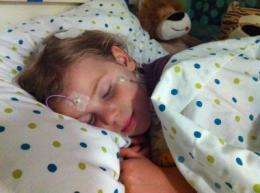
A new investigation of the value of naps for young children conducted by researchers at UMass Amherst will take sleep study techniques out of the bedroom and into preschool classrooms across western Massachusetts. Credit: UMass Amherst
Parents may feel it's clear that missing a nap means their young children will be grumpy and out-of-sorts, but scientists who study sleep say almost nothing is known about how daytime sleep affects children's coping skills and learning.
Now neuroscientist Rebecca Spencer at the University of Massachusetts Amherst has received a five-year, $2 million grant from NIH's Heart, Lung and Blood Institute to significantly advance knowledge about how napping and sleep affect memory, behavior and emotions in preschoolers.
Spencer says with pressure mounting in some school districts to eliminate naps, "we feel it's important to study this and know their value more precisely. There's a sense among some educators that kids have to 'get over' napping in preparation for kindergarten, but it could be misguided. There's some evidence in young adults and in older children that naps are beneficial. So I suspect there is a benefit for younger children too. We need to know whether keeping naps in the school day is important."
Attending preschool offers life-long benefits in physical health, emotional stability and quality of life, Spencer points out, and in the United States, 70 percent of four- and five-year-olds attend. There is a trend now toward incorporating new curricula in preschool such as anti-bullying messages and lessons on how to brush your teeth. If sleep protects and enhances physical and emotional learning in young children as it does in older kids, taking away naptime could undercut such efforts, she adds.
"Right now, there's nothing to support teachers who feel that naps can really help young children, there's no concrete science behind that," the neuroscientist says. "But if sleep is going to enhance all these benefits of attending preschool, we need to know it."
Over the next five years, Spencer and her graduate students hope to study about 480 preschoolers between 3 and 5 years old, boys and girls in diverse communities across western Massachusetts. The research will include fact-based and emotional memory studies with and without napping, measures of physical activity levels and parent reports of their children's' nighttime sleep, to find out how classroom experience interacts with sleep and physical activity and whether daytime sleep enhances learning. The research will also explore the relationship between sleep and behavior disorders.
"I think we'll have a rich data set for examining sleep, physical activity and the child's behavior," says Spencer. "We think that the nap benefit is going to be especially useful for kids who don't get optimal overnight sleep. Culture plays a role in how late you stay up, and some kids live in noisy inner city neighborhoods. If we can help them with a nap, we want to know that."
Provided by
University of Massachusetts Amherst
-
Losing sleep? Scientists evaluate why
May 03, 2013 |
5 / 5 (3) |
0
-
Metabolic disorders predict the hardening of the arterial walls already in childhood
Apr 25, 2013 |
not rated yet |
0
-
Tips to help your child manage the challenges of autism
Apr 03, 2013 |
3.3 / 5 (3) |
0
-
Five year-olds who watch TV for 3+ hours a day more likely to be antisocial
Mar 25, 2013 |
not rated yet |
0
-
New triggers for weight gain: Researchers focus on air pollution, sleep deprivation
Oct 08, 2012 |
4.5 / 5 (2) |
2
-
Motion perception revisited: High Phi effect challenges established motion perception assumptions
Apr 23, 2013 |
3 / 5 (2) |
2
-
Anything you can do I can do better: Neuromolecular foundations of the superiority illusion (Update)
Apr 02, 2013 |
4.5 / 5 (11) |
5
-
The visual system as economist: Neural resource allocation in visual adaptation
Mar 30, 2013 |
5 / 5 (2) |
9
-
Separate lives: Neuronal and organismal lifespans decoupled
Mar 27, 2013 |
4.9 / 5 (8) |
0
-
Sizing things up: The evolutionary neurobiology of scale invariance
Feb 28, 2013 |
4.8 / 5 (10) |
14
-
Classical and Quantum Mechanics via Lie algebras
Apr 15, 2011
- More from Physics Forums - Independent Research
More news stories
Calorie information in fast food restaurants used by 40 percent of 9-18 year olds when making food choices
A new study published online today (Thursday) in the Journal of Public Health has found that of young people who visited fast food or chain restaurants in the U.S. in 2010, girls and youth who were obese were more likely ...
Health
6 hours ago |
not rated yet |
0
Systematic screening of med adherence will ID barriers
(HealthDay)—Implementation of systematic monitoring for medication adherence will allow for identification of barriers to adherence and tailoring of interventions, according to a viewpoint piece published ...
Health
8 hours ago |
not rated yet |
0
More doctors, hospitals using electronic records
(AP)—The Obama administration says more doctors and hospitals are embracing technology as adoption of computerized medical records reaches a "tipping point" in America.
Health
9 hours ago |
not rated yet |
0
Hospitals profit when patients develop bloodstream infections
Johns Hopkins researchers report that hospitals may be reaping enormous income for patients whose hospital stays are complicated by preventable bloodstream infections contracted in their intensive care units.
Health
10 hours ago |
not rated yet |
0
Alleviating hunger in the US, it's a SNAP, researcher says
A University of Illinois researcher says that the cornerstone of our efforts to alleviate food insecurity should be to encourage more people to participate in the Supplemental Nutrition Assistance Program (SNAP) "because ...
Health
10 hours ago |
not rated yet |
0
Rate of bicycle-related fatalities significantly lower in states with helmet laws
Existing research shows that bicyclists who wear helmets have an 88 percent lower risk of brain injury, but researchers at Boston Children's Hospital found that simply having bicycle helmet laws in place showed a 20 percent ...
Slowing the aging process—only with antibiotics
Swiss scientists reveal the mechanism responsible for aging hidden deep within mitochondria—and dramatically slow it down in worms by administering antibiotics to the young.
Researchers complete largest genetic sequencing study of human disease
Researchers from Queen Mary, University of London have led the largest sequencing study of human disease to date, investigating the genetic basis of six autoimmune diseases.
Brain can be trained in compassion, study shows
Until now, little was scientifically known about the human potential to cultivate compassion—the emotional state of caring for people who are suffering in a way that motivates altruistic behavior.
Having both migraines, depression may mean smaller brain
(HealthDay)—Migraines and depression can each cause a great deal of suffering, but new research indicates the combination of the two may be linked to something else entirely—a smaller brain.
Novel approach for influenza vaccination shows promise in early animal testing
A new approach for immunizing against influenza elicited a more potent immune response and broader protection than the currently licensed seasonal influenza vaccines when tested in mice and ferrets. The vaccine ...