Scientists reverse disorder of neuronal circuits in autism
September 14, 2012 in Autism spectrum disorders
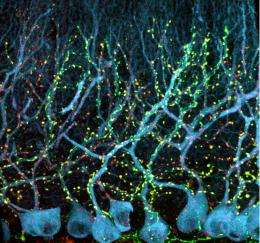
Synaptic networks in brains of rodent models of autism. Credit: Stephane Baudouin
People with autism suffer from a pervasive developmental disorder of the brain that becomes evident in early childhood. Peter Scheiffele and Kaspar Vogt, Professors at the Biozentrum of the University of Basel, have identified a specific dysfunction in neuronal circuits that is caused by autism. In the respected journal Science, the scientists also report about their success in reversing these neuronal changes. These findings are an important step in drug development for the treatment for autism.
According to current estimates, about one percent of all children develop an autistic spectrum disorder. Individuals with autism may exhibit impaired social behavior, rigid patterns of behavior and limited speech development. Autism is a hereditary developmental disorder of the brain. A central risk factor for the development of autism are numerous mutations in over 300 genes that have been identified, including the gene neuroligin-3, which is involved in the formation of synapses, the contact junction between nerve cells.
Loss of neuroligin-3 interferes with neuronal signal transmission
The consequences of neuroligin-3 loss can be studied in animal models. Mice lacking the gene for neuroligin-3 develop behavioral patterns reflecting important aspects observed in autism. In collaboration with Roche the research groups from the Biozentrum at the University of Basel have now identified a defect in synaptic signal transmission that interferes with the function and plasticity of the neuronal circuits. These negative effects are associated with increased production of a specific neuronal glutamate receptor, which modulates the signal transmission between neurons. An excess of these receptors inhibits the adaptation of the synaptic signal transmission during the learning process, thus disrupting the development and function of the brain in the long term.
Of major importance is the finding that the impaired development of the neuronal circuit in the brain is reversible. When the scientists reactivated the production of neuroligin-3 in the mice, the nerve cells scaled down the production of the glutamate receptors to a normal level and the structural defects in the brain typical for autism disappeared. Hence, these glutamate receptors could be a suitable pharmacological target in order to stop the developmental disorder autism or even reverse it.
Vision for the future: Medication for autism
Autism currently cannot be cured. At present, only the symptoms of the disorder can be alleviated through behavioral therapy and other treatment. A new approach to its treatment, however, has been uncovered through the results of this study. In one of the European Union supported projects, EU-AIMS, the research groups from the Biozentrum are working in collaboration with Roche and other partners in industry on applying glutamate receptor antagonists for the treatment of autism and hope, that in the future, this disorder can be treated successfully in both children and adults.
More information: Baudouin S. J., Gaudias J., Gerharz S., Hatstatt L., Zhou K., Punnakkal P., Tanaka K. F., Spooren W., Hen R., De Zeeuw C.I., Vogt K., Scheiffele K.
Shared Synaptic Pathophysiology in Syndromic and Non-syndromic Rodent Models of Autism, Science, Published online September 13 (2012) doi: 10.1126/science.1224159
Journal reference:
Science
Provided by Universität Basel
-
When nerve cells can’t make contact
Sep 22, 2006 |
not rated yet |
0
-
Autism-related Proteins Control Nerve Excitability, Researchers Find
Jun 20, 2007 |
not rated yet |
0
-
Gene mutation is linked to autism-like symptoms in mice
Feb 23, 2010 |
not rated yet |
0
-
Study finds first-ever genetic animal model of autism
Dec 09, 2007 |
not rated yet |
0
-
Communication problems in the brainMaturation disorders of nerve terminals may trigger autism
Jan 20, 2010 |
not rated yet |
0
-
Motion perception revisited: High Phi effect challenges established motion perception assumptions
Apr 23, 2013 |
3 / 5 (2) |
2
-
Anything you can do I can do better: Neuromolecular foundations of the superiority illusion (Update)
Apr 02, 2013 |
4.5 / 5 (11) |
5
-
The visual system as economist: Neural resource allocation in visual adaptation
Mar 30, 2013 |
5 / 5 (2) |
9
-
Separate lives: Neuronal and organismal lifespans decoupled
Mar 27, 2013 |
4.9 / 5 (8) |
0
-
Sizing things up: The evolutionary neurobiology of scale invariance
Feb 28, 2013 |
4.8 / 5 (10) |
14
-
gravity is std. therefore can we rate a 'mass at height' by watts?
5 hours ago
-
Calculating on-axis elements of a solenoid
17 hours ago
-
latitude & longitude & air pressure
18 hours ago
-
Differences of Classical Mechanics when learned with Calc vs algebra?
21 hours ago
-
what is the distance traveled
May 22, 2013
-
Image of a Convex Lens Cut in Half Horizontally
May 22, 2013
- More from Physics Forums - Classical Physics
More news stories
Enrichment therapy effective among children with autism, study finds
Children with autism showed significant improvement after six months of simple sensory exercises at home using everyday items such as scents, spoons and sponges, according to UC Irvine neurobiologists.
Autism spectrum disorders
May 21, 2013 |
3 / 5 (1) |
0
|
Researcher helps give children with autism the chance to communicate
Research by Victoria University PhD education graduand Larah van der Meer highlights the importance of understanding the communication preferences of children with developmental disabilities such as autism.
Autism spectrum disorders
May 14, 2013 |
3.3 / 5 (3) |
1
Developers dive in to create a wealth of autism apps
At times, Andy Shih still finds himself overwhelmed by the groundswell of interest in autism applications he's seen in the three years since Apple Inc. released the first iPad.
Autism spectrum disorders
May 09, 2013 |
2 / 5 (1) |
0
Enhanced motion perception in autism may point to an underlying cause of the disorder
Children with autism see simple movement twice as quickly as other children their age, and this hypersensitivity to motion may provide clues to a fundamental cause of the developmental disorder, according ...
Autism spectrum disorders
May 08, 2013 |
not rated yet |
0
|
Autism scientists seek more brains to aid research
(AP)—Autism scientists are seeking more brain samples for research.
Autism spectrum disorders
May 02, 2013 |
5 / 5 (1) |
0
Researchers find common childhood asthma unconnected to allergens or inflammation
Little is known about why asthma develops, how it constricts the airway or why response to treatments varies between patients. Now, a team of researchers at Weill Cornell Medical College, Columbia University Medical Center ...
Scientists discover molecule triggers sensation of itch
Scientists at the National Institutes of Health report they have discovered in mouse studies that a small molecule released in the spinal cord triggers a process that is later experienced in the brain as the sensation of ...
Multiple research teams unable to confirm high-profile Alzheimer's study
Teams of highly respected Alzheimer's researchers failed to replicate what appeared to be breakthrough results for the treatment of this brain disease when they were published last year in the journal Science.
Brain uses internal 'average voice' prototype to identify who is talking
(Medical Xpress)—The human brain is able to identify individuals' voices by comparing them against an internal 'average voice' prototype, according to neuroscientists.
Drug reverses Alzheimer's disease deficits in mice, research confirms
An anti-cancer drug reverses memory deficits in an Alzheimer's disease mouse model, University of Pittsburgh Graduate School of Public Health researchers confirm in the journal Science.
Antibiotics: A new understanding of sulfonamide nervous system side effects
Since the discovery of Prontosil in 1932, sulfonamide antibiotics have been used to combat a wide spectrum of bacterial infections, from acne to chlamydia and pneumonia. However, their side effects can include serious neurological ...
Sep 16, 2012
Rank: 1 / 5 (2)
Increased iron in the brain has been linked to Autism.
"Currently, a growing number of reports have documented evidence of individuals with ASD displaying impairments associated with a common medical condition called hemochromatosis, a disorder characterized with increased intestinal absorption of iron and the deposition of excessive amounts of iron in multiple organs"