The brain's circuit diagram: New method facilitates the mapping of connections between neurons
October 18, 2012 in Neuroscience
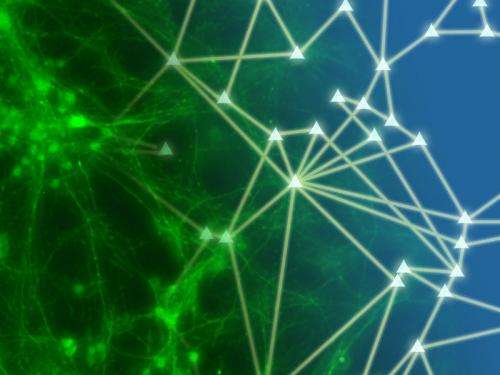
Calcium fluorescence measurements show the activity of neurons (left). From this, the scientists can deduce how the neurons are connected with each other (right). Credit: MPI for Dynamics and Self-Organization
(Medical Xpress)—The human brain accomplishes its remarkable feats through the interplay of an unimaginable number of neurons that are interconnected in complex networks. A team of scientists has now developed a method for decoding neural circuit diagrams. Using measurements of total neuronal activity, they can determine the probability that two neurons are connected with each other.
The human brain consists of around 80 billion neurons, none of which lives or functions in isolation. The neurons form a tight-knit network that they use to exchange signals with each other. The arrangement of the connections between the neurons is far from arbitrary, and understanding which neurons connect with each other promises to provide valuable information about how the brain works. At this point, identifying the connection network directly from the tissue structure is practically impossible, even in cell cultures with only a few thousand neurons. In contrast, there are currently well-developed methods for recording dynamic neuronal activity patterns. Such patterns indicate which neuron transmitted a signal at what time, making them a kind of neuronal conversation log. The Göttingen-based team headed by Theo Geisel, Director at the Max Planck Institute for Dynamics and Self-Organization, has now made use of these activity patterns.
The scientists use data from so-called calcium fluorescence measurements that were recorded in collaboration with the University of Barcelona. This imaging method uses specially tailored molecules placed in a cell that fluoresce when they bind calcium. Since the calcium concentration inside a neuron follows its electrical activity, it is possible to record the activity of thousands of neurons simultaneously - whether in a cell culture or in the living brain. However, the speed of the communication is too high to directly observe directly how an impulse is "fired" sand thus tease apart whether a connection is direct or takes places across several stations. By taking into account these difficulties, the algorithm developed in Theo Geisel's team makes it possible to obtain from the measured data remarkably precise information about the lines of connection in the neural network.
"Our method is based on a concept known as transfer entropy," explains Olav Stetter from the Max Planck Institute in Göttingen, lead author of the now published article. Transfer entropy is a measure used in information theory to quantify directed information flows. In other words, it is possible to calculate how probable it is that the signal from a particular neuron would result in activity in another. "Using transfer entropy, we developed a robust method that can reliably distinguish between true causal relationships and those that only appear to exist but resulted from indirect connections or measurement errors," says Stetter.
The scientists initially applied their new method to simulated calcium fluorescence experiments. They used a neuronal network model to simulate the measured signals including realistic effects of calcium dynamics and fluorescence measurements. As the scientists show, the causal relationships in the network are time variable and dependent on the state of the network activity. Only in calmer phases with relatively low activity did the causal relationships coincide with the actual structure of the network. The researchers in Göttingen were able to use this fact for their predictions. In more active phases so many neurons are simultaneously participating in the neuronal conversation that it is no longer easily possible to trace the path of information.
In the present article, they also examined real neurons. The analysis with the new method revealed an unusual concentration of connections surrounding individual cells. The researchers are optimistic that their method can be used on a broad class of systems: "Our method makes it possible to reconstruct neural networks without any specific assumptions regarding their makeup. Rather, we take a data-driven approach," explains Demian Battaglia.
The scientists hope that their algorithm will permit neural circuit diagrams to be calculated on a broad scale, in both cultivated and natural networks. The collected information from a number of different neural networks may then help researchers understand when and where neurons create connections, and which criteria they use to select their partners.
More information: Olav Stetter, Demian Battaglia, Jordi Soriano, Theo Geisel. Model-free Reconstruction of Excitatory Neuronal Connectivity from Calcium Imaging Signals. PLoS Computational Biology, 8(8): e1002653 (23 August 2012) doi:10.1371/journal.pcbi.1002653
Journal reference:
PLoS Computational Biology
Provided by
Max Planck Society
-
New statistical method provides way to analyze synchronized neural activity in animals
Aug 03, 2012 |
not rated yet |
0
-
Researchers connect neurons to computers to decipher the enigmatic code of neuronal circuits
Jul 12, 2011 |
not rated yet |
0
-
Out of mind in a matter of seconds: How fast neuronal networks delete sensory information
Jan 24, 2011 |
not rated yet |
0
-
Deeper insight in the activity of cortical cells
Jul 12, 2011 |
not rated yet |
0
-
Brain cell networks recreated with new view of activity behind memory formation
May 25, 2011 |
not rated yet |
0
-
Motion perception revisited: High Phi effect challenges established motion perception assumptions
Apr 23, 2013 |
3 / 5 (2) |
2
-
Anything you can do I can do better: Neuromolecular foundations of the superiority illusion (Update)
Apr 02, 2013 |
4.5 / 5 (11) |
5
-
The visual system as economist: Neural resource allocation in visual adaptation
Mar 30, 2013 |
5 / 5 (2) |
9
-
Separate lives: Neuronal and organismal lifespans decoupled
Mar 27, 2013 |
4.9 / 5 (8) |
0
-
Sizing things up: The evolutionary neurobiology of scale invariance
Feb 28, 2013 |
4.8 / 5 (10) |
14
-
How can there be villous adenoma in colon, if there are no villi there
2 hours ago
-
How can there be a term called "intestinal metaplasia" of stomach
May 21, 2013
-
Pressure-volume curve: Elastic Recoil Pressure don't make sense
May 18, 2013
-
If you became brain-dead, would you want them to pull the plug?
May 17, 2013
-
MRI bill question
May 15, 2013
-
Ratio of Hydrogen of Oxygen in Dessicated Animal Protein
May 13, 2013
- More from Physics Forums - Medical Sciences
More news stories
Reducing caloric intake delays nerve cell loss
Activating an enzyme known to play a role in the anti-aging benefits of calorie restriction delays the loss of brain cells and preserves cognitive function in mice, according to a study published in the May ...
Neuroscience
16 hours ago |
5 / 5 (6) |
0
|
B vitamins could delay dementia
(Medical Xpress)—Despite spending billions of dollars on research and development, drug companies have been unable to come up with effective treatments for dementia and Alzheimer's Disease (AD). Now, A. ...
Neuroscience
20 hours ago |
4.9 / 5 (14) |
0
|
Waiting for a sign? Researchers find potential brain 'switch' for new behavior
You're standing near an airport luggage carousel and your bag emerges on the conveyor belt, prompting you to spring into action. How does your brain make the shift from passively waiting to taking action when ...
Neuroscience
20 hours ago |
5 / 5 (1) |
0
|
If you can remember it, you can remember it wrong
(Medical Xpress)—Native peoples in regions where cameras are uncommon sometimes react with caution when their picture is taken. The fear that something must have been stolen from them to create the photo ...
Neuroscience
22 hours ago |
4.3 / 5 (6) |
0
|
Study shows where scene context happens in our brain
In a remote fishing community in Venezuela, a lone fisherman sits on a cliff overlooking the southern Caribbean Sea. This man –– the lookout –– is responsible for directing his comrades on the water, ...
Neuroscience
May 21, 2013 |
4 / 5 (1) |
0
|
Alcohol sales fall due to ban on multi-buy promotions
(Medical Xpress)—A report published today shows a 2.6% decrease in the amount of alcohol sold per adult in Scotland in the year following the introduction of the Alcohol etc. (Scotland) Act in October 2011.
Facing the chill wind of blood pressure
(Medical Xpress)—High blood pressure is something that has traditionally been a problem in Scotland, but might there be a link to our climate?
US health care: Does more spending yield better health?
(Medical Xpress)—Health care spending is much higher for older Americans than for younger adults and children, on average, and analysts have said that increasing spending leads to longer life expectancy.
Study shows low rate of late lumen loss with bioresorbable DESolve device
The DESolve bioresorbable coronary scaffold system achieves good efficacy and safety with low rates of late lumen loss and major coronary adverse events at six months, show first results from the pivotal DESolve Nx trial ...
Study finds COPD is over-diagnosed among uninsured patients
More than 40 percent of patients being treated for COPD at a federally funded clinic did not have the disease, researchers found after evaluating the patients with spirometry, the diagnostic "gold standard" for chronic obstructive ...
Registry questions superiority of bivalirudin over heparin
Results from a large observational study reported at EuroPCR 2013 today question whether bivalirudin is superior to heparin in the absence of GPIIb/IIIa blockade, showing similar 30-day mortality in patients with non-ST segment ...
Oct 18, 2012
Rank: not rated yet
Bad news for lateralization of function.
Congratulations to all involve.