Genome-wide study identifies eight new susceptibility loci for atopic dermatitis
October 7, 2012 in Genetics

Genome-wide study identifies 8 new susceptibility loci for atopic dermatitis

Enlarge

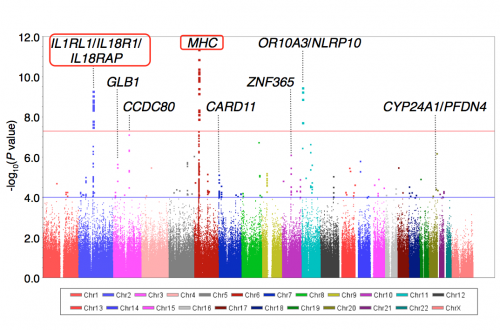
This shows eight new loci associated with susceptibility to atopic dermatitis. Credit: RIKEN

Japanese researchers at the RIKEN Center for Genomic Medicine (CGM) and their colleagues have identified 8 new loci associated with susceptibility to atopic dermatitis in the Japanese population. The findings, which appear in the journal Nature Genetics, advance our understanding of the genetic basis of the skin disorder, which affects millions of children and adults around the world.

Atopic dermatitis (often called ecszema) is a chronic, relapsing inflammatory skin condition affecting as much as one-fifth of children and 1-3% of adults in industrialized countries. Those with the condition have skin that reacts easily to the environment and becomes flaky and itchy. While treatment can alleviate some of these symptoms, current techniques remain ineffective in many cases, due in part to a limited scientific understanding of the origins of the condition.

The research group set out to shed light on these origins using a genome-wide association study (GWAS), an approach which identifies gene loci associated with a particular trait. With its strong genetic basis, atopic dermatitis is well suited to the GWAS approach. Three previous GWAS on European and Chinese populations identified 7 loci associated with the condition, but no such studies have been conducted on Japanese people.

To fill this gap, the group conducted a thorough GWAS on 1472 subjects with atopic dermatitis and 7971 controls from among the Japanese population, and then validated their results in a separate study on 1856 subjects with atopic dermatitis and 7021 controls. Analyzing a total of roughly 600,000 genetic variants (called or SNPs), they identified 8 new genetic regions associated with atopic dermatitis and confirmed the 7 loci observed in earlier studies. Among these regions, they identified variants at the IL1RL1/IL18R1/IL18RAP and (HLA) loci, both of which have been associated with in recent GWAS.

The group's findings thus suggest that and asthma have overlapping susceptibility regions, and thus that these regions contain common genetic factors for many allergic diseases. Other loci reveal a wide variety of additional factors possibly involved in the condition, suggesting paths for future research and pointing the way to more effective treatment techniques.

More information: Tomomitsu Hirota, et al. "Genome-wide association study identifies eight new susceptibility loci for atopic dermatitis in the Japanese population." Nature Genetics, 2012, DOI: 10.1038/ng.2438

Journal reference: Nature Genetics search and more info website

Provided by RIKEN search and more info website

1 /5 (1 vote)  

Rank 1 /5 (1 vote)
Relevant PhysicsForums posts

More news stories

Researchers identify first drug targets in childhood genetic tumor disorder

Two mutations central to the development of infantile myofibromatosis (IM)—a disorder characterized by multiple tumors involving the skin, bone, and soft tissue—may provide new therapeutic targets, according to researchers ...

Genetics created May 24, 2013 | popularity 3 / 5 (2) | comments 0 | with audio podcast

Patenting the human genome

Can human genes be patented? That was the question posed by Alan J. Snyder, vice president and associate provost for research and graduate studies at Lehigh, and Lee Kaplan, scientific director of cellular and molecular genetics ...

Genetics created May 24, 2013 | popularity 4 / 5 (1) | comments 0

Researchers complete largest genetic sequencing study of human disease

Researchers from Queen Mary, University of London have led the largest sequencing study of human disease to date, investigating the genetic basis of six autoimmune diseases.

Genetics created May 22, 2013 | popularity 4.5 / 5 (4) | comments 0 | with audio podcast

Researchers develop model for better testing, targeting of malignant peripheral nerve sheath tumors

University of Minnesota Medical School researchers from the Masonic Cancer Center, University of Minnesota, in partnership with the University's Brain Tumor Program, have developed a new mouse model of malignant peripheral ...

Genetics created May 20, 2013 | popularity 5 / 5 (1) | comments 0 | with audio podcast

Researchers identify new circadian clock component

Northwestern University scientists have shown a gene involved in neurodegenerative disease also plays a critical role in the proper function of the circadian clock.

Genetics created May 16, 2013 | popularity 3 / 5 (1) | comments 1 | with audio podcast


Seniors more likely to crash when driving with pet, study finds

(HealthDay)—Animals make great companions for senior citizens, but elderly people who always drive with a pet in the car are far more likely to crash than those who never drive with a pet, researchers have ...

First drug to improve heart failure mortality in over a decade

Coenzyme Q10 decreases all cause mortality by half, according to the results of a multicentre randomised double blind trial presented today at Heart Failure 2013 congress. It is the first drug to improve heart failure mortality ...

Heart failure accelerates male 'menopause'

Heart failure accelerates the aging process and brings on early andropausal syndrome (AS), according to research presented today at the Heart Failure Congress 2013. AS, also referred to as male 'menopause', was four times ...

Death highest in heart failure patients admitted in January, on Friday, and overnight

Mortality and length of stay are highest in heart failure patients admitted in January, on Friday, and overnight, according to research presented today at the Heart Failure Congress 2013. The analysis of nearly 1 million ...

Feds fight morning-after pill age ruling in NY

(AP)—Department of Justice lawyers have again asked a federal appeals court in New York to delay lifting age restrictions and prescription requirements on an emergency contraceptive popularly known as the morning-after ...

New immune system discovered

(Medical Xpress)—A research team, led by Jeremy Barr, a biology post-doctoral fellow, unveils a new immune system that protects humans and animals from infection.