A mammal lung, in 3-D: Researchers create model of mysterious region
October 2, 2012 by Richard C. Lewis in Medical research
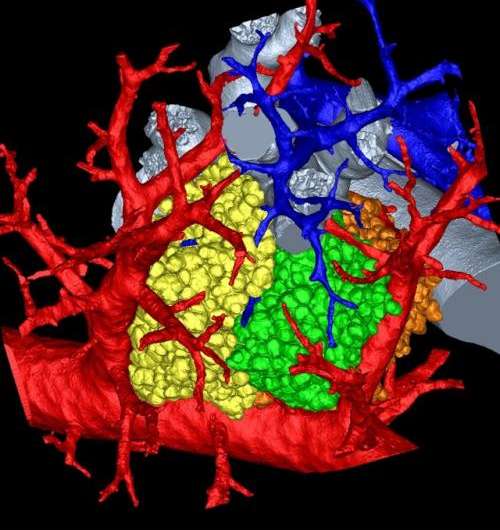
A research team led by the University of Iowa has created the most detailed, three-dimensional rendering of a mammal lung. The image pictured here shows a mouse's pulmonary acini, the terminals where gases and blood mix in a lung and whose function remains a mystery. Credit: Dragos Vasilescu
(Medical Xpress)—Amidst the extraordinarily dense network of pathways in a mammal lung is a common destination. There, any road leads to a cul-de-sac of sorts called the pulmonary acinus. This place looks like a bunch of grapes attached to a stem (acinus means "berry" in Latin).
Scientists have struggled to understand more specifically what happens in this microscopic, labyrinthine intersection of alleys and dead ends. To find out, a research team led by the University of Iowa created the most detailed, three-dimensional rendering of the pulmonary acinus. The computerized model, derived from mice, faithfully mimics each twist and turn in this region, including the length, direction and angles of the respiratory branches that lead to the all-important air sacs called alveoli.
"The imaging and image analysis methods described here provide for branch morphometry at the acinar level that has not been available previously," the researchers write in the paper, published this week in the online early edition of the Proceedings of the National Academy of Sciences.
The model is important, because it can help scientists understand where and how lung diseases emerge as well as the role the pulmonary acinus plays in the delivery of drugs, such as those commonly administered with inhalers.
This video is not supported by your browser at this time.
The video shows the imaging of a section of a mouse lung. As the image rotates, more respiratory branches (bronchioles) are shown, along with three acini (yellow, green and orange clusters). The blood vessels feeding the acini are then added with the arteries shown in blue and the veins in red. Credit: University of Iowa
"These methods allow us to understand where in the lung periphery disease begins and how it progresses," says Eric Hoffman, professor in the departments of radiology, medicine, and biomedical engineering at the UI and corresponding author on the paper. "How do gases and inhaled substances get there and do they accumulate in one or another acinus? How do they swirl around and clear out? We just don't have a complete understanding how that happens."As an example, Hoffman said the model could be used to determine how smoking-induced emphysema originates. "It has been hypothesized recently that it begins with the loss of peripheral airways rather than the lung air sacs," he says, citing ongoing research by James Hogg at the University of British Columbia, who was not involved in this study. It also could shed light and lead to more effective treatment of chronic obstructive pulmonary disease, which causes irreversible damage to the lung, says Dragos Vasilescu, first author on the paper who based his thesis on the research while a graduate student at the UI.
For years, the best that lung anatomy pioneers such as study co-corresponding author Ewald Weibel, professor emeritus of anatomy at the University of Bern, could do to study specific areas of a lung was to make measurements in two dimensions or create 3D casts of a lung's air spaces. The techniques, while giving the earliest insights into a lungs's makeup and functioning, had their limitations. For one, they did not directly replicate a lung's structure in real life, and they could not convey how various parts act together as a whole. Yet advances in imaging and computation have enabled researchers to more fully explore how gases and other inhaled substances act in the lung's furthest recesses.
In this study, the team worked with 22 pulmonary acini culled from young and old mice. They then set to "reconstruct" the acini based on micro computed tomography imaging of scanned lungs in mice and extracted from them. The extracted lungs were preserved in a way that kept the anatomy intact—including the tiny air spaces required for successful imaging. From that, the researchers were able to measure an acinus, estimate the number of acini for each mouse lung and even count the alveoli and measure their surface area.
The mouse lung, in its structure and function, is remarkably similar to the human lung. That means researchers can alter the genetics of a mouse and see how those changes affect the peripheral structure of the lung and its performance.
Already, the researchers found in the current study that mouse alveoli increase in number long past the two weeks that at least one previous study had indicated. Hoffman adds that a separate study is needed to determine whether humans, too, increase the number of air sacs past a certain, predetermined age.
The researchers next aim to use the model to more fully understand how gases interact with the bloodstream within the acini and the alveoli.
"Our imaging and image-analysis methodologies enable new ways to investigate the lung's structure and can now be used to further investigate the normal healthy-lung anatomy in humans and be used to visualize and assess the pathological changes in animal models of specific structural diseases," says Vasilescu, who is a postdoctoral researchfellow at the University of British Columbia.
Journal reference:
Proceedings of the National Academy of Sciences
Provided by
University of Iowa
-
US researchers identify first human lung stem cell
May 11, 2011 |
not rated yet |
0
-
New technique reveals insights into lung disease
Dec 13, 2007 |
not rated yet |
0
-
ATS, ERS issue official standards for the quantitative assessment of lung structure
Feb 17, 2010 |
not rated yet |
0
-
Stem cells repair lung damage after flu infection
Oct 27, 2011 |
not rated yet |
0
-
New study fundamentally alters our understanding of lung growth
Dec 06, 2011 |
not rated yet |
0
-
Motion perception revisited: High Phi effect challenges established motion perception assumptions
Apr 23, 2013 |
3 / 5 (2) |
2
-
Anything you can do I can do better: Neuromolecular foundations of the superiority illusion (Update)
Apr 02, 2013 |
4.5 / 5 (11) |
5
-
The visual system as economist: Neural resource allocation in visual adaptation
Mar 30, 2013 |
5 / 5 (2) |
9
-
Separate lives: Neuronal and organismal lifespans decoupled
Mar 27, 2013 |
4.9 / 5 (8) |
0
-
Sizing things up: The evolutionary neurobiology of scale invariance
Feb 28, 2013 |
4.8 / 5 (10) |
14
-
How can there be a term called "intestinal metaplasia" of stomach
5 hours ago
-
Pressure-volume curve: Elastic Recoil Pressure don't make sense
May 18, 2013
-
If you became brain-dead, would you want them to pull the plug?
May 17, 2013
-
MRI bill question
May 15, 2013
-
Ratio of Hydrogen of Oxygen in Dessicated Animal Protein
May 13, 2013
-
Alcohol and acetaminophen
May 13, 2013
- More from Physics Forums - Medical Sciences
More news stories
Common food supplement fights degenerative brain disorders
Widely available in pharmacies and health stores, phosphatidylserine is a natural food supplement produced from beef, oysters, and soy. Proven to improve cognition and slow memory loss, it's a popular treatment for older ...
Medical research
5 minutes ago |
not rated yet |
0
|
Finding a family for a pair of orphan receptors in the brain
Researchers at Emory University have identified a protein that stimulates a pair of "orphan receptors" found in the brain, solving a long-standing biological puzzle and possibly leading to future treatments for neurological ...
Medical research
35 minutes ago |
not rated yet |
0
|
Insight into the dazzling impact of insulin in cells
Australian scientists have charted the path of insulin action in cells in precise detail like never before. This provides a comprehensive blueprint for understanding what goes wrong in diabetes.
Medical research
1 hour ago |
4.5 / 5 (2) |
0
|
Do men's and women's hearts burn fuel differently?
Researchers at the University of Illinois at Chicago College of Medicine will study gender differences in how the heart uses and stores fat—its main energy source—and how changes in fat metabolism play ...
Medical research
3 hours ago |
not rated yet |
0
Study suggests new source of kidneys for transplant
Nearly 20 percent of kidneys that are recovered from deceased donors in the U.S. are refused for transplant due to factors ranging from scarring in small blood vessels of the kidney's filtering units to the organ going too ...
Medical research
20 hours ago |
5 / 5 (2) |
0
|
Estimates reveal low population immunity to new bird flu virus H7N9 in humans
The level of immunity to the recently circulating H7N9 influenza virus in an urban and rural population in Vietnam is very low, according to the first population level study to examine human immunity to the virus, which was ...
Study finds vitamin C can kill drug-resistant TB (w/ video)
In a striking, unexpected discovery, researchers at Albert Einstein College of Medicine of Yeshiva University have determined that vitamin C kills drug-resistant tuberculosis (TB) bacteria in laboratory culture. The finding ...
Glaucoma drug can cause droopy eyelids
Prostaglandin analogues (PGAs), drugs which lower intraocular pressure, are often the first line of treatment for people with glaucoma, but their use is not without risks. PGAs have long been associated with blurred vision, ...
Teens exposed to schoolmate's death by suicide much more likely to consider or attempt suicide
Youth who had a schoolmate die by suicide are significantly more likely to consider or attempt suicide, according to a study in published in CMAJ (Canadian Medical Association Journal). This effect can last 2 years or mo ...
New search engine finds rare diagnoses
Doctors are trained to think "common disease" when they meet patients in their practices, and as they rarely or never meet a rare disease, it often takes many years to reach the right diagnosis. A new search tool called FindZebra ...
If you can remember it, you can remember it wrong
(Medical Xpress)—Native peoples in regions where cameras are uncommon sometimes react with caution when their picture is taken. The fear that something must have been stolen from them to create the photo ...