Hunting for the last remaining tumour cell
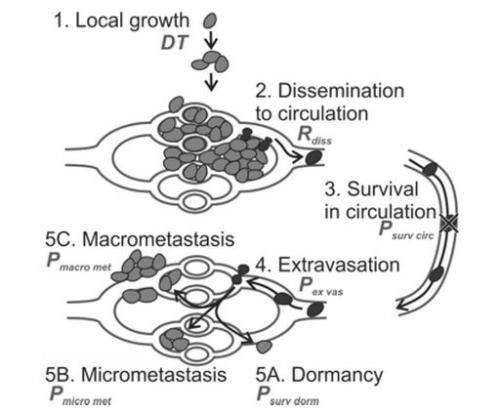
Cells that are freed from the primary tumour circulate in the blood, when they surivive they can form metastases, or stay dormant for a while.
The 7.5 millilitres of blood contained in a standard sample tube is not nearly enough to detect circulating tumour cells (CTCs) in the blood of patients with metastatic breast cancer, prostate cancer, or colorectal cancer with a high enough degree of reliability. These CTCs are the cause of metastases in cancer patients. If they can be effectively characterized, it is possible to arrive at a prognosis and to determine the most effective course of treatment. However, the only way to detect "that one particular cell" is to subject the patient's entire blood volume to a kind of dialysis. This was the conclusion reached by Dr Frank Coumans in an article published in the journal Clinical Cancer Research. Dr Coumans works at the University of Twente's MIRA Institute for Biomedical Technology and Technical Medicine. He was recently awarded a PhD (with distinction) on this topic.
The standard test for circulating tumour cells (CTCs) involves a 7.5 millilitre blood sample and the use of magnetic particles to separate CTCs from the other components of the blood. However, Dr Coumans found that this method failed to detect any CTCs in nearly half of those patients who are known to have metastases. Accordingly, for these patients, this method is an insufficiently reliable indicator of metastases. Furthermore, if no CTCs can be isolated, it will not be possible to develop treatment plans that are tailored to individual patients.
Difficult to identify
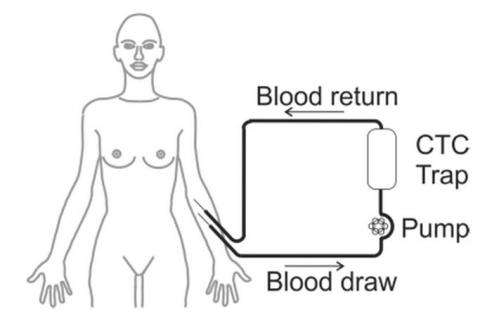
Schematic drawing of the CTC Trap setup, analysing the entire blood volume of the patient.
There are several reasons for this. It is no easy matter to pick out CTCs, as they resemble many of the cells that are normally found in the blood. For this reason, the test focuses on specific indicators. One of these is the epithelial adhesion molecule (EpCAM), which "sticks cells together" in organs, but which is not normally found in blood cells. Other such indicators are cytokeratin and CD45, a protein found in all white blood cells. Any white blood cells that unexpectedly contain traces of EpCAM and cytokeratin but very little CD45 could mistakenly be counted as circulating tumour cells. Errors can also creep into the count during the enrichment of CTCs from blood using magnetic particles. For instance, the magnetic field used might be too weak to capture the CTCs. Finally, if the concentration of CTCs is sufficiently low, there is only a small chance that any of these cells will be present in the blood sample. The latter turned out to be the case. Taking two blood samples rather than one has no effect whatsoever. The concentration of CTCs is logarithmic, so doubling the sample size does not double the chances of finding one of these cells.Large volume
Frank Coumans carried out his PhD research in Prof. Leon Terstappen's Medical Cell Biophysics group. Research previously carried out by this group showed that gains can still be made, for example, by using an improved CellSearch analyser, with better illumination. However, according to Dr Coumans, the only way to achieve a 99 percent chance of detecting a CTC is to sample a blood volume of five litres. This approach would involve the use of additional technology. This works best with fresh blood, so a type of dialysis or apheresis is needed that can separate specific components from the blood and return "the rest" to the patient. This is known as the CTCtrap or CTC TheRapeutic APheresis.
Dr Coumans' research is part of a major European research programme (http://www.utwente.nl/tnw/ctctrap/). He expects this programme to deliver a technique capable of entering the clinical phase. Metastases often dramatically worsen the prognoses of cancer patients. It is therefore vital to improve the chances of a CTC "hit" and to better understand the mechanisms involved.
The article entitled "Challenges in the Enumeration and Phenotyping of CTC" by Frank Coumans, Sjoerd Ligthart, Jonathan Uhr and Leon Terstappen, was published in Clinical Cancer Research, the journal of the American Association for Cancer Research (ACCR).
Journal reference:
Clinical Cancer Research
Provided by
University of Twente
-
Individual therapy for all cancer patients
Jun 26, 2012 |
not rated yet |
0
-
Cancer cells in blood can identify risk of recurrence in breast cancer
Sep 24, 2007 |
not rated yet |
0
-
Cancer cells in blood predict chances of survival and can help target breast cancer treatment
Mar 22, 2012 |
not rated yet |
0
-
Blood test could lead to improved diagnosis and treatment of breast cancer
Jun 05, 2012 |
not rated yet |
0
-
Researchers identify potential treatment target for metastatic pancreatic cancer using CTC chip technology
Jul 30, 2012 |
not rated yet |
0
-
Motion perception revisited: High Phi effect challenges established motion perception assumptions
Apr 23, 2013 |
3 / 5 (2) |
2
-
Anything you can do I can do better: Neuromolecular foundations of the superiority illusion (Update)
Apr 02, 2013 |
4.5 / 5 (11) |
5
-
The visual system as economist: Neural resource allocation in visual adaptation
Mar 30, 2013 |
5 / 5 (2) |
9
-
Separate lives: Neuronal and organismal lifespans decoupled
Mar 27, 2013 |
4.9 / 5 (8) |
0
-
Sizing things up: The evolutionary neurobiology of scale invariance
Feb 28, 2013 |
4.8 / 5 (10) |
14
-
Pressure-volume curve: Elastic Recoil Pressure don't make sense
May 18, 2013
-
If you became brain-dead, would you want them to pull the plug?
May 17, 2013
-
MRI bill question
May 15, 2013
-
Ratio of Hydrogen of Oxygen in Dessicated Animal Protein
May 13, 2013
-
Alcohol and acetaminophen
May 13, 2013
-
Marie Curie's leukemia
May 13, 2013
- More from Physics Forums - Medical Sciences
More news stories
Older prostate cancer patients should think twice before undergoing treatment
Older prostate cancer patients with other underlying health conditions should think twice before committing to surgery or radiation therapy for their cancer, according to a multicenter study led by researchers in the UCLA ...
Cancer
5 hours ago |
not rated yet |
0
|
Two radiotherapy treatments show similar morbidity, cancer control after prostatectomy
Intensity-modulated radiation therapy has become the most commonly used type of radiation in prostate cancer, but research from the University of North Carolina suggests that the therapy may not be more effective than older, ...
Cancer
7 hours ago |
not rated yet |
0
The compound in the Mediterranean diet that makes cancer cells 'mortal'
New research suggests that a compound abundant in the Mediterranean diet takes away cancer cells' "superpower" to escape death. By altering a very specific step in gene regulation, this compound essentially re-educates cancer ...
Cancer
8 hours ago |
4.8 / 5 (8) |
1
|
CT radiation risk less than risk of examination indicator
(HealthDay)—For young adults needing either a chest or abdominopelvic computed tomography (CT), the short-term risk of death from underlying morbidity is greater than the long-term risk of radiation-induced ...
Cancer
9 hours ago |
not rated yet |
0
Team finds mechanism linking key inflammatory marker to cancer
In a new study described in the journal Oncogene, researchers reveal how a key player in cell growth, immunity and the inflammatory response can be transformed into a primary contributor to tumor growth.
Cancer
14 hours ago |
not rated yet |
0
|
Do salamanders hold the solution to regeneration?
Salamanders' immune systems are key to their remarkable ability to regrow limbs, and could also underpin their ability to regenerate spinal cords, brain tissue and even parts of their hearts, scientists have ...
Scientists identify molecular trigger for Alzheimer's disease
Researchers have pinpointed a catalytic trigger for the onset of Alzheimer's disease – when the fundamental structure of a protein molecule changes to cause a chain reaction that leads to the death of neurons ...
Practice makes perfect? Not so much
Turns out, that old "practice makes perfect" adage may be overblown. New research led by Michigan State University's Zach Hambrick finds that a copious amount of practice is not enough to explain why people ...
New test better detects elephantiasis worm infection
A new diagnostic test for a worm infection that can lead to severe enlargement and deformities of the legs and genitals is far more sensitive than the currently used test, according to results of a field ...
Researchers develop model for better testing, targeting of malignant peripheral nerve sheath tumors
University of Minnesota Medical School researchers from the Masonic Cancer Center, University of Minnesota, in partnership with the University's Brain Tumor Program, have developed a new mouse model of malignant peripheral ...
Study shows how bilinguals switch between languages
(Medical Xpress)—Individuals who learn two languages at an early age seem to switch back and forth between separate "sound systems" for each language, according to new research conducted at the University of Arizona.
