Eliminating visual clutter helps people with mild cognitive impairment
October 1, 2012 by Jason Maderer in Neuroscience

Eliminating visual clutter helps people with mild cognitive impairment

Enlarge

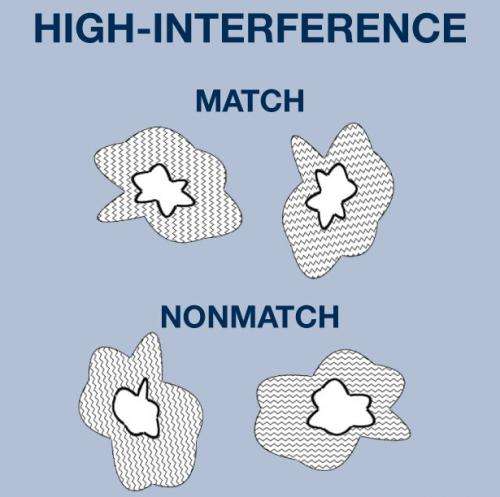
In the high-interference trials, many photos of the same thing (a blob-like object) were shown. The photos varied only slightly when they weren’t a perfect match, either by shape, color or fill pattern. As expected, MCI patients struggled greatly to identify identical pairings. Credit: University of Toronto/Georgia Tech

(Medical Xpress)—A new study from Georgia Tech and the University of Toronto suggests that memory impairments for people diagnosed with early stage Alzheimer's disease may be due, in part, to problems in determining the differences between similar objects. The findings also support growing research indicating that a part of the brain once believed to support memory exclusively – the medial temporal lobe - also plays a role in object perception. The results are published in the October edition of Hippocampus.

(MCI) is a disorder commonly thought to be a to Alzheimer's disease. The study's , partnering with the Emory Alzheimer's Disease Research Center, tested MCI patients on their ability to determine whether two rotated, side-by-side pictures were different or identical.

In the high-interference trials, many photos of the same thing (a blob-like object) were shown. The photos varied only slightly when they weren't a perfect match, either by shape, color or fill pattern. As expected, MCI patients struggled greatly to identify identical pairings.

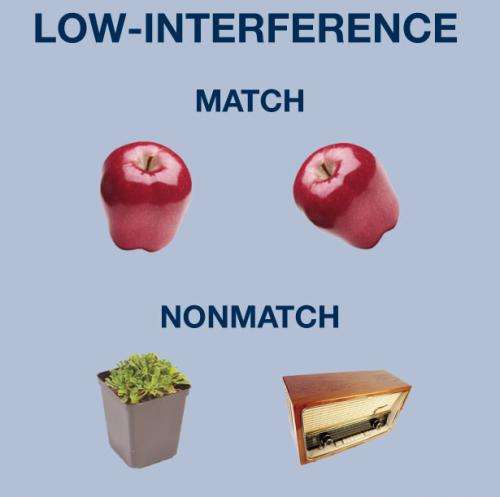
In the low-interference trials, these blob-like objects were interspersed with trials in which non-matches were more extreme and varied widely. For example, a picture of a butterfly was shown next to a photo of a . Interspersing the very similar blob-like objects with photos of dissimilar objects greatly reduced the amount of interference.

"Minimizing the degree of perceptual improved patients' object perception by reducing the number of visually similar features," said project leader Rachel Newsome, a University of Toronto Ph.D. student and Georgia Tech graduate.

The findings suggest that, under certain circumstances, reducing "visual clutter" could help MCI patients with . For example, buttons on a telephone tend to be the same size and color. Only the numbers are different – a very slight visual difference for someone who struggles with object perception. One solution could be a phone with varying sized buttons and different colors.
Eliminating visual clutter helps people with mild cognitive impairment
Enlarge

In the low-interference trials, pictures of more extreme, widely varied objects were interspersed with blob-like objects (used in high-performance trials). For example, a picture of a plant was shown next to a photo of a radio. Interspersing the very similar blob-like objects with photos of dissimilar objects greatly reduced the amount of interference. Minimizing the degree of perceptual interference improved patients’ object perception by reducing the number of visually similar features. Credit: University of Toronto/Georgia Tech

People diagnosed with MCI weren't the only ones to struggle in the study. The researchers performed the same tests on candidates at-risk for MCI, people who had previously shown no signs of . They performed the same as those with MCI, suggesting that the perception test could be used as an early indicator of cognitive impairment.

"People often associate MCI and dementia solely with memory impairment," said Georgia Tech Psychology Assistant Professor Audrey Duarte, one of the study's authors. "Memory and perception appear to be intertwined in the same area of the human brain."

Duarte and her colleagues are among the growing number of researchers studying Alzheimer's who believe damage to a small area of the medial temporal lobes, the perirhinal cortex, affects object perception.

"Not only does memory seem to be very closely linked to perception, but it's also likely that one affects the other," said Toronto's Morgan Barense, the final member of the team. "Alzheimer's patients may have trouble recognizing a loved one's face, not only because they can't remember it, but also because they aren't able to correctly perceive its distinct combination of features to begin with."

More information: onlinelibrary.wile… o.22071/full

Provided by Georgia Institute of Technology search and more info website

not rated yet  

Filter


Move the slider to adjust rank threshold, so that you can hide some of the comments.


Display comments: newest first

Tausch
Oct 01, 2012

Rank: not rated yet
http://medicalxpr...ays.html

The authors to the link above disagree with:

The lack of features (or if you will - the less 'clutter')when perceiving your surroundings the less likely your memory of that event is prone or susceptible to lost.

The authors of this article here agree to the assertion:

The lack of features (or if you will - the less 'clutter')when perceiving your surroundings the less likely your memory of that event is prone or susceptible to lost.

In a 'clutter-less' (featureless poor)world Alzheimer patients have perfect memory - all humans do.

It only takes one outstanding (in this case , visual) feature to recognize a loved one's face - the brain and mind want more - to store all the perceptions delivered by more than one sense - in this case the visual.

Object perception runs parallel along all the senses.
Focus on just one feature of an object 'strengthens' memory retention - the less remembered, the less forgotten.

Mike_Massen
Oct 01, 2012

Rank: not rated yet
It seems to me, after having looked after a parent with a variant of Alzheimers, that an initial symptom is adherence to an idea or ideal which cannot easily be argued against despite exploration of logic or rationale which encompasses any complexity or diversity.

ie Fixation and attachment to an idea which in essence is dynamic yet viewed as concrete static by the patient - this seems to be a key issue, I have since seen this several times as indication of some biological or psychological aspect of the initial offerings of alzheimers...

Thanks

Rank not rated yet
Relevant PhysicsForums posts

More news stories

Addiction as a disorder of decision-making

New research shows that craving drugs such as nicotine can be visualized in specific regions of the brain that are implicated in determining the value of actions, in planning actions and in motivation. Dr. Alain Dagher, from ...

Neuroscience created 1 hour ago | popularity not rated yet | comments 0

Reducing caloric intake delays nerve cell loss

Activating an enzyme known to play a role in the anti-aging benefits of calorie restriction delays the loss of brain cells and preserves cognitive function in mice, according to a study published in the May ...

Neuroscience created 18 hours ago | popularity 5 / 5 (6) | comments 0 | with audio podcast

B vitamins could delay dementia

(Medical Xpress)—Despite spending billions of dollars on research and development, drug companies have been unable to come up with effective treatments for dementia and Alzheimer's Disease (AD). Now, A. ...

Neuroscience created 21 hours ago | popularity 4.9 / 5 (15) | comments 0 | with audio podcast report

Waiting for a sign? Researchers find potential brain 'switch' for new behavior

You're standing near an airport luggage carousel and your bag emerges on the conveyor belt, prompting you to spring into action. How does your brain make the shift from passively waiting to taking action when ...

Neuroscience created 22 hours ago | popularity 5 / 5 (1) | comments 0 | with audio podcast

If you can remember it, you can remember it wrong

(Medical Xpress)—Native peoples in regions where cameras are uncommon sometimes react with caution when their picture is taken. The fear that something must have been stolen from them to create the photo ...

Neuroscience created May 21, 2013 | popularity 4.3 / 5 (6) | comments 0 | with audio podcast report


Study finds new pneumococcal vaccine appears to be as safe as previously used vaccine

The new 13-valent pneumococcal conjugate vaccine (PCV13) appears to be as safe as the previous version used prior to 2010, the 7-valent pneumococcal conjugate vaccine (PCV7), according to a Kaiser Permanente study published ...

Addiction to unhealthy foods could help explain the global obesity epidemic

Research presented today shows that high-fructose corn syrup can cause behavioural reactions in rats similar to those produced by drugs of abuse such as cocaine. These results, presented by addiction expert Francesco Leri, ...

Study says empathy plays a key role in moral judgments

Is it permissible to harm one to save many? Those who tend to say "yes" when faced with this classic dilemma are likely to be deficient in a specific kind of empathy, according to a report published in the scientific journal ...

A molecular explanation for age-related fertility decline in women

(Medical Xpress)—Scientists supported by the National Institutes of Health have a new theory as to why a woman's fertility declines after her mid-30s. They also suggest an approach that might help slow ...

Phthalates: Study links chemicals widely found in plastics, processed food to elevated blood pressure in children, teens

Plastic additives known as phthalates (pronounced THAL-ates) are odorless, colorless and just about everywhere: They turn up in flooring, plastic cups, beach balls, plastic wrap, intravenous tubing and—according to the ...

Medical researchers discover new ways to target, develop and design drugs to prevent and treat viral infection

Researchers at the University of Alberta have discovered a new drug target, developed a new drug and identified a new way to design drugs—all of which could be a winning combination in the battle against viruses.