Brain's code for visual working memory deciphered in monkeys
November 2, 2012 in Neuroscience

In-sync brain waves hold memory of objects just seen

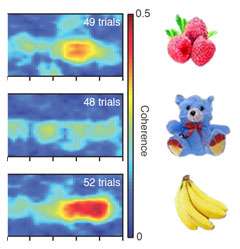
A brain visual working memory circuit holds information in mind about what has just been seen. It represents the memory and distinguishes among objects via unique patterns of brain wave synchronization between neurons in the circuit. The large area of red in the lowest graph indicates that the brain waves in the two regions were highly in-sync after seeing a particular object – indicating that they were highly involved in holding in short-term memory information about that object. The modest amount of red for the top graph indicates lesser involvement for another object. By contrast, lack of red in the middle graph shows that the two groups of neurons weren't much involved in remembering a third object. So the memory of any particular object appears to be represented by its own unique mix of neurons oscillating in-sync. Credit: Charles Gray, Ph.D., Montana State University

The brain holds in mind what has just been seen by synchronizing brain waves in a working memory circuit, an animal study supported by the National Institutes of Health suggests. The more in-sync such electrical signals of neurons were in two key hubs of the circuit, the more those cells held the short-term memory of a just-seen object.

Charles Gray, Ph.D., of Montana State University, Bozeman, a grantee of NIH's National Institute of Mental Health (NIMH), and colleagues, report their findings Nov. 1, 2012, online, in the journal .

"This work demonstrates, for the first time, that there is information about short term memories reflected in in-sync brainwaves," explained Gray.

"The Holy Grail of neuroscience has been to understand how and where information is encoded in the brain. This study provides more evidence that large scale across distant may carry information for visual memories," said NIMH director Thomas R. Insel, M.D.

Prior to the study, scientists had observed synchronous patterns of electrical activity between the two circuit hubs after a monkey saw an object, but weren't sure if the signals actually represent such short-term visual memories in the brain. Rather, it was thought that such neural oscillations might play the role of a traffic cop, directing information along brain highways.

To find out more, Gray, Rodrigo Salazar Ph.D., and Nick Dotson of Montana State and Steven Bressler, Ph.D., at Florida Atlantic University, Boca Raton, recorded from groups of neurons in both hubs of two monkeys performing a visual working . To earn a reward, the monkeys had to remember an object – or its location – that they saw momentarily on a computer screen and correctly match it. The researchers expected to see the telltale boost in synchrony during a delay period immediately after an object disappeared from the screen, when the monkey had to hold information briefly in mind.
In-sync brain waves hold memory of objects just seen

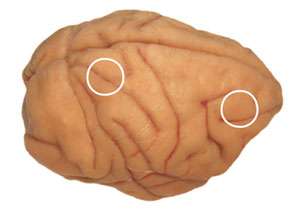
A brain visual working memory circuit holds information in mind about what has just been seen. It represents the memory and distinguishes among objects via unique patterns of brain wave synchronization between neurons in the circuit. For example, two distant hubs in the circuit, one at the front of the brain (right circle) and the other at the rear side (left circle), showed varying amounts of synchrony in their brain waves, depending on what object a monkey was holding in memory. The coherence of synchronous activity between cells in these regions was plotted for different objects the monkey saw over several trials. Credit: Charles Gray, Ph.D., Montana State University

The degree of synchronous activity, or coherence, between cells in the areas was plotted for different objects the monkeys saw.

Brain waves of many neurons in the two hubs, called the prefrontal cortex and posterior parietal cortex, synchronized to varying degrees – depending on an object's identity (see picture below). This and other evidence indicated that neurons in these hubs are selective for particular features in the visual field and that synchronization in the circuit carries content-specific information that might contribute to visual working memory.

The researchers also determined that the parietal cortex was more influential than the prefrontal cortex in driving this process. Previously, many researchers had thought that the firing rate of single neurons in the prefrontal cortex, the brain's executive, is the major player in .

Since synchronized oscillations between populations of cells distinguished between visual stimuli, it's theoretically possible to determine the correct answers for the matching tasks the monkeys performed simply by reading their brain waves. Similarly, synchrony between cell populations in the two hubs also distinguished between locations. So the location of visual information, like object identity, also appears to be represented by synchronous . Again, researchers previously thought that these functions had mostly to do with the firing rates of neurons.

So the new findings may upturn prevailing theory.

Journal reference: Science Express search and more info website

Provided by National Institutes of Health search and more info website

5 /5 (1 vote)  

Filter


Move the slider to adjust rank threshold, so that you can hide some of the comments.


Display comments: newest first

Tausch
Nov 02, 2012

Rank: not rated yet
Kudos.
Misleading caption.
Neuroscience is dogged by unwilling proponents of old school theory.
Rank 5 /5 (1 vote)
Relevant PhysicsForums posts

More news stories

Having both migraines, depression may mean smaller brain

(HealthDay)—Migraines and depression can each cause a great deal of suffering, but new research indicates the combination of the two may be linked to something else entirely—a smaller brain.

Neuroscience created 4 hours ago | popularity 5 / 5 (1) | comments 0 | with audio podcast

Researchers analyse hunting behaviour of fish larvae in virtual reality

Moving objects attract greater attention – a fact exploited by video screens in public spaces and animated advertising banners on the Internet. For most animal species, moving objects also play a major ...

Neuroscience created 7 hours ago | popularity not rated yet | comments 0 | with audio podcast

Signs of motor disorders can appear years before disease manifestation

It is known that signs of neurological disorders such as Alzheimer's and Huntington's disease can appear years before the disease becomes manifest; these signs take the form of subtle changes in the brain and behavior of ...

Neuroscience created 7 hours ago | popularity not rated yet | comments 0

Taming suspect gene reverses schizophrenia-like abnormalities in mice

Scientists have reversed behavioral and brain abnormalities in adult mice that resemble some features of schizophrenia by restoring normal expression to a suspect gene that is over-expressed in humans with ...

Neuroscience created 8 hours ago | popularity 5 / 5 (1) | comments 0 | with audio podcast

Scientists uncover molecular roots of cocaine addiction in the brain

Researchers at Johns Hopkins have unraveled the molecular foundations of cocaine's effects on the brain, and identified a compound that blocks cravings for the drug in cocaine-addicted mice. The compound, already proven safe ...

Neuroscience created 8 hours ago | popularity not rated yet | comments 0 | with audio podcast


Slowing the aging process—only with antibiotics

Swiss scientists reveal the mechanism responsible for aging hidden deep within mitochondria—and dramatically slow it down in worms by administering antibiotics to the young.

Brain can be trained in compassion, study shows

Until now, little was scientifically known about the human potential to cultivate compassion—the emotional state of caring for people who are suffering in a way that motivates altruistic behavior.

Researchers complete largest genetic sequencing study of human disease

Researchers from Queen Mary, University of London have led the largest sequencing study of human disease to date, investigating the genetic basis of six autoimmune diseases.

Novel approach for influenza vaccination shows promise in early animal testing

A new approach for immunizing against influenza elicited a more potent immune response and broader protection than the currently licensed seasonal influenza vaccines when tested in mice and ferrets. The vaccine ...

Calorie information in fast food restaurants used by 40 percent of 9-18 year olds when making food choices

A new study published online today (Thursday) in the Journal of Public Health has found that of young people who visited fast food or chain restaurants in the U.S. in 2010, girls and youth who were obese were more likely ...

Systematic screening of med adherence will ID barriers

(HealthDay)—Implementation of systematic monitoring for medication adherence will allow for identification of barriers to adherence and tailoring of interventions, according to a viewpoint piece published ...