Brain displays an intrinsic mechanism for fighting infection
November 19, 2012 in Medical research

Brain displays an intrinsic mechanism for fighting infection

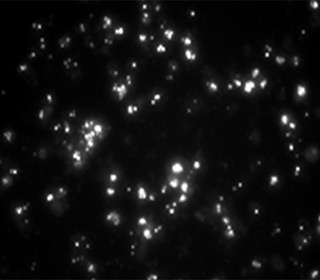
Interfering with interferon. Herpes simplex virus-infected neurons (above) are from patients with a genetic defect that impairs their brain’s ability to make interferon, an important immune system protein, and leaves their brain cells unable to fight off the infection. Healthy people, in turn, have an intrinsic immune response to the virus.

(Medical Xpress)—White blood cells have long reigned as the heroes of the immune system. When an infection strikes, the cells, produced in bone marrow, race through the blood to fight off the pathogen. But new research is emerging that individual organs can also play a role in immune system defense, essentially being their own hero. In a study examining a rare and deadly brain infection, scientists at The Rockefeller University have found that the brain cells of healthy people likely produce their own immune system molecules, demonstrating an "intrinsic immunity" that is crucial for stopping an infection.

Shen-Ying Zhang, a clinical scholar in the St. Giles Laboratory of of Infectious Diseases, has been studying children with Herpes simplex encephalitis, a life-threatening from the herpes virus, HSV-1, that can cause significant . The scientists already knew from previous work that children with this encephalitis have a that impairs the function of an immune system receptor—toll-like receptor 3 (TLR3)—in the brain. For this study they wanted to see how the defect in TLR3 was hampering the brain's ability to fight the .

When TLR3 detects a pathogen it triggers an immune response causing the release of proteins called interferons to sound the alarm and "interfere" with the pathogen's replication. It's most commonly associated with white blood cells, found throughout the body, but here the researchers were examining the receptor's presence on neurons and other brain cells.

"One interesting thing about these patients is that they didn't have any of the other, more common herpes symptoms. They didn't have an infection on their skin or their mouths, just in their brains. We therefore hypothesized that the TLR3 response must be specifically responsible for keeping the from infecting the brain and not necessary in other parts of the body," says Zhang.

The lab, headed by Jean-Laurent Casanova, collaborated with scientists at Harvard Medical School and Memorial Sloan-Kettering Cancer Institute to create induced pluripotent stem cells. Made from the patients' own tissue, the stem cells were developed into central nervous system cells that carried the patients' genetic defects. Zhang exposed the cells to HSV-1 and to synthetic double-stranded RNA, which mimics a byproduct of the virus that spurs the toll-like receptors into action. By measuring levels of interferon, Zhang showed that the patients' TLR3 response was indeed faulty; their cells weren't making these important immune system proteins, leaving them unable to fight off the infection.

Zhang also exposed the patients' blood cells to the virus and found that the TLR3 defect was not an issue there as it was in the brain—interferons were released by other means.

Because the toll-like receptors on neurons proved to be vital in preventing the encephalitis infection, the researchers concluded that use it as an in-house mechanism to fight infection, rather than relying on . When its function was impaired, patients couldn't get better.

"This is evidence of an intrinsic immunity, a newly-discovered function of the immune system," says Zhang. "It's likely that other organs also have their own specific tools for fighting infection."

The researchers are putting together a pilot study to test an interferon-based treatment in patients with the encephalitis, believing it will help speed recovery and increase the survival rate when used alongside antiviral drugs. They'll also explore whether the brain displays an intrinsic immunity to other types of viral infection.

More information: Impaired intrinsic immunity to HSV-1 in human iPSC-derived TLR3-deficient CNS cells, Nature online: October 28, 2012. www.nature.com/nat… re11583.html

Journal reference: Nature search and more info website

Provided by Rockefeller University search and more info website

5 /5 (3 votes)  

Filter


Move the slider to adjust rank threshold, so that you can hide some of the comments.


Display comments: newest first

Tausch
Nov 19, 2012

Rank: not rated yet
What life form exhibits no immunity specific to location?
saraet
Dec 05, 2012

Rank: not rated yet
Datehsv,com is? a warm-hearted and exclusive community for singles and friends with herpes , HPV,HIV/AIDS or any other STDs. Here you can get on with your life and meet new friends, partners or potential spouses, or learn about STD medical information. If you just need to find someone to talk to or offer help or advice, this is the best place.Never feel lonely again!
Rank 5 /5 (3 votes)
Relevant PhysicsForums posts

More news stories

Baby's life saved with groundbreaking 3-D printed device that restored his breathing

Every day, their baby stopped breathing, his collapsed bronchus blocking the crucial flow of air to his lungs. April and Bryan Gionfriddo watched helplessly, just praying that somehow the dire predictions ...

Medical research created 4 hours ago | popularity 5 / 5 (1) | comments 0

Research shows how immune system peacefully co-exists with 'good' bacteria

The human gut is loaded with commensal bacteria – "good" microbes that, among other functions, help the body digest food. The gastrointestinal tract contains literally trillions of such cells, and yet the ...

Medical research created 8 hours ago | popularity 5 / 5 (1) | comments 0 | with audio podcast

Slowing the aging process—only with antibiotics

Swiss scientists reveal the mechanism responsible for aging hidden deep within mitochondria—and dramatically slow it down in worms by administering antibiotics to the young.

Medical research created 8 hours ago | popularity 4.7 / 5 (3) | comments 0 | with audio podcast

How healthy are you for your age?

On May 22, JoVE will publish details of a technique to measure the health of human genetic material in relation to a patient's age. The method is demonstrated by the laboratory of Dr. Gil Atzmon at New York's Albert Einste ...

Medical research created 11 hours ago | popularity not rated yet | comments 0

A molecular explanation for age-related fertility decline in women

(Medical Xpress)—Scientists supported by the National Institutes of Health have a new theory as to why a woman's fertility declines after her mid-30s. They also suggest an approach that might help slow ...

Medical research created 13 hours ago | popularity not rated yet | comments 0 | with audio podcast


Researchers complete largest genetic sequencing study of human disease

Researchers from Queen Mary, University of London have led the largest sequencing study of human disease to date, investigating the genetic basis of six autoimmune diseases.

Having both migraines, depression may mean smaller brain

(HealthDay)—Migraines and depression can each cause a great deal of suffering, but new research indicates the combination of the two may be linked to something else entirely—a smaller brain.

Brain can be trained in compassion, study shows

Until now, little was scientifically known about the human potential to cultivate compassion—the emotional state of caring for people who are suffering in a way that motivates altruistic behavior.

Novel approach for influenza vaccination shows promise in early animal testing

A new approach for immunizing against influenza elicited a more potent immune response and broader protection than the currently licensed seasonal influenza vaccines when tested in mice and ferrets. The vaccine ...

Enzyme-activating antibodies revealed as marker for most severe form of rheumatoid arthritis

In a series of lab experiments designed to unravel the workings of a key enzyme widely considered a possible trigger of rheumatoid arthritis, researchers at Johns Hopkins have found that in the most severe ...

Systematic screening of med adherence will ID barriers

(HealthDay)—Implementation of systematic monitoring for medication adherence will allow for identification of barriers to adherence and tailoring of interventions, according to a viewpoint piece published ...