How connections in the brain must change to form memories could help to develop artificial cognitive computers
November 7, 2012 in Neuroscience
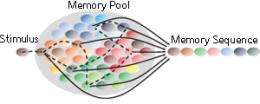
A schematic diagram depicting the recall of a sequence of memory items when the network containing the pool of memory items is triggered by a stimulus. Credit: 2012 A*STAR Institute for Infocomm Research
Exactly how memories are stored and accessed in the brain is unclear. Neuroscientists, however, do know that a primitive structure buried in the center of the brain, called the hippocampus, is a pivotal region of memory formation. Here, changes in the strengths of connections between neurons, which are called synapses, are the basis for memory formation. Networks of neurons linking up in the hippocampus are likely to encode specific memories.
Since direct tests cannot be performed in the brain, experimental evidence for this process of memory formation is difficult to obtain but mathematical and computational models can provide insight. To this end, Eng Yeow Cheu and co-workers at the A*STAR Institute for Infocomm Research, Singapore, have developed a model that sheds light on the exact synaptic conditions required in memory formation.
Their work builds on a previously proposed model of auto-associative memory, a process whereby a memory is retrieved or completed after partial activation of its constituent neural network. The earlier model proposed that neural networks encoding short-term memories are activated at specific points during oscillations of brain activity. Changes in the strengths of synapses, and therefore the abilities of neurons in the network to activate each other, lead to an auto-associative long-term memory.
Cheu and his team then adapted a mathematical model that describes the activity of a single neuron to incorporate specific characteristics of cells in the hippocampus, including their inhibitory activity. This allowed them to model neural networks in the hippocampus that encode short-term memories. They showed that for successful formation of auto-associative memories, the strength of synapses needs to be within a certain range: if synapses become too strong, the associated neurons are activated at the wrong time and networks become muddled, destroying the memories. If they are not strong enough, however, activation of some neurons in the network is not enough to activate the rest, and memory retrieval fails.
As well as providing insight into how memories may be stored and retrieved in the brain, Cheu thinks this work also has practical applications. "This study has significant implications in the construction of artificial cognitive computers in the future," he says. "It helps with developing artificial cognitive memory, in which memory sequences can be retrieved by the presentation of a partial query." According to Cheu, one can compare it to a single image being used to retrieve a sequence of images from a video clip.
More information: Cheu, E. Y., Yu, J., Tan, C. H. & Tang, H. Synaptic conditions for auto-associative memory storage and pattern completion in Jensen et al.'s model of hippocampal area CA3. Journal of Computational Neuroscience advance online publication, 30 May 2012 (doi: 10.1007/s10827-012-0394-8). http://link.springer.com/article/10.1007%2Fs10827-012-0394-8
Provided by
Agency for Science, Technology and Research (A*STAR), Singapore
-
Neuroscientists isolate molecular 'when' and 'where' of memory formation
Oct 15, 2012 |
not rated yet |
0
-
Researchers restore memory process in most common form of mental disability
Oct 05, 2007 |
not rated yet |
0
-
To make memories, new neurons must erase older ones
Nov 12, 2009 |
not rated yet |
0
-
Neuroscientists identify a master controller of memory
Dec 22, 2011 |
not rated yet |
0
-
Scientists discover brain structures associated with learning
May 02, 2011 |
not rated yet |
0
-
Motion perception revisited: High Phi effect challenges established motion perception assumptions
Apr 23, 2013 |
3 / 5 (2) |
2
-
Anything you can do I can do better: Neuromolecular foundations of the superiority illusion (Update)
Apr 02, 2013 |
4.5 / 5 (11) |
5
-
The visual system as economist: Neural resource allocation in visual adaptation
Mar 30, 2013 |
5 / 5 (2) |
9
-
Separate lives: Neuronal and organismal lifespans decoupled
Mar 27, 2013 |
4.9 / 5 (8) |
0
-
Sizing things up: The evolutionary neurobiology of scale invariance
Feb 28, 2013 |
4.8 / 5 (10) |
14
-
Why is zone 1 in liver more prone to ischemic injury?
May 23, 2013
-
How can there be villous adenoma in colon, if there are no villi there
May 22, 2013
-
How can there be a term called "intestinal metaplasia" of stomach
May 21, 2013
-
Pressure-volume curve: Elastic Recoil Pressure don't make sense
May 18, 2013
-
If you became brain-dead, would you want them to pull the plug?
May 17, 2013
-
MRI bill question
May 15, 2013
- More from Physics Forums - Medical Sciences
More news stories
New neuron formation could increase capacity for new learning, at the expense of old memories
New research presented today shows that formation of new neurons in the hippocampus - a brain region known for its importance in learning and remembering - could cause forgetting of old memories by causing a reorganization ...
Neuroscience
17 hours ago |
4 / 5 (4) |
0
Help at hand for people with schizophrenia
How can healthy people who hear voices help schizophrenics? Finding the answer for this is at the centre of research conducted at the University of Bergen.
Neuroscience
17 hours ago |
4 / 5 (2) |
2
Japanese research organizations contribute to Human Brain Project
One of the major frontiers of modern science is a comprehensive understanding of the human brain and its functions to guide the development of new technologies in information and communication. In a major announcement for ...
Neuroscience
18 hours ago |
3.7 / 5 (3) |
0
Controlling mood through the motions of mitochondria
(Medical Xpress)—Regulating the distribution of power in neurons is done by a system that makes the national electric grid look simple by comparison. Each neuron has several thousand mitochondria confined ...
Neuroscience
May 23, 2013 |
4.9 / 5 (9) |
0
|
Brain uses internal 'average voice' prototype to identify who is talking
(Medical Xpress)—The human brain is able to identify individuals' voices by comparing them against an internal 'average voice' prototype, according to neuroscientists.
Neuroscience
May 23, 2013 |
3 / 5 (2) |
3
|
Engineered cytomegalovirus protects monkeys from HIV equivalent
(Medical Xpress)—A new study by researchers in the US has shown that an ancient virus can be modified to help in the fight against the simian immunodeficiency virus SIV, which is the equivalent in monkeys ...
Researchers identify first drug targets in childhood genetic tumor disorder
Two mutations central to the development of infantile myofibromatosis (IM)—a disorder characterized by multiple tumors involving the skin, bone, and soft tissue—may provide new therapeutic targets, according to researchers ...
Hormone levels may provide key to understanding psychological disorders in women
Women at a particular stage in their monthly menstrual cycle may be more vulnerable to some of the psychological side-effects associated with stressful experiences, according to a study from UCL.
Going live: Immune cell activation in multiple sclerosis
Biological processes are generally based on events at the molecular and cellular level. To understand what happens in the course of infections, diseases or normal bodily functions, scientists would need to ...
Alzheimer's disease, the soft target of the euthanasia debate
(Medical Xpress)—The way Alzheimer's disease is portrayed by advocacy groups and the media is having undue influence on the euthanasia debate, according to a Deakin University nursing ethics professor.
Depression raises diabetics' risk of severe low blood sugar episodes
(Medical Xpress)—Patients with diabetes who are depressed are much more likely to develop episodes of dangerously low blood sugars, or hypoglycemia, than are those who are not depressed, a new study has ...