Like coffee, blue light keeps night drivers alert
November 23, 2012 in Other

Like coffee, blue light keeps night drivers alert

Enlarge

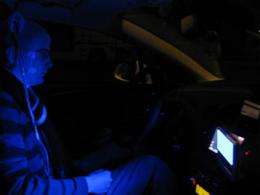
Interior of a vehicle showing the position and brightness of the light source. Credit: Sanpsy 2012 (CNRS/Université Bordeaux Segalen)

(Medical Xpress)—Researchers from the Université Bordeaux Segalen, France, and their Swedish colleagues have recently demonstrated that constant exposure to blue light is as effective as coffee at improving night drivers' alertness. Based on tests conducted in real driving conditions, the results have been published in the journal PLoS One. They could pave the way for the development of an electronic anti-sleep system to be built into vehicles. Before then, the scientists will be testing this equipment in a broader range of situations.

When driving at night, drowsiness brought about by reduces a driver's alertness, reflexes and . Sleepiness is responsible for one third of fatalities on motorways. Apart from taking a nap, which is often impractical, drinking coffee remains the best . However, this forces drivers to stop, which they often leave too late. For road safety purposes, it is therefore essential to develop an "embedded" anti-sleepiness device working continuously.

Blue light is known to increase alertness by stimulating : specialized present on the retina, a membrane located at the back of the eye. These cells are connected to the areas of the brain controlling alertness. Stimulating these cells with blue light stops the secretion of melatonin, the hormone that reduces alertness at night. The positive effect of blue light on night-time alertness has been known since 2005, notably through American research. But these previous studies only demonstrated this effect during simple , like pushing a button in response to a light stimulus. Driving is a much more complex task.
 
To study the efficiency of blue light during night driving, a special continuously emitting blue light was installed on the dashboard of an experimental vehicle. The researchers then asked 48 male volunteers (average age 33.2) to drive 400 km on a motorway. Each driver completed three night drives, spaced out by at least a week, between 1 a.m. and 5:15 a.m., with a 15-minute break halfway through the journey. During each of the three nights, the volunteers were either exposed to continuous blue light, or given two cups of coffee (one before departure and one during the break). These either contained 200 mg of caffeine or were decaffeinated, representing a placebo. It is worth noting that drivers' sleep was not affected following the journeys with exposure to blue light. The researchers then analyzed the number of times that a driver encroached on road markings (hard shoulder or centre line), reflecting a decrease in .

The results of this test showed that on average, the line was accidentally crossed 15 times by the drivers exposed to blue light, 13 times by those who had had coffee and 26 times by those who had had the placebo. Continuous exposure to blue light while driving therefore appears to be as efficient as coffee for fighting sleepiness at the wheel, as long as this light does not hinder the driver. In fact, eight of the 48 volunteers (17%) found that they were dazzled by the blue light and therefore could not do the test.

The researchers are now verifying these first results by making a test on a larger number of subjects, including women and the elderly. One of the applications could be the development of an embedded anti-sleepiness device in vehicles.

More information: In-Car Nocturnal Blue Light Exposure Improves Motorway Driving: A Randomized Controlled Trial. Jacques Taillard, Aurore Capelli, Patricia Sagaspe, Anna Anund, Torbjorn Akerstedt, Pierre Philip. PLoS One, 19 October 2012.

Journal reference: PLoS ONE search and more info website

Provided by CNRS search and more info website

5 /5 (3 votes)  

Rank 5 /5 (3 votes)
Relevant PhysicsForums posts

More news stories

Survey points out deficiencies in addictions training for medical residents

A 2012 survey of internal medicine residents at Massachusetts General Hospital (MGH) – one of the nation's leading teaching hospitals – found that more than half rated the training they had received in addiction and other ...

Other created 4 hours ago | popularity not rated yet | comments 0

Early use of tracheostomy for mechanically ventilated patients not associated with improved survival

For critically ill patients receiving mechanical ventilation, early tracheostomy (within the first 4 days after admission) was not associated with an improvement in the risk of death within 30 days compared to patients who ...

Other created May 21, 2013 | popularity not rated yet | comments 0

Decisions to forgo life support may depend heavily on the ICU where patients are treated

The decision to limit life support in patients in the intensive care unit (ICU) appears to be significantly influenced by physician practices and/or the culture of the hospital, suggests new findings from researchers at the ...

Other created May 21, 2013 | popularity not rated yet | comments 0

People on higher incomes are happier with new knees

Knee replacement surgery is a very common procedure. However, it does not always resolve function or pain in all the recipients of new knees. A study by Robert Barrack, MD and his colleagues from the Washington University ...

Other created May 21, 2013 | popularity not rated yet | comments 0

New search engine finds rare diagnoses

Doctors are trained to think "common disease" when they meet patients in their practices, and as they rarely or never meet a rare disease, it often takes many years to reach the right diagnosis. A new search tool called FindZebra ...

Other created May 21, 2013 | popularity not rated yet | comments 0


Slowing the aging process—only with antibiotics

Swiss scientists reveal the mechanism responsible for aging hidden deep within mitochondria—and dramatically slow it down in worms by administering antibiotics to the young.

Having both migraines, depression may mean smaller brain

(HealthDay)—Migraines and depression can each cause a great deal of suffering, but new research indicates the combination of the two may be linked to something else entirely—a smaller brain.

Brain can be trained in compassion, study shows

Until now, little was scientifically known about the human potential to cultivate compassion—the emotional state of caring for people who are suffering in a way that motivates altruistic behavior.

Researchers complete largest genetic sequencing study of human disease

Researchers from Queen Mary, University of London have led the largest sequencing study of human disease to date, investigating the genetic basis of six autoimmune diseases.

Calorie information in fast food restaurants used by 40 percent of 9-18 year olds when making food choices

A new study published online today (Thursday) in the Journal of Public Health has found that of young people who visited fast food or chain restaurants in the U.S. in 2010, girls and youth who were obese were more likely ...

Novel approach for influenza vaccination shows promise in early animal testing

A new approach for immunizing against influenza elicited a more potent immune response and broader protection than the currently licensed seasonal influenza vaccines when tested in mice and ferrets. The vaccine ...