Scores isolated after new Ebola outbreak in Uganda
November 15, 2012 by Rodney Muhumuza in Diseases, Conditions, Syndromes
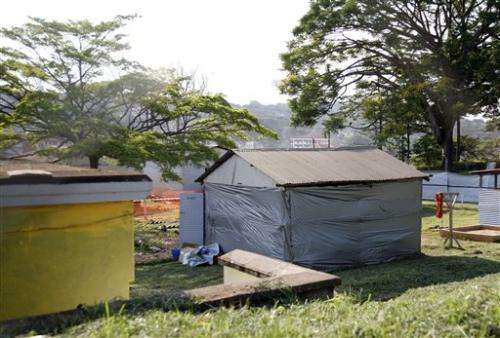
An isolation unit to care for impeding victims , Thursday, Nov. 15, 2012, at Nyimbwa Sub County Health Centre IV 60 kilometers (40 miles) from the Uganda capital Kampala. Scores of Ugandans were isolated on Thursday to prevent the spread of a new outbreak of Ebola which has already killed three people. Uganda has experienced increasingly regular outbreaks of deadly hemorrhagic fevers that have left health officials grappling for answers. (AP Photo/Rebecca Vassie)
(AP)—Scores of Ugandans were isolated on Thursday to prevent the spread of a new outbreak of Ebola which has already killed three people.
Uganda has experienced increasingly regular outbreaks of deadly hemorrhagic fevers that have left health officials grappling for answers.
The new Ebola outbreak was confirmed Wednesday in a district 60 kilometers (40 miles) from the Ugandan capital, Kampala. The outbreak comes roughly a month after Uganda declared itself Ebola-free following an earlier outbreak in a remote district of western Uganda. Last month at least five people in a southwestern district of Uganda were killed by Marburg, a hemorrhagic fever similar to Ebola.
The latest Ebola outbreak, officials say, is of the Sudan strain of Ebola and not linked to the previous one, of the Congo variety, which killed at least 16 villagers in July and August in the western district of Kibaale. In addition to the three dead in the latest outbreak, up to 15 are being monitored for signs of the disease, officials said. They advised against panic after it was revealed that two possible Ebola patients had since checked into Kampala's main referral hospital.
"The Ministry of Health once again calls upon the public to stay calm as all possible measures are being undertaken to control the situation," Christine Ondoa, Uganda's minister of health, said.
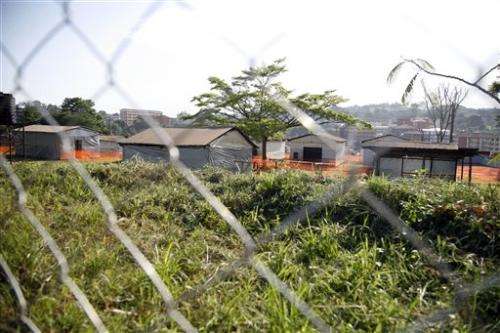
An isolation unit to care for impeding victims, Thursday, Nov. 15, 2012, at Nyimbwa Sub County Health Centre IV, 60 kilometers (40 miles) from the Uganda capital of Kampala. Scores of Ugandans were isolated on Thursday to prevent the spread of a new outbreak of Ebola which has already killed three people. Uganda has experienced increasingly regular outbreaks of deadly hemorrhagic fevers that have left health officials grappling for answers. (AP Photo/Rebecca Vassie)
Ebola is especially feared in Uganda, where multiple outbreaks have occurred over the years, and news of it can cause patients to flee hospitals to avoid infection. In 2000, in one of the world's worst Ebola outbreaks, the disease infected 425 Ugandans and killed more than half of them in the country's north. Another outbreak in 2007 killed 37 people in Bundibugyo, a remote district close to the Congolese border.Ebola is highly infectious and kills quickly.
Denis Lwamafa, the director-general of health services in Uganda's Ministry of Health, suggested that there were more reported cases of Ebola in Uganda than other countries because "our diagnostic capability" has increased. But a World Health Organization official in Kampala said there were progressively more cases of Ebola because of an increase in "the interaction between man and the forests."
Investigators believe the first victim of Ebola in any outbreak acquires the disease after coming into contact with a "reservoir," an infected animal that is often a monkey.
"Whenever there is contact between man and the reservoir of Ebola then you get the first case," said Miriam Nanyunja of the World Health Organization.
Ebola was first reported in 1976 in Congo and is named for the river where it was recognized. There is no cure or vaccine for it. Ebola is "characterized by fever, headache, joint and muscle aches, sore throat, and weakness, followed by diarrhea, vomiting, and stomach pain. A rash, red eyes, hiccups and internal and external bleeding may be seen in some patients," according to a factsheet by the U.S.-based Centers for Disease Control and Prevention.
The virus can be transmitted through direct contact with the blood or secretions of an infected person, or objects that have been contaminated with infected secretions. During communal funerals, for example, when the bereaved come into contact with an Ebola victim, the virus can be contracted, officials said, warning against unnecessary contact with suspected cases of Ebola.
Nanyunja of WHO said Ugandans near the Ebola epicenter should practice what she called "social distancing," avoiding things such as handshakes and similar contact.
Copyright 2012 The Associated Press. All rights reserved. This material may not be published, broadcast, rewritten or redistributed.
-
New Ebola outbreak in Uganda kills 2
Nov 14, 2012 |
not rated yet |
0
-
10 people die of suspected Ebola in Congo
Aug 22, 2012 |
not rated yet |
0
-
Two dead in new outbreak of Ebola in Uganda (Update)
Nov 15, 2012 |
not rated yet |
0
-
Officials: Ebola breaks out in Uganda
Jul 28, 2012 |
not rated yet |
0
-
Uganda Ebola outbreak over: government
Oct 04, 2012 |
not rated yet |
0
-
Motion perception revisited: High Phi effect challenges established motion perception assumptions
Apr 23, 2013 |
3 / 5 (2) |
2
-
Anything you can do I can do better: Neuromolecular foundations of the superiority illusion (Update)
Apr 02, 2013 |
4.5 / 5 (11) |
5
-
The visual system as economist: Neural resource allocation in visual adaptation
Mar 30, 2013 |
5 / 5 (2) |
9
-
Separate lives: Neuronal and organismal lifespans decoupled
Mar 27, 2013 |
4.9 / 5 (8) |
0
-
Sizing things up: The evolutionary neurobiology of scale invariance
Feb 28, 2013 |
4.8 / 5 (10) |
14
-
Classical and Quantum Mechanics via Lie algebras
Apr 15, 2011
- More from Physics Forums - Independent Research
More news stories
Study finds COPD is over-diagnosed among uninsured patients
More than 40 percent of patients being treated for COPD at a federally funded clinic did not have the disease, researchers found after evaluating the patients with spirometry, the diagnostic "gold standard" for chronic obstructive ...
Diseases, Conditions, Syndromes
23 minutes ago |
not rated yet |
0
Mysterious illness kills two in southeast Alabama
(AP)—Alabama health officials say a mysterious respiratory illness has left five people hospitalized and two dead in the southeastern part of the state.
Diseases, Conditions, Syndromes
2 hours ago |
not rated yet |
0
Researchers find genetic risk factor for pulmonary fibrosis
A paper recently published in the New England Journal of Medicine and co-written by physicians and scientists at the University of Colorado School of Medicine finds that an important genetic risk factor for pulmonary fibros ...
Diseases, Conditions, Syndromes
16 hours ago |
not rated yet |
0
Biomarkers discovered for inflammatory bowel disease
Using the Department of Defense Serum Repository (DoDSR), University of Cincinnati (UC) researchers have identified a number of biomarkers for inflammatory bowel disease (IBD), which could help with earlier diagnosis and ...
Diseases, Conditions, Syndromes
16 hours ago |
5 / 5 (1) |
0
CDC says high number of public pools contain microbes
(HealthDay)—Three-quarters of public schools in the metro Atlanta area contain microbes, including bacteria indicating the presence of fecal matter, according to research published in the May 17 issue of ...
Diseases, Conditions, Syndromes
17 hours ago |
not rated yet |
0
Alcohol sales fall due to ban on multi-buy promotions
(Medical Xpress)—A report published today shows a 2.6% decrease in the amount of alcohol sold per adult in Scotland in the year following the introduction of the Alcohol etc. (Scotland) Act in October 2011.
Facing the chill wind of blood pressure
(Medical Xpress)—High blood pressure is something that has traditionally been a problem in Scotland, but might there be a link to our climate?
US health care: Does more spending yield better health?
(Medical Xpress)—Health care spending is much higher for older Americans than for younger adults and children, on average, and analysts have said that increasing spending leads to longer life expectancy.
Study shows low rate of late lumen loss with bioresorbable DESolve device
The DESolve bioresorbable coronary scaffold system achieves good efficacy and safety with low rates of late lumen loss and major coronary adverse events at six months, show first results from the pivotal DESolve Nx trial ...
Registry questions superiority of bivalirudin over heparin
Results from a large observational study reported at EuroPCR 2013 today question whether bivalirudin is superior to heparin in the absence of GPIIb/IIIa blockade, showing similar 30-day mortality in patients with non-ST segment ...
New blood-thinner measures may cut medication errors
Blood thinners are the preferred treatment option to prevent heart attacks, blood clots and stroke, but they are not without risk, and not just because of their side effects. These high-risk drugs, known as anticoagulants, ...
