Recently discovered stem cell population could one day provide useful source material for kidney repair
November 7, 2012 in Medical research
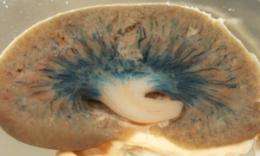
By the time kidney development is complete in mice, individual Lgr5+ve cells have developed into tubules (blue) that contribute to nephron formation. Credit: 2012 Elsevier
Within every human kidney, millions of filtration units known as nephrons are hard at work clearing metabolic waste products from the blood. Given the dirty work they perform, one might expect that the cells composing the nephrons undergo routine self-replacement, but nephrons retain very limited regenerative capabilities and essentially shut down when those limits are exceeded—a potential prelude to organ failure.
"Identification of stem cells in the kidney is of paramount importance if we are to better understand their contribution to kidney disease and harness their regenerative medicine potential," says Nick Barker of the A*STAR Institute of Medical Biology, Singapore. Barker's team has now made important progress towards this goal, identifying cells that appear to be critical progenitors for several structures within the mammalian nephron.
Previous studies have revealed the general cell pool from which these structures emerge, but not the specific cell subsets within that pool that directly contribute to nephron formation. Barker and colleagues were therefore interested in identifying specific proteins that might 'mark' such cells. Since his team had recently identified a gene called Lgr5 as a marker for key stem cell pools in several other major organ systems, they attempted to determine whether this same gene may also be relevant in the early stages of kidney formation.
Nephron development begins in the late stages in embryonic development and proceeds until shortly after birth. Barker and co-workers examined patterns of Lgr5 expression during that time-span in mice. This revealed the existence of a stem-like population of Lgr-positive (Lgr5+ve) epithelial cells localized within primitive nephron precursor structures. The researchers subsequently genetically engineered various strains of mice for a series of 'lineage tracing' experiments, wherein a cell's expression of a gene of interest, such as Lgr5, switches on an indicator gene that will also remain active in that cell's descendants, enabling generation of a visible cellular family tree.
These labeling studies allowed Barker and co-workers to monitor Lgr5+ve cells as they participated in the formation of nephron tubules during kidney development (see image). "We succeeded in demonstrating that these were indeed multipotent, self-renewing stem cells responsible for generating part of the nephron blood filtration unit," says Barker.
Barker is hopeful that these recently discovered stem cells might provide valuable seeds for kidney regeneration in the clinic. "We could try and grow new nephrons in the culture dish or expand these stem cells for use in transplantation into damaged kidneys," he says.
More information: Barker, N., Rookmaaker, M. B., Kujala, P., Ng, A., Leushacke, M., Snippert, H. et al. Lgr5+ve stem/progenitor cells contribute to nephron formation during kidney development. Cell Reports 2, 540–552 (2012). www.cell.com/cell-… 12%2900258-6
Journal reference:
Cell Reports
Provided by
Agency for Science, Technology and Research (A*STAR), Singapore
-
Key gene in kidney development found
Oct 10, 2006 |
not rated yet |
0
-
Attacking bowel cancer on two fronts
Mar 31, 2011 |
not rated yet |
0
-
Adult kidney stem cells found in fish
Jan 26, 2011 |
not rated yet |
0
-
Clues found to way embryonic kidney maintains its fleeting stem cells
Jun 11, 2012 |
not rated yet |
0
-
Kidney damage and high blood pressure
Sep 22, 2011 |
not rated yet |
0
-
Motion perception revisited: High Phi effect challenges established motion perception assumptions
Apr 23, 2013 |
3 / 5 (2) |
2
-
Anything you can do I can do better: Neuromolecular foundations of the superiority illusion (Update)
Apr 02, 2013 |
4.5 / 5 (11) |
5
-
The visual system as economist: Neural resource allocation in visual adaptation
Mar 30, 2013 |
5 / 5 (2) |
9
-
Separate lives: Neuronal and organismal lifespans decoupled
Mar 27, 2013 |
4.9 / 5 (8) |
0
-
Sizing things up: The evolutionary neurobiology of scale invariance
Feb 28, 2013 |
4.8 / 5 (10) |
14
-
Why is zone 1 in liver more prone to ischemic injury?
May 23, 2013
-
How can there be villous adenoma in colon, if there are no villi there
May 22, 2013
-
How can there be a term called "intestinal metaplasia" of stomach
May 21, 2013
-
Pressure-volume curve: Elastic Recoil Pressure don't make sense
May 18, 2013
-
If you became brain-dead, would you want them to pull the plug?
May 17, 2013
-
MRI bill question
May 15, 2013
- More from Physics Forums - Medical Sciences
More news stories
Study reveals new mechanism for estrogen suppression of liver lipid synthesis
By discovering the new mechanism by which estrogen suppresses lipid synthesis in the liver, UC Irvine endocrinologists have revealed a potential new approach toward treating certain liver diseases.
Medical research
May 23, 2013 |
5 / 5 (1) |
0
|
MRI-based measurement helps predict vascular disease in the brain
Aortic arch pulse wave velocity, a measure of arterial stiffness, is a strong independent predictor of disease of the vessels that supply blood to the brain, according to a new study published in the June issue the journal ...
Medical research
May 23, 2013 |
not rated yet |
0
Antibiotics: A new understanding of sulfonamide nervous system side effects
Since the discovery of Prontosil in 1932, sulfonamide antibiotics have been used to combat a wide spectrum of bacterial infections, from acne to chlamydia and pneumonia. However, their side effects can include serious neurological ...
Medical research
May 23, 2013 |
3 / 5 (1) |
0
|
Scientists discover molecule triggers sensation of itch
Scientists at the National Institutes of Health report they have discovered in mouse studies that a small molecule released in the spinal cord triggers a process that is later experienced in the brain as ...
Medical research
May 23, 2013 |
5 / 5 (3) |
0
|
Discarded immune cells induce the relocation of stem cells
Spanish researchers have discovered that the daily clearance of neutrophils from the body stimulates the release of hematopoietic stem cells from the bone marrow into the bloodstream, according to a report published today ...
Medical research
May 23, 2013 |
5 / 5 (2) |
0
First drug to improve heart failure mortality in over a decade
Coenzyme Q10 decreases all cause mortality by half, according to the results of a multicentre randomised double blind trial presented today at Heart Failure 2013 congress. It is the first drug to improve heart failure mortality ...
Hormone levels may provide key to understanding psychological disorders in women
Women at a particular stage in their monthly menstrual cycle may be more vulnerable to some of the psychological side-effects associated with stressful experiences, according to a study from UCL.
Heart failure accelerates male 'menopause'
Heart failure accelerates the aging process and brings on early andropausal syndrome (AS), according to research presented today at the Heart Failure Congress 2013. AS, also referred to as male 'menopause', was four times ...
Researchers identify first drug targets in childhood genetic tumor disorder
Two mutations central to the development of infantile myofibromatosis (IM)—a disorder characterized by multiple tumors involving the skin, bone, and soft tissue—may provide new therapeutic targets, according to researchers ...
Going live: Immune cell activation in multiple sclerosis
Biological processes are generally based on events at the molecular and cellular level. To understand what happens in the course of infections, diseases or normal bodily functions, scientists would need to ...
Feds fight morning-after pill age ruling in NY
(AP)—Department of Justice lawyers have again asked a federal appeals court in New York to delay lifting age restrictions and prescription requirements on an emergency contraceptive popularly known as the morning-after ...