94-year-old man among first to get implant restoring some vision lost to macular degeneration
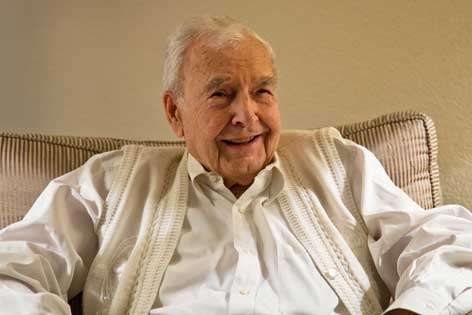
(Medical Xpress)—Ask most people to describe a telescope and they might imagine a large device in an observatory training its penetrating gaze into outer space.
Don Mason has one implanted in his right eye. He's among the first patients in the country to receive a pea-sized telescope designed to partially restore vision in those with age-related macular degeneration.
"Macular degeneration damages the retina and causes a blind spot in the center of a person's field of vision," says Dr. Sumit "Sam" Garg, medical director of UC Irvine's Gavin Herbert Eye Institute. "The implantable miniature telescope projects an image onto an undamaged portion of the retina, making it possible for patients to recognize faces, read and perform daily activities."
In May, he placed the 4-millimeter device in the 94-year-old Anaheim resident's right eye.
"Mr. Mason came to me with years of poor vision due to macular degeneration," Garg says. "He was interested in exploring options to improve his vision and quality of life, and when presented with this option, he was excited at the possibilities."
Mason had been a builder, traveling around the world as an operations manager based in Hong Kong and Australia before settling his family in Southern California. He worked into his late 80s, when heart trouble and macular degeneration slowed his active lifestyle. The condition had progressed to where Mason retained only peripheral vision in each eye.
The hourlong surgery involves a small incision in the patient's cornea, removing the eye's natural lens and replacing it with the telescope. The procedure does not require general anesthesia or an overnight hospital stay. Virtually unnoticeable to others, the telescope is implanted inside the eye and is mostly covered by the iris, the colored portion of the eye.
"I was a bit apprehensive before the operation," Mason says. "But there was no real pain; I would do it again."
After surgery, he worked with a vision specialist from the Southern California College of Optometry each week to train his eye and brain to integrate the partially restored central vision in his right eye with the peripheral vision in his left eye.
A lifelong baseball fan, Mason recalls the Angels' first games in 1961. Now, for the first time in years, he can again read the sports pages and watch games on TV.
"Before the operation, I was vaguely aware the TV was on," Mason says. "I feel that this has been a vast improvement." He's also looking forward to finishing his written family history.
Generally, Garg notes, the vision lost in advanced macular degeneration cannot be recovered. "The implantable telescope gives these patients a new option for treatment and, more importantly, the possibility of regaining useful vision," he says.
Garg and UC Irvine colleague Dr. Marjan Farid are the first in Orange County to place the miniature device in the eyes of patients with end-stage age-related macular degeneration, the leading cause of blindness among older Americans. In December 2011, Farid implanted the telescope in the left eye of an 85-year-old Irvine woman. This summer, she placed it in another patient.
UC Irvine's Gavin Herbert Eye Institute is the sole facility in Orange County and among only a few nationwide to offer this new technology.
Clinical trials have demonstrated that the implant increases people's independence by improving vision. It also fosters social interaction by making visible the facial expressions of family and friends.
"Until now, there has been no mechanism – surgical or medical – to restore that central sight," says Farid, UC Irvine's director of cornea, cataract and refractive surgery. "These patients are now experiencing a quality of life that they've not enjoyed in many years. My original patient is seeing her son's face for the first time in more than a decade."
The federal Food & Drug Administration approved the miniature telescope last year for use in patients with irreversible end-stage macular degeneration. At least 15 million Americans are affected by some form of the disease. The implant cost is covered by Medicare. The device is integral to CentraSight, a new patient care program developed by VisionCare Ophthalmic Technologies.


