Young brain develops activity peaks while it is still growing
November 7, 2012 in Neuroscience
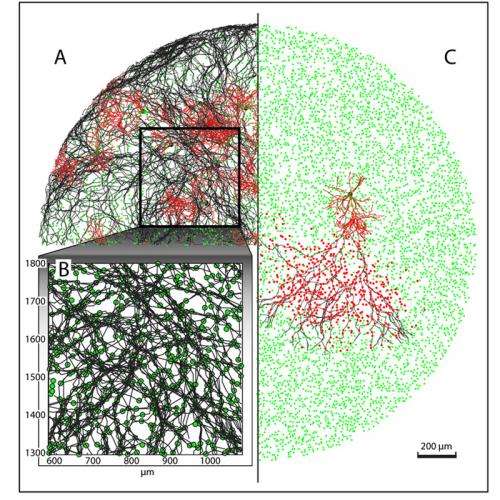
Image of simulated growth of a network out of 10,000 neurons.
After a short period of growth, cultured networks of neurons regularly exhibit major activity in the absence of external stimulation. These "bursts" are entirely related to growth. At this stage, they have little to do with learning behaviour, as the network is still too young to sustain a process of memory formation. This has now for the first time been simulated for networks ranging in size from 10,000 to 50,000 neurons. The simulations provide insight into the role of the growth process in initial activity. Researchers at the University of Twente's MIRA Institute recently published details of this work in PLOS ONE.
"Isolated" neurons, which have yet to form any interconnections, soon put out cell extensions (axons and dendrites) that connect them to other neurons. The resultant network starts to show signs of activity after just one week. The researchers made these observations in networks that they had cultured from neurons extracted from the brains of young rats. These cells were grown in culture dishes whose bases had been fitted with electrodes. Here, the network grows in a single plane, as far as possible. If it were to grow "upwards" (3D), it would be difficult to determine what was actually being measured. After a week, observations show that the neurons have become active and that they start to "fire". This activity can be seen to pass through the entire network in the form of a "burst".
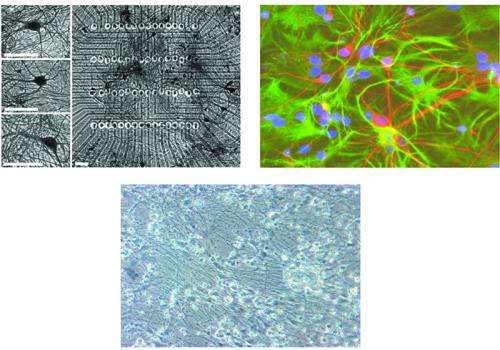
Images of cultured neurons on an array of electrodes.
The question was whether these bursts might be related to the development of a long-term memory, by a process of synapse strengthening. This process of memory formation begins to develop after three weeks. Now, for the first time, substantial computer capacity has been used to simulate larger networks (10,000-50,000 neurons). This showed that the bursts really do arise during the first few weeks of growth. The simulations reveal a correlation between the growth of the network and the occurrence of the first bursts, which is in line with the observations. The burst runs through the network like a wave, at enormous speed. As in the experiments, no external stimulation was applied to the network. However, the simulations do include certain types of neurons that act as "pacemakers" by initiating a process. This corresponds to what happens in reality.A realistic simulation model that simultaneously calculates both growth and activity provides a better picture of the workings of a "brain" of limited size. Bursts are the expression of coordinated action in networks. They are generally seen as building blocks of human brain function. If coordination between networks is disrupted, bursts can degenerate into total discharges of the type seen in brain abnormalities such as strokes or epileptic seizures. One particularly exciting research question being explored by Prof. Wim Rutten's group is whether artificially cultured brains could be linked to robots, for example, as they learn more efficiently than any existing algorithms. The use of reliable simulations will also help to reduce the number of experiments involving living neural networks.
More information: The article entitled "Growth dynamics explain the development of spatiotemporal burst activity of young cultured neuronal networks in detail" by Taras Gritsun, Joost le Feber and Wim Rutten, has been published in PLOS ONE, Volume 7, Issue 9.
Journal reference:
PLoS ONE
Provided by
University of Twente
-
How connections in the brain must change to form memories could help to develop artificial cognitive computers
Nov 07, 2012 |
not rated yet |
0
-
Persistent sync for neurons: Rats' neurons reveal steady neural network coordination
Nov 07, 2012 |
not rated yet |
0
-
Brain cell networks recreated with new view of activity behind memory formation
May 25, 2011 |
not rated yet |
0
-
Researchers connect neurons to computers to decipher the enigmatic code of neuronal circuits
Jul 12, 2011 |
not rated yet |
0
-
Suckling infants trigger surges of trust hormone in mothers' brains
Jul 18, 2008 |
not rated yet |
0
-
Motion perception revisited: High Phi effect challenges established motion perception assumptions
Apr 23, 2013 |
3 / 5 (2) |
2
-
Anything you can do I can do better: Neuromolecular foundations of the superiority illusion (Update)
Apr 02, 2013 |
4.5 / 5 (11) |
5
-
The visual system as economist: Neural resource allocation in visual adaptation
Mar 30, 2013 |
5 / 5 (2) |
9
-
Separate lives: Neuronal and organismal lifespans decoupled
Mar 27, 2013 |
4.9 / 5 (8) |
0
-
Sizing things up: The evolutionary neurobiology of scale invariance
Feb 28, 2013 |
4.8 / 5 (10) |
14
-
Pressure-volume curve: Elastic Recoil Pressure don't make sense
May 18, 2013
-
If you became brain-dead, would you want them to pull the plug?
May 17, 2013
-
MRI bill question
May 15, 2013
-
Ratio of Hydrogen of Oxygen in Dessicated Animal Protein
May 13, 2013
-
Alcohol and acetaminophen
May 13, 2013
-
Marie Curie's leukemia
May 13, 2013
- More from Physics Forums - Medical Sciences
More news stories
Researchers find far-reaching, microvascular damage in uninjured side of brain after stroke
While the effects of acute stroke have been widely studied, brain damage during the subacute phase of stroke has been a neglected area of research. Now, a new study by the University of South Florida reports that within a ...
Neuroscience
2 hours ago |
not rated yet |
0
|
Neurons that can multitask greatly enhance the brain's computational power, study finds
Over the past few decades, neuroscientists have made much progress in mapping the brain by deciphering the functions of individual neurons that perform very specific tasks, such as recognizing the location ...
Neuroscience
5 hours ago |
5 / 5 (5) |
0
|
For combat veterans suffering from post-traumatic stress disorder, 'fear circuitry' in the brain never rests
Chronic trauma can inflict lasting damage to brain regions associated with fear and anxiety. Previous imaging studies of people with post-traumatic stress disorder, or PTSD, have shown that these brain regions can over-or ...
Neuroscience
May 18, 2013 |
5 / 5 (1) |
0
|
Temporal processing in the olfactory system
The neural machinery underlying our olfactory sense continues to be an enigma for neuroscience. A recent review in Neuron seeks to expand traditional ideas about how neurons in the olfactory bulb might encode information about ...
Neuroscience
May 17, 2013 |
4 / 5 (1) |
0
|
Melon focus headband turns to Kickstarter for rollout plans
(Medical Xpress)—What if the quality of your work depends more on your focus on the piano keys or canvas or laptop than your musical or painting or computing skills? If target users can be convinced, they ...
Neuroscience
May 17, 2013 |
3.7 / 5 (3) |
0
|
Music therapy reduces anxiety, use of sedatives for patients receiving ventilator support
New research suggests that for some hospitalized ICU patients on mechanical ventilators, using headphones to listen to their favorite types of music could lower anxiety and reduce their need for sedative medications.
Tiny, implantable coil promises hope for emphysema patients
A small, easily implantable device called the Lung Volume Reduction Coil (LVRC) may play a key role in the treatment of two types of emphysema, according to a study conducted in Europe. Results of the study indicate the beneficial ...
Early IV nutrition for certain patients does improve survival or reduce ICU length of stay
The early (within 24 hours of intensive care unit [ICU] admission) provision of intravenous nutrition among critically ill patients with contraindications (a condition that makes a particular procedure potentially inadvisable) ...
Having a nighttime critical care physician in the ICU doesn't improve patient outcomes, research finds
With little evidence to guide them, many hospital intensive care units (ICUs) have been employing critical care physicians at night with the notion it would improve patients' outcomes. However, new results from a one-year ...
CT radiation risk less than risk of examination indicator
(HealthDay)—For young adults needing either a chest or abdominopelvic computed tomography (CT), the short-term risk of death from underlying morbidity is greater than the long-term risk of radiation-induced ...
Extra vitamin D may ease Crohn's symptoms, study finds
(HealthDay)—Vitamin D supplements may help those with Crohn's disease overcome the fatigue and decreased muscle strength associated with the inflammatory bowel disease, according to new research.

Nov 10, 2012
Rank: 3 / 5 (1)
All (living) cells grow.
'Coordination' implies an ability or the acquisition of this ability before the bursts.
Where and when is 'coordination' learned in the absent of external stimulus?
What determines the timing of the bursts?
I disagree.
You used the word 'coordination'. All coordination requires bookmarking location first.
'Bookmarking' of location is memory.
[q}"Isolated" neurons, which have yet to form any interconnections, soon put out cell extensions (axons and dendrites) that connect them to other neurons.
'put out extensions' is growth.
Does this qualify as 'burst activity' as well?
Nov 10, 2012
Rank: 3 / 5 (1)
Nov 11, 2012
Rank: not rated yet
Okay, these guys/researchers, have shown a bit of their logic and work..and their links, ok...where is your research? Your book? Please show proof, diagrams, pictures just as they have for your line of thinking...this is only fair and right.
word-to-ya-muthas
Nov 11, 2012
Rank: not rated yet
Their important observation is uncontested in neuroscience:
So what if they drew the false conclusion from this observation?
(That the activity has nothing to do with learning or memory.)
From my line of reasoning if you separate growth from memory at the very beginning of conception you will find re-introducing learning and memory at later point in time impossible and inconsistent.
The pathway for learning and memory:
"All this work fits well into the framework and provides a molecular explanation for how estrogen facilitates learning and memory," Baudry said. "We now know the cascade of events that takes place: estrogen to MAP kinase to calpain to actin polymerization to glutamate receptors."
Read more at: http://phys.org/n...75.html#
Nov 11, 2012
Rank: not rated yet
Estrogen > MAP kinase > calpain > actin polymerization > glutamate receptors
The components of that pathway are synonymous to regularly re-occurring MAJOR ACTIVITY, learning, memory AND growth WITHOUT external stimulus! And right there from the word 'go' (conception)
No need to reinvent the neuroscience wheel!!
Nov 11, 2012
Rank: not rated yet
The origin of human languages.
A direct link between the mechanical and biochemical processes.
All of Chomsky's approaches to any language is intractable.
Pinkerton is no better. Müll.