Novel antibodies for combating Alzheimer's and Parkinson's disease
December 3, 2012 in Neuroscience
Antibodies developed by researchers at Rensselaer Polytechnic Institute are unusually effective at preventing the formation of toxic protein particles linked to Alzheimer's disease and Parkinson's disease, as well as Type 2 diabetes, according to a new study. Credit: Rensselaer/Tessier
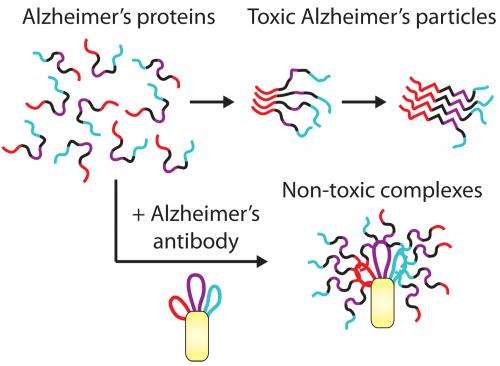
Antibodies developed by researchers at Rensselaer Polytechnic Institute are unusually effective at preventing the formation of toxic protein particles linked to Alzheimer's disease and Parkinson's disease, as well as Type 2 diabetes, according to a new study.
The onset of these devastating diseases is associated with the inappropriate clumping of proteins into particles that are harmful to cells in the brain (Alzheimer's disease and Parkinson's disease) and pancreas (Type 2 diabetes). Antibodies, which are commonly used by the immune system to target foreign invaders such as bacteria and viruses, are promising weapons for preventing the formation of toxic protein particles. A limitation of conventional antibodies, however, is that high concentrations are required to completely inhibit the formation of toxic protein particles in Alzheimer's, Parkinson's, and other disorders.
To address this limitation, a team of researchers led by Rensselaer Professor Peter Tessier has developed a new process for creating antibodies that potently inhibit formation of toxic protein particles. Conventional antibodies typically bind to one or two target proteins per antibody. Antibodies created using Tessier's method, however, bind to 10 proteins per antibody. The increased potency enables the novel antibodies to prevent the formation of toxic protein particles at unusually low concentrations. This is an important step toward creating new therapeutic molecules for preventing diseases such as Alzheimer's and Parkinson's.
"It is extremely difficult to get antibodies into the brain. Less than 5 percent of an injection of antibodies into a patient's blood stream will enter the brain. Therefore, we need to make antibodies as potent as possible so the small fraction that does enter the brain will completely prevent formation of toxic protein particles linked to Alzheimer's and Parkinson's disease," said Tessier, assistant professor in the Howard P. Isermann Department of Chemical and Biological Engineering at Rensselaer. "Our strategy for designing antibody inhibitors exploits the same molecular interactions that cause toxic particle formation, and the resulting antibodies are more potent inhibitors than antibodies generated by the immune system."
More information: Results of the new study, titled "Rational design of potent domain antibody inhibitors of amyloid fibril assembly," were published online last week by the journal Proceedings of the National Academy of Sciences (PNAS). The study may be viewed at: www.pnas.org/conte… 109.abstract
Journal reference:
Proceedings of the National Academy of Sciences
Provided by
Rensselaer Polytechnic Institute
-
Researchers design Alzheimer's antibodies
Dec 09, 2011 |
not rated yet |
0
-
New research works towards early diagnosis of Parkinson's disease
May 04, 2011 |
not rated yet |
0
-
Reversing cognitive deficits: Injectable antibody may attack source of problem
Oct 08, 2007 |
not rated yet |
0
-
Chemical probes beat antibodies at own game
Apr 26, 2007 |
not rated yet |
0
-
New approach to Alzheimer's therapy
Jul 30, 2010 |
not rated yet |
0
-
Motion perception revisited: High Phi effect challenges established motion perception assumptions
Apr 23, 2013 |
3 / 5 (2) |
2
-
Anything you can do I can do better: Neuromolecular foundations of the superiority illusion (Update)
Apr 02, 2013 |
4.5 / 5 (11) |
5
-
The visual system as economist: Neural resource allocation in visual adaptation
Mar 30, 2013 |
5 / 5 (2) |
9
-
Separate lives: Neuronal and organismal lifespans decoupled
Mar 27, 2013 |
4.9 / 5 (8) |
0
-
Sizing things up: The evolutionary neurobiology of scale invariance
Feb 28, 2013 |
4.8 / 5 (10) |
14
-
How can there be villous adenoma in colon, if there are no villi there
9 hours ago
-
How can there be a term called "intestinal metaplasia" of stomach
May 21, 2013
-
Pressure-volume curve: Elastic Recoil Pressure don't make sense
May 18, 2013
-
If you became brain-dead, would you want them to pull the plug?
May 17, 2013
-
MRI bill question
May 15, 2013
-
Ratio of Hydrogen of Oxygen in Dessicated Animal Protein
May 13, 2013
- More from Physics Forums - Medical Sciences
More news stories
Having both migraines, depression may mean smaller brain
(HealthDay)—Migraines and depression can each cause a great deal of suffering, but new research indicates the combination of the two may be linked to something else entirely—a smaller brain.
Neuroscience
56 minutes ago |
5 / 5 (1) |
0
|
Researchers analyse hunting behaviour of fish larvae in virtual reality
Moving objects attract greater attention – a fact exploited by video screens in public spaces and animated advertising banners on the Internet. For most animal species, moving objects also play a major ...
Neuroscience
3 hours ago |
not rated yet |
0
|
Signs of motor disorders can appear years before disease manifestation
It is known that signs of neurological disorders such as Alzheimer's and Huntington's disease can appear years before the disease becomes manifest; these signs take the form of subtle changes in the brain and behavior of ...
Neuroscience
3 hours ago |
not rated yet |
0
Taming suspect gene reverses schizophrenia-like abnormalities in mice
Scientists have reversed behavioral and brain abnormalities in adult mice that resemble some features of schizophrenia by restoring normal expression to a suspect gene that is over-expressed in humans with ...
Neuroscience
5 hours ago |
5 / 5 (1) |
0
|
Scientists uncover molecular roots of cocaine addiction in the brain
Researchers at Johns Hopkins have unraveled the molecular foundations of cocaine's effects on the brain, and identified a compound that blocks cravings for the drug in cocaine-addicted mice. The compound, already proven safe ...
Neuroscience
5 hours ago |
not rated yet |
0
|
Baby's life saved with groundbreaking 3-D printed device that restored his breathing
Every day, their baby stopped breathing, his collapsed bronchus blocking the crucial flow of air to his lungs. April and Bryan Gionfriddo watched helplessly, just praying that somehow the dire predictions weren't true.
'Boys will be boys' in US, but not in Asia
A new study shows there is a gender gap when it comes to behavior and self-control in American young children – one that does not appear to exist in children in Asia.
Swine flu pandemic of 2009 more deadly for younger adults, study finds
As the world prepares for what may be the next pandemic strain of influenza virus, in the H7N9 bird flu, a new UC Irvine study reveals that the 2009 H1N1 swine flu pandemic was deadliest for people under the age of 65, while ...
Canada lifts ban on gay men donating blood
Canadian health authorities lifted Wednesday what was effectively a ban on gay men giving blood, announcing new rules making men who have not had sex with men in the past five years eligible.
CT detects twice as many lung cancers as X-ray at initial screening exam
National Lung Screening Trial (NLST) investigators also conclude that the 20 percent reduction in lung cancer mortality with low-dose computed tomography (LDCT) versus chest X-ray (CXR) screening previously reported in the ...
More doctors, hospitals using electronic records
(AP)—The Obama administration says more doctors and hospitals are embracing technology as adoption of computerized medical records reaches a "tipping point" in America.
Dec 03, 2012
Rank: not rated yet
It seems like all the research into Alzheimer's, et al is driven by the desire to develop a treatment, as opposed to a cure, and the underlying conditions that give rise to the disease are still largely unknown.
but this lack doesn't stop billions of dollars being spent to develop a "bandaid" treatment...oh, no --far from it, as there is an almost inconceivably large amount of money to be made by the marketing of any such treatment-- even if it is only marginally effective and has a lousy safety profile.
The excuse for this putting the cart before the horse research strategy is that any help is better than none. Even if it bankrupts before it kills.