Researchers discover surprising complexities in the way the brain makes mental maps
December 5, 2012 in Neuroscience
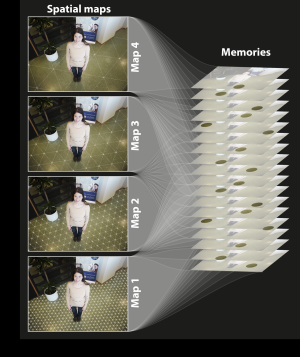
Spatial location is closely connected to the formation of new memories. Until now, grid cells were thought to be part of a single unified map system. New findings from the Norwegian University of Science and Technology demonstrate that the grid system is in fact composed of a number of independent grid maps, each with unique properties. Each map displays a particular resolution (mesh size), and responds independently to changes in the environment. A system of several distinct grid maps (illustrated on left) can support a large number of unique combinatorial codes used to associate new memories formed with specific spatial information (illustrated on right). The findings are published in the 6 December issue of the journal Nature and are a part of doctoral research conducted by Hanne Stensola (picture) and Tor Stensola at the Kavli Institute for Systems Neuroscience. Tor Stensola
Your brain has at least four different senses of location – and perhaps as many as 10. And each is different, according to new research from the Kavli Institute for Systems Neuroscience, at the Norwegian University of Science and Technology.
The findings, published in the 6 December 2012 issue of Nature, show that rather than just a single sense of location, the brain has a number of "modules" dedicated to self-location. Each module contains its own internal GPS-like mapping system that keeps track of movement, and has other characteristics that also distinguishes one from another.
"We have at least four senses of location," says Edvard Moser, director of the Kavli Institute. "Each has its own scale for representing the external environment, ranging from very fine to very coarse. The different modules react differently to changes in the environment. Some may scale the brain's inner map to the surroundings, others do not. And they operate independently of each other in several ways."
This is also the first time that researchers have been able to show that a part of the brain that does not directly respond to sensory input, called the association cortex, is organized into modules. The research was conducted using rats.
Technical breakthroughs
A rat's brain is the size of a grape, while the area that keeps track of the sense of location and memory is comparable in size to a small grape seed. This tiny area holds millions of nerve cells.
A research team of six people worked for more than four years to acquire extensive electrophysiological measurements in this seed-sized region of the brain. New measurement techniques and a technical breakthrough made it possible for Hanne Stensola and her colleagues to measure the activity in as many as 186 grid cells of the same rat brain. A grid cell is a specialized cell named for its characteristic of creating hexagonal grids in the brain's mental map of its surroundings.
"We knew that the 'grid maps' in this area of the brain had resolutions covering different scales, but we did not know how independent the scales were of each other," Stensola said. "We then discovered that the maps were organized in four to five modules with different scales, and that each of these modules reacted slightly differently to changes in their environment. This independence can be used by the brain to create new combinations - many combinations - which is a very useful tool for memory formation."
After analysing the activity of nearly 1000 grid cells, researchers were able to conclude that the brain has not just one way of making an internal map of its location, but several.
Perhaps 10 different senses of location
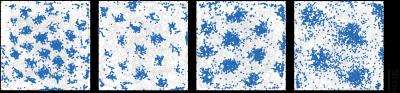
The entorhinal cortex is a part of the neocortex that represents space by way of brain cells that have GPS-like properties. Each cell describes the environment as a hexagonal grid mesh, earning them the name 'grid cells'. The panels show a bird's-eye view of a rat's recorded movements (grey trace) in a 2.2x2.2 m box. Each panel shows the activity of one grid cell (blue dots) with a particular map resolution as the animal moved through the environment. Credit: Kavli Institute for Systems Neuroscience, NTNU
Institute director Moser says that while researchers are able to state with confidence that there are at least four different location modules, and have seen clear evidence of a fifth, there may be as many as 10 different modules.He says, however, that researchers need to conduct more measurements before they will have covered the entire grid-cell area. "At this point we have measured less than half of the area," he says.
Aside from the time and challenges involved in making these kinds of measurements, there is another good reason why researchers have not yet completed this task. The lower region of the sense of location area, the entorhinal cortex, has a resolution that is so coarse or large that it is virtually impossible to measure it.
"The thinking is that the coordinate points for some of these maps are as much as ten metres apart," explains Moser. "To measure this we would need to have a lab that is quite a lot larger and we would need time to test activity over the entire area. We work with rats, which run around while we make measurements from their brain. Just think how long it would take to record the activity in a rat if it was running back and forth exploring every nook and cranny of a football field. So you can see that we have some challenges here in scaling up our experiments."
New way to organize
Part of what makes the discovery of the grid modules so special is that it completely changes our understanding of how the brain physically organizes abstract functions. Previously, researchers have shown that brain cells in sensory systems that are directly adjacent to each other tend to have the same response pattern. This is how they have been able to create detailed maps of which parts of the sensory brain do what.
The new research shows that a modular organization is also found in the highest parts of the cortex, far away from areas devoted to senses or motor outputs. But these maps are different in the sense that they overlap or infiltrate other. It is thus not possible to locate the different modules with a microscope, because the cells that work together are intermingled with other modules in the same area.
"The various components of the grid map are not organized side by side," explains Moser. "The various components overlap. This is the first time a brain function has been shown to be organized in this way at separate scales. We have uncovered a new way for neural network function to be distributed."
A map and a constant
The researchers were surprised, however, when they started calculating the difference between the scales. They may have discovered an ingenious mathematical coding system, along with a number, a constant. (Anyone who has read or seen "The Hitchhiker's Guide to the Galaxy" may enjoy this.) The scale for each sense of location is actually 42% larger than the previous one.
"We may not be able to say with certainty that we have found a mathematical constant for the way the brain calculates the scales for each sense of location, but it's very funny that we have to multiply each measurement by 1.42 to get the next one. That is approximately equal to the square root of the number two," says Moser.
Maps are genetically encoded
Moser thinks it is striking that the relationship between the various functional modules is so orderly. He believes this orderliness shows that the way the grid map is organized is genetically built in, and not primarily the result of experience and interaction with the environment.
So why has evolution equipped us with four or more senses of location?
Moser believes the ability to make a mental map of the environment arose very early in evolution. He explains that all species need to navigate, and that some types of memory may have arisen from brain systems that were actually developed for the brain's sense of location.
"We see that the grid cells that are in each of the modules send signals to the same cells in the hippocampus, which is a very important component of memory," explains Moser. "This is, in a way, the next step in the line of signals in the brain. In practice this means that the location cells send a different code into the hippocampus at the slightest change in the environment in the form of a new pattern of activity. So every tiny change results in a new combination of activity that can be used to encode a new memory, and, with input from the environment, becomes what we call memories.
Journal reference:
Nature
Provided by
Norwegian University of Science and Technology
-
'Teleportation' of rats sheds light on how the memory is organized
Sep 28, 2011 |
not rated yet |
0
-
The brain's zoom button: Study describes how the brain handles spatial resolution
Nov 17, 2011 |
not rated yet |
0
-
Better understanding of mapmaking in the brain
Aug 09, 2010 |
not rated yet |
0
-
Electrical oscillations critical for storing spatial memories in brain: study
Apr 28, 2011 |
not rated yet |
0
-
The human brain uses a grid to represent space
Jan 20, 2010 |
not rated yet |
0
-
Motion perception revisited: High Phi effect challenges established motion perception assumptions
Apr 23, 2013 |
3 / 5 (2) |
2
-
Anything you can do I can do better: Neuromolecular foundations of the superiority illusion (Update)
Apr 02, 2013 |
4.5 / 5 (11) |
5
-
The visual system as economist: Neural resource allocation in visual adaptation
Mar 30, 2013 |
5 / 5 (2) |
9
-
Separate lives: Neuronal and organismal lifespans decoupled
Mar 27, 2013 |
4.9 / 5 (8) |
0
-
Sizing things up: The evolutionary neurobiology of scale invariance
Feb 28, 2013 |
4.8 / 5 (10) |
14
-
How can there be a term called "intestinal metaplasia" of stomach
22 hours ago
-
Pressure-volume curve: Elastic Recoil Pressure don't make sense
May 18, 2013
-
If you became brain-dead, would you want them to pull the plug?
May 17, 2013
-
MRI bill question
May 15, 2013
-
Ratio of Hydrogen of Oxygen in Dessicated Animal Protein
May 13, 2013
-
Alcohol and acetaminophen
May 13, 2013
- More from Physics Forums - Medical Sciences
More news stories
Reducing caloric intake delays nerve cell loss
Activating an enzyme known to play a role in the anti-aging benefits of calorie restriction delays the loss of brain cells and preserves cognitive function in mice, according to a study published in the May ...
Neuroscience
12 hours ago |
5 / 5 (4) |
0
|
B vitamins could delay dementia
(Medical Xpress)—Despite spending billions of dollars on research and development, drug companies have been unable to come up with effective treatments for dementia and Alzheimer's Disease (AD). Now, A. ...
Neuroscience
16 hours ago |
4.9 / 5 (14) |
0
|
Waiting for a sign? Researchers find potential brain 'switch' for new behavior
You're standing near an airport luggage carousel and your bag emerges on the conveyor belt, prompting you to spring into action. How does your brain make the shift from passively waiting to taking action when ...
Neuroscience
16 hours ago |
5 / 5 (1) |
0
|
If you can remember it, you can remember it wrong
(Medical Xpress)—Native peoples in regions where cameras are uncommon sometimes react with caution when their picture is taken. The fear that something must have been stolen from them to create the photo ...
Neuroscience
18 hours ago |
4.2 / 5 (5) |
0
|
Study shows where scene context happens in our brain
In a remote fishing community in Venezuela, a lone fisherman sits on a cliff overlooking the southern Caribbean Sea. This man –– the lookout –– is responsible for directing his comrades on the water, ...
Neuroscience
20 hours ago |
4 / 5 (1) |
0
|
Study says empathy plays a key role in moral judgments
Is it permissible to harm one to save many? Those who tend to say "yes" when faced with this classic dilemma are likely to be deficient in a specific kind of empathy, according to a report published in the scientific journal ...
Phthalates: Study links chemicals widely found in plastics, processed food to elevated blood pressure in children, teens
Plastic additives known as phthalates (pronounced THAL-ates) are odorless, colorless and just about everywhere: They turn up in flooring, plastic cups, beach balls, plastic wrap, intravenous tubing and—according to the ...
Insight into the dazzling impact of insulin in cells
Australian scientists have charted the path of insulin action in cells in precise detail like never before. This provides a comprehensive blueprint for understanding what goes wrong in diabetes.
New sleeping pill poised to hit US markets
An experimental sleeping pill from US drug company Merck is effective at helping people fall and stay asleep, according to reviewers at the US Food and Drug Administration, which could soon approve the new drug.
Antidepressant reduces stress-induced heart condition
A drug commonly used to treat depression and anxiety may improve a stress-related heart condition in people with stable coronary heart disease, according to researchers at Duke Medicine.
Drugs found to both prevent and treat Alzheimer's disease in mice
Researchers at USC have found that a class of pharmaceuticals can both prevent and treat Alzheimer's Disease in mice.
Dec 05, 2012
Rank: 1.8 / 5 (5)
Dec 05, 2012
Rank: not rated yet
Kudos. Ignore the provocation. The obfuscation.
Yes. Lateralization of function retold/remolded.
Congratulations to all - Hanne Stensola and her colleagues.
Dec 05, 2012
Rank: not rated yet
http://en.wikiped...r_system
Isn't evolution just amazing? So complex, and yet so totally by chance. - 9 (-mal falsch)
Dec 05, 2012
Rank: 5 / 5 (1)
Dec 06, 2012
Rank: not rated yet
Obviously the figure 1.42 is incidental, and as Moser notes it's rather indicative of an underlying function depending on the square root of two. The scaling constant i expected was dependent on factors of two, which i thought would be optimal for delineating information into discrete bandwidths, so now i'm flummoxed...
The reason for the discrepancy seems to be that i expected the base 'cell' size to be that of single nodes, with the size ratios for each larger grid converging towards 2:1, rather than a constant multiplier.
Whence this sqrt2?
Dec 06, 2012
Rank: not rated yet
That includes all of your comments.
Try another language. Are you multilingual?
Dec 06, 2012
Rank: not rated yet
The randomness or not of non-linear systems does not invalidate the statement that "evolution [is] just amazing? So complex, and yet so totally by chance."
Also, another point is that until we can examine the universe with much greater precision and resolution we don't know whether or how linear systems, or any systems, themselves 'evolve' or emerge statistically from randomness. Indeed it is possible that as we are part of such systems ourselves we can never know. However this is a whole different debate. Information and entropy are themselves amazing and complex anyway...
Dec 06, 2012
Rank: not rated yet
There is no "or not".
Non-linear systems are not random. Period.
The rest of your comment is philosophy of self. We=you.
Dec 08, 2012
Rank: 4 / 5 (1)
These can be regarded as different scales within the matrix. However, the size ratios between successively larger scales is not constant, rather, it converges. So the scale difference between the smallest and next-largest might be 136%, then 148%, 154% etc.
So to have a constant scaling is unexpected; It doesn't follow from simple cellular geometry.
In trying to think of a reason for the anomaly, the lead researcher notes that the value of the 142% constant measured is close to the square root of 2.
Thus raising the question: what processing function might cause or depend on that operation?
Dec 08, 2012
Rank: not rated yet
A grid itself represents no information - the information would be deviations from the peak efficiency configuration; in other words the grid represents minimal entropy and the information that binds to it increases its entropy.
If the scaling function of such overlaid grids were purely geometrical, larger grids would also contain the information held in the smaller ones they're composed of.
By organising grids at each scale independently of others, their information can be discrete from that of other scales without overlap or interference.
1.42x is therefore likely to represent the most efficient 'stacking geometry' for optimising the information density.
This much seems obvious. The question is; from what physical constraints does this scaling constant emerge? What underlying principle does it follow from?
Dec 09, 2012
Rank: not rated yet
Here the sense of location is the sense of touch.
The authors have asserted (at least) four senses of location.
The article states:"Perhaps 10 different senses of location".
You can not live without touch.
You can live without vision, hearing, speech, taste and smell.
Whatever environment the skin's sense of touch and location represent, you can be sure that this representation of 'external' environment is one of the first that must exist to ensure life.
@Vib
I can not offer any comment to your comment because I do not understand what you write.
If you can make a distinction between what information means when transferred and what information means when transmitted you will have an insight that I found was helpful in understanding what the brain does.
Dec 09, 2012
Rank: not rated yet
The emphasis is no longer on lateralization of function.
This "new way to organize" resolves all forms of synesthesia.
Dec 09, 2012
Rank: not rated yet
Klaman filter and the sections;
'applications', 'see also', 'references','further reading' and 'external links'.
Dec 13, 2012
Rank: not rated yet
No, you did not:
Without your/a model you anticipated nothing much less predication.
Dec 19, 2012
Rank: not rated yet
FYI i've been interested in hexagonal matrices wrt cognitive function for decades, as a cursory browse of my posting history will attest. They're interesting because they're a ubiquitous emergent feature across a diverse range of nuclei, both in primary and higher processing tasks, hence my observations above...
Dec 30, 2012
Rank: not rated yet
Word for word I stated the exact same thing here on physorg before they published.
http://medicalxpr...lls.html
I don't mind them quoting me verbatim. Their approach is NOT novel. We started with the EXACT same approach and they got it wrong.
So now I have to do a follow up on 'THEIR' work! I am just simply amazed, stunned, and in awe - point people in the right direction and they still wonder off
Dec 30, 2012
Rank: not rated yet