'Junk DNA' drives embryonic development
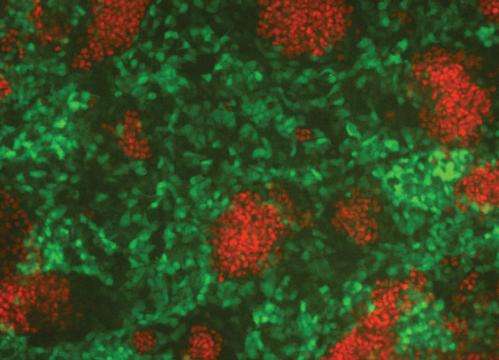
These are differentiating mouse embryonic stem cells (green = mesoderm progenitor cells, red = endoderm progenitor cells). The microRNAs identified in this study block endoderm formation, while enhancing mesoderm formation. Credit: Sanford-Burnham Medical Research Institute
An embryo is an amazing thing. From just one initial cell, an entire living, breathing body emerges, full of working cells and organs. It comes as no surprise that embryonic development is a very carefully orchestrated process—everything has to fall into the right place at the right time. Developmental and cell biologists study this very thing, unraveling the molecular cues that determine how we become human.
"One of the first, and arguably most important, steps in development is the allocation of cells into three germ layers—ectoderm, mesoderm, and endoderm—that give rise to all tissues and organs in the body," explains Mark Mercola, Ph.D., professor and director of Sanford-Burnham's Muscle Development and Regeneration Program in the Sanford Children's Health Research Center.
In a study published in the journal Genes & Development, Mercola and his team, including postdoctoral researcher Alexandre Colas, Ph.D., and Wesley McKeithan, discovered that microRNAs play an important role in this cell- and germ layer-directing process during development.
MicroRNA: one man's junk is another's treasure
MicroRNAs are small pieces of genetic material similar to the messenger RNA that carries protein-encoding recipes from a cell's genome out to the protein-building machinery in the cytoplasm. Only microRNAs don't encode proteins. So, for many years, scientists dismissed the regions of the genome that encode these small, non-protein coding RNAs as "junk."
We now know that microRNAs are far from junk. They may not encode their own proteins, but they do bind messenger RNA, preventing their encoded proteins from being constructed. In this way, microRNAs play important roles in determining which proteins are produced (or not produced) at a given time.
MicroRNAs are increasingly recognized as an important part of both normal cellular function and the development of human disease.
So, why not embryonic development, too?
Directing cellular traffic
To pinpoint which—if any—microRNAs influence germ layer formation in early embryonic development, Mercola and his team individually studied most (about 900) of the microRNAs from the human genome. They tested each microRNA's ability to direct formation of mesoderm and endoderm from embryonic stem cells. In doing so, they discovered that two microRNA families—called let-7 and miR-18—block endoderm formation, while enhancing mesoderm and ectoderm formation.
The researchers confirmed their finding by artificially blocking let-7 function and checking to see what happened. That move dramatically altered embryonic cell fate, diverting would-be mesoderm and ectoderm into endoderm and underscoring the microRNA's crucial role in development.
But they still wanted to know more…how do let-7 and miR-18 work? Mercola's team went on to determine that these microRNAs direct mesoderm and ectoderm formation by dampening the TGFβ signaling pathway. TGFβ is a molecule that influences many cellular behaviors, including proliferation and differentiation. When these microRNAs tinker with TGFβ activity, they send cells on a certain course—some go on to become bone, others brain.
"We've now shown that microRNAs are powerful regulators of embryonic cell fate," Mercola says. "But our study also demonstrates that screening techniques, combined with systems biology, provide a paradigm for whole-genome screening and its use in identifying molecular signals that control complex biological processes."
More information: Colas AR, McKeithan WL, Cunningham TJ, Bushway PJ, Garmire LX, Duester G, Subramaniam S, & Mercola M (2012). Whole-genome microRNA screening identifies let-7 and mir-18 as regulators of germ layer formation during early embryogenesis. Genes & development PMID: 23152446
Journal reference:
Genes & Development
Provided by
Sanford-Burnham Medical Research Institute
-
Scientists identify role of tiny RNAs in controlling stem cell fate
Mar 05, 2008 |
not rated yet |
0
-
Putting microRNAs on the stem cell map
Aug 07, 2008 |
not rated yet |
0
-
Mechanism of microRNAs deciphered
May 16, 2007 |
not rated yet |
0
-
Scientists identify genes involved in embryonic heart development
Apr 18, 2011 |
not rated yet |
0
-
Renegade RNA -- Clues to cancer and normal growth
Jan 04, 2007 |
not rated yet |
0
-
Motion perception revisited: High Phi effect challenges established motion perception assumptions
Apr 23, 2013 |
3 / 5 (2) |
2
-
Anything you can do I can do better: Neuromolecular foundations of the superiority illusion (Update)
Apr 02, 2013 |
4.5 / 5 (11) |
5
-
The visual system as economist: Neural resource allocation in visual adaptation
Mar 30, 2013 |
5 / 5 (2) |
9
-
Separate lives: Neuronal and organismal lifespans decoupled
Mar 27, 2013 |
4.9 / 5 (8) |
0
-
Sizing things up: The evolutionary neurobiology of scale invariance
Feb 28, 2013 |
4.8 / 5 (10) |
14
-
Classical and Quantum Mechanics via Lie algebras
Apr 15, 2011
- More from Physics Forums - Independent Research
More news stories
Researchers develop model for better testing, targeting of malignant peripheral nerve sheath tumors
University of Minnesota Medical School researchers from the Masonic Cancer Center, University of Minnesota, in partnership with the University's Brain Tumor Program, have developed a new mouse model of malignant peripheral ...
Genetics
17 seconds ago |
not rated yet |
0
|
Researchers identify new circadian clock component
Northwestern University scientists have shown a gene involved in neurodegenerative disease also plays a critical role in the proper function of the circadian clock.
Genetics
May 16, 2013 |
3 / 5 (1) |
1
|
Returning genetic incidental findings without patient consent violates basic rights, experts say
Informed consent is the backbone of patient care. Genetic testing has long required patient consent and patients have had a "right not to know" the results. However, as 21st century medicine now begins to use the tools of ...
Genetics
May 16, 2013 |
5 / 5 (1) |
3
|
Ethicists provide framework supporting new recommendations on reporting incidental findings in gene sequencing
In a paper published in Science Express, a group of experts led by bioethicists in the Center for Medical Ethics and Health Policy at Baylor College of Medicine provide a framework for the new American College of Medical Geneti ...
Genetics
May 16, 2013 |
not rated yet |
0
Experts urge caution over use of new genetic sequencing techniques
The use of genome-wide analysis (GWA), where the entirety of an individual's DNA is examined to look for the genomic mutations or variants which can cause health problems is a massively useful technology for diagnosing disease. ...
Genetics
May 16, 2013 |
not rated yet |
0
Practice makes perfect? Not so much
Turns out, that old "practice makes perfect" adage may be overblown. New research led by Michigan State University's Zach Hambrick finds that a copious amount of practice is not enough to explain why people ...
The compound in the Mediterranean diet that makes cancer cells 'mortal'
New research suggests that a compound abundant in the Mediterranean diet takes away cancer cells' "superpower" to escape death. By altering a very specific step in gene regulation, this compound essentially re-educates cancer ...
Study suggests new source of kidneys for transplant
Nearly 20 percent of kidneys that are recovered from deceased donors in the U.S. are refused for transplant due to factors ranging from scarring in small blood vessels of the kidney's filtering units to the organ going too ...
Study shows how bilinguals switch between languages
(Medical Xpress)—Individuals who learn two languages at an early age seem to switch back and forth between separate "sound systems" for each language, according to new research conducted at the University of Arizona.
Do salamanders hold the solution to regeneration?
Salamanders' immune systems are key to their remarkable ability to regrow limbs, and could also underpin their ability to regenerate spinal cords, brain tissue and even parts of their hearts, scientists have ...
Scientists identify molecular trigger for Alzheimer's disease
Researchers have pinpointed a catalytic trigger for the onset of Alzheimer's disease – when the fundamental structure of a protein molecule changes to cause a chain reaction that leads to the death of neurons ...
Dec 03, 2012
Rank: 1.8 / 5 (5)
Dec 03, 2012
Rank: 1.7 / 5 (6)
The structures of life are produced in a specific order, showing forward planning at every stage of the development, which means there is no junk, and clearly means it was intelligently designed at some stage of existence.
The fact some scientist is only just now figuring this out is just proof that previous "scientists" did not do due diligence, and were far too eager to accept the "life exists by accident and junk DNA proves it" lie that they fed one another for years.
Junk DNA believing atheists can spout their vitriol at "creationists," but it is the "junk DNA" believing evolutionists, and especially the hard atheist evolutionists, who now look like complete fools; as if we didn't already know that ahead of time.
Dec 04, 2012
Rank: 3 / 5 (2)
Based on what's currently known, I presented an updated model of that last month: http://f1000.com/.../1092760
This model of systems biology represents the conservation of bottom-up organization and top-down activation via:
1.Nutrient-dependent stress-induced and social stress-induced intracellular changes in the homeostatic balance of microRNA(miRNA) and messenger RNA (mRNA);
2.Intermolecular changes in DNA (genes);
3.Non-random experience-dependent stochastic variations in de novo gene expression for odor receptors;
4.The required gene-cell-tissue-organ-organ system pathway that links sensory input directly to gene activation in neurosecretory cells of the brain;
5.The required reciprocity that links gene expression to behavior that alters gene expression (i.e., from genes to behavior and back).
The only good reason to believe is evidence!
Dec 04, 2012
Rank: 1 / 5 (1)
Dec 04, 2012
Rank: 3 / 5 (2)
Dec 04, 2012
Rank: 5 / 5 (1)
We use this thing called evidence. Even if Junk DNA isnt Junk, this doesnt change the fact that thousands of species have been genetically identified and they fit perfectly on evolutionary/phylogenetic trees in terms of conserved genes and when genes develop and changed etc, within predictable and known timescales, with not a single anomolous result throwing everything out of whack.
Also, the term "Junk DNA" was not popularised by most scientists, its term was coined due to the fact we didn't know its exact workings and didnt directly make proteins. Most scientists agreed it probably does have a role, but as yet unknown.
Dec 04, 2012
Rank: 1.7 / 5 (6)
Dec 04, 2012
Rank: 5 / 5 (2)
This is at best pathetic, at worst, extremely ignorant. You're doing EXACTLY what those "atheistic scientists" APPARENTLY do. Get one or two bits of evidence and claim unknown things to be true (in your case, design and creation).
Hypocritical much?
Also no, most "atheistic scientists" did not state Junk DNA is definitely Junk DNA. Any decent scientist will say "more research is required" for any unknowns. You get the occasional few crazy ones, but they're few and far between. This one tiny development into genetics does not remove the fact that masses of genetic data still comply perfectly with evolution and a bottom up natural selection approach, not a top down designer approach.
Dec 04, 2012
Rank: 5 / 5 (1)
Dec 04, 2012
Rank: 2.3 / 5 (3)
Dec 05, 2012
Rank: 5 / 5 (1)
Dec 05, 2012
Rank: not rated yet
"...dampening the TGFβ signaling pathway" from the random process you referenced results in chaos not order.
There is no regulation model for the binding. A non random model of regulated binding aligns more readily with the processes already uncovered.
Dec 05, 2012
Rank: 1.8 / 5 (5)
"Random mutations in Biology however, are for all intents and purposes-random."
I understand your point of view but differ diametrically from it. To me, the "noise" of random quantum fluctuations that then cause "random" mutation resulting in e.g. teratogenic and autoimmune phenomena, are not random at all. I also understand that this orientation cannot be empirically proven - it is a matter of intuitive, philosophical inclination but - does have evidence when a vastly bigger picture is addressed - e.g. morphogenetic fields (Weiss, Speman, etc.); phantom DNA effect; epigenetic mRNA optimisation of allelic switching; paraphysical phenomena such as NDE and OBE (van Lommel study); and more. I feel that the randomicity perspective is generated by an overwhelming many-to-one ratio between quantal entities and observer making it look "random" where such dynamics could also be explained as quantisations of consciousness from a singular collective - experimenting with potential..
Dec 05, 2012
Rank: 2.3 / 5 (3)
I thought that was obvious. Bottom-up receptor-mediated stochastic gene expression driven by nutrient chemicals is simultaneously controlled by top-down receptor mediated pheromone-controlled stochastic gene expression, which makes the gene to behavior and back (e.g., to receptor-mediated behavior) non-random. It would be great if triplehelix attempted to answer my question about how random mutations could cause adaptive evolution of the gene to behavior and back model I have detailed.
Random or not, I don't see how natural selection guarantees survival of mutations; most are deleterious as everyone else seems to know.
Dec 06, 2012
Rank: 5 / 5 (1)
Try rewording your thoughts.
A stochastic process is a random process.
I suggested otherwise.
You think that is obvious.
And then dismiss both processes with "Random or not", and assume the knowledge everyone else knows with an change in topic issue.
You make no sense. You never have.
Dec 06, 2012
Rank: 1 / 5 (2)
If you cannot understand representations drawn from award-winning publications, simply admit the problem is your ignorance, not my inability to make sense of non-random stochastic gene expression in the context of adaptive evolution. http://f1000.com/.../1092760
Dec 06, 2012
Rank: 5 / 5 (1)
Your constant use of not only this but other meaningless expressions will increase your inability to make sense of anything.
You need only to post. Until the only reply from others is indifference - a response worthy of the nonsense you post.
Dec 06, 2012
Rank: 1 / 5 (2)
Only a moron would ignore my publication history and the ENCODE project data. But, here you are, again! You have built a straw man argument outside the context of the gene expression that drives embryonic development by taking "...non-random stochastic..." outside the context of systems biology and the requirement for non-random stochastic gene expression. Stochastic gene expression that is altered from the bottom up by the epigenetic effects of nutrient chemicals and altered from the top down by pheromones is not random (It's calibrated, standardized, and controlled). That makes it non-random stochastic gene expression whether or not you are intelligent enough to realize it.
Dec 06, 2012
Rank: 5 / 5 (1)
Dec 06, 2012
Rank: 1 / 5 (2)
Indifference is difficult to distinguish from ignorance in your case.
"Systems biology meets epigenetics: A computational model explains epigenome dynamics during differentiation." December 4th, 2012.
http://phys.org/n...ion.html
Dec 08, 2012
Rank: 1 / 5 (2)