See-through 'MitoFish' opens a new window on brain diseases
December 5, 2012 in Neuroscience
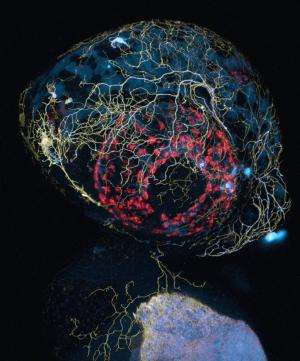
This is a confocal image of a zebrafish head showing labeling of sensory axon membranes (yellow), mitochondria (cyan), and autofluorescence (red). Credit: Image: Leanne Godinho and Thomas Misgeld, TU Muenchen
German scientists have demonstrated a new way to investigate mechanisms at work in Alzheimer's and other neurodegenerative diseases, which also could prove useful in the search for effective drugs. For new insights, they turned to the zebrafish, which is transparent in the early stages of its life. The researchers developed a transgenic variety, the "MitoFish," that enables them to see – within individual neurons of living animals – how brain diseases disturb the transport of mitochondria, the power plants of the cell.
Neurodegenerative diseases such as Alzheimer's, Parkinson's, ALS (amyotrophic lateral sclerosis), and MS (multiple sclerosis) are quite different in their effects on patients' cognitive and motor functions, behavior, and prognosis. Yet on the level of individual neurons, common mechanisms can be observed that either cause or accompany nerve degeneration in a number of different diseases. One of these is a disturbance in the transport of mitochondria, organelles that play several vital roles in the life of a cell—above all, delivering energy where it is needed. And in a neuron, an extremely power-hungry cell, that means moving mitochondria all the way down its longest extension, the axon. Studying mitochondria transport in other animal models of neurodegenerative disease, particularly in mice, has been revealing. But the MitoFish model opens up new possibilities.
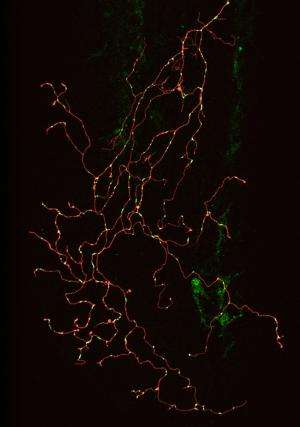
This is a confocal image of a single zebrafish sensory neuron with labeled membrane (red) and mitochondria (green). Credit: Image: Gabriela Plucinska, TU Muenchen
The new model was jointly developed in the labs of Prof. Thomas Misgeld of the Technische Universität München (TUM) and Dr. Bettina Schmid, a senior scientist of the German Center for Neurodegenerative Diseases (DZNE) based at the institute of LMU Prof. Christian Haass. "This collaboration has provided a system," Misgeld says, "with which we can try to understand the traffic rules or the life cycle of a given organelle, in this case mitochondria, in the context of a nerve cell that's existing in its physiological environment, where it is developing and changing. Most of these things we don't understand well enough to model them in another setting, so we have the organism do it for us."The MitoFish is both readily manipulated, enabling researchers to pose specific questions, and literally transparent—allowing non-invasive in vivo observation of changes relevant to disease processes. It is possible to image a whole, living neuron over time and to follow the movements of mitochondria within it. "The zebrafish is an established genetic model," Schmid explains, "which means you can bring foreign genes or certain proteins into a fish to test hypotheses about basic biology, disease mechanisms, or potential therapies. And because the early embryo is transparent, you can label specific nerve cells with a fluorescent protein and then look at them in an intact, living animal."
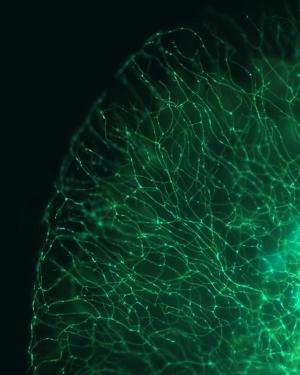
This is a wide-field image of a zebrafish tail showing labeling of sensory axon membranes (green) and mitochondria (cyan). Credit: Image: Dominik Paquet, LMU Munich
The researchers stress that this new window into the neurodegenerative diseases could not have been opened without combining complementary expertise: from Misgeld's lab, imaging and analysis focused on organelle dynamics; and from Schmid's lab, development of transgenic zebrafish models that are stable enough for long-term study. The first authors of the team's report in the Journal of Neuroscience are Gabriela Plucinska (TUM) and Dominik Paquet (DZNE). The collaboration leaders are linked through participation in the newly established Excellence Cluster SyNergy (Munich Cluster for Systems Neurology), as well as in the DZNE and the Excellence Cluster CIPSM."Just talking to each other," Misgeld recalls, "we realized that this would be a perfect match—that she would have situations in which the kind of trafficking question I wanted to look at could be of high relevance, and that she had all the tools we would need to carry this forward."
The driving force, they emphasize, is to understand more about Alzheimer's and other brain diseases to help steer the search for therapies in the right direction. "We need to understand how the machine works before we can operate it," Schmid says, "and modern biology is so technically advanced that no lab can be cutting-edge across the whole range of needed expertise."
More information: Gabriela Plucińska, Dominik Paquet, Alexander Hruscha, Leanne Godinho, Christian Haass, Bettina Schmid, and Thomas Misgeld. In Vivo Imaging of Disease-Related Mitochondrial Dynamics in a Vertebrate Model System. The Journal of Neuroscience, 32(46):16203-16212. DOI:10.1523/JNEUROSCI.1327-12.2012
Journal reference:
Journal of Neuroscience
Provided by
Technical University Munich
-
Observations refute widely held view on causal mechanism in amyotrophic lateral sclerosis
Feb 29, 2012 |
not rated yet |
0
-
Alzheimer cell death in Zebrafish: Demise of neurons observed live for the first time
Apr 14, 2009 |
not rated yet |
0
-
Researchers develop marker that identifies energy-producing centers in nerve cells
Feb 01, 2007 |
not rated yet |
0
-
Molecular knock-out alleviates Alzheimer's symptoms in mice
Nov 30, 2012 |
not rated yet |
0
-
Why do neurons die in Parkinson's disease?
Nov 10, 2011 |
not rated yet |
0
-
Motion perception revisited: High Phi effect challenges established motion perception assumptions
Apr 23, 2013 |
3 / 5 (2) |
2
-
Anything you can do I can do better: Neuromolecular foundations of the superiority illusion (Update)
Apr 02, 2013 |
4.5 / 5 (11) |
5
-
The visual system as economist: Neural resource allocation in visual adaptation
Mar 30, 2013 |
5 / 5 (2) |
9
-
Separate lives: Neuronal and organismal lifespans decoupled
Mar 27, 2013 |
4.9 / 5 (8) |
0
-
Sizing things up: The evolutionary neurobiology of scale invariance
Feb 28, 2013 |
4.8 / 5 (10) |
14
-
Why is zone 1 in liver more prone to ischemic injury?
6 hours ago
-
How can there be villous adenoma in colon, if there are no villi there
May 22, 2013
-
How can there be a term called "intestinal metaplasia" of stomach
May 21, 2013
-
Pressure-volume curve: Elastic Recoil Pressure don't make sense
May 18, 2013
-
If you became brain-dead, would you want them to pull the plug?
May 17, 2013
-
MRI bill question
May 15, 2013
- More from Physics Forums - Medical Sciences
More news stories
Researchers identify networks of neurons in the brain that are disrupted in psychiatric disease
Studying the networks of connections in the brains of people affected by schizophrenia, bipolar disease or depression has allowed Dr. Peter Williamson, from Western University, to gain a better understanding of the biological ...
Neuroscience
51 minutes ago |
not rated yet |
0
Pay attention: How we focus and concentrate
Scientists at Newcastle University have shed new light on how the brain tunes in to relevant information.
Neuroscience
51 minutes ago |
5 / 5 (1) |
0
|
New imaging techniques used to help patients suffering from epilepsy
New techniques in imaging of brain activity developed by Jean Gotman, from McGill University's Montreal Neurological Institute, and his colleagues lead to improved treatment of patients suffering from epilepsy. The combination ...
Neuroscience
52 minutes ago |
not rated yet |
0
Common brain processes of anesthetic-induced unconsciousness identified
A study from the June issue of Anesthesiology found feedback from the front region of the brain is a crucial building block for consciousness and that its disruption is associated with unconsciousness when the anesthetics ketami ...
Neuroscience
1 hour ago |
5 / 5 (1) |
0
Having both migraines, depression may mean smaller brain
(HealthDay)—Migraines and depression can each cause a great deal of suffering, but new research indicates the combination of the two may be linked to something else entirely—a smaller brain.
Neuroscience
18 hours ago |
4.3 / 5 (3) |
0
|
New discovery in fight against deadly meningococcal disease
Professor Michael Jennings, Deputy Director of the Institute for Glycomics at Griffith University, was part of an international team that discovered the previously unknown pathway of how the bacterium colonizes people.
Are kids who take music lessons different from other kids?
(Medical Xpress)—Research by U of T Mississauga psychology professor Glenn Schellenberg reveals that two key personality traits – openness-to-experience and conscientiousness—predict better than IQ ...
Study reveals active site of enzyme linked to stuttering
(Medical Xpress)—Scientists from the Joint Center for Structural Genomics (JCSG) at SLAC National Accelerator Laboratory have determined the 3-D structure of the chemically active part of an enzyme involved ...
Cold plasma successful against brain cancer cells
For the first time, physicists from the Max Planck Institute for Extraterrestrial Physics (MPE), biologists and physicians demonstrated the synergistic effect of cold atmospheric plasma - a partly ionized ...
Can you put a price on health?
As health services strive to improve quality and reduce costs, researchers study the benefits – and the pitfalls – of 'pay for performance' in hospitals.
Key find for early bladder cancer treatment
Aggressive forms of bladder cancer involve the protein PODXL – a discovery that could hold the key to improved treatment, according to researchers at Lund University, Uppsala University and KTH in Sweden.

