Albertans getting more active, but still room to move
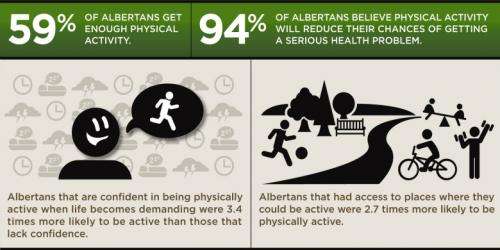
The 2013 Alberta Survey on Physical Activity offers insights into Albertans' physical activity levels and recommendations for helping more people get active. Credit: Alberta Centre for Active Living
More Albertans may be benefiting from physical activity, but there's still plenty of room for people to get moving, according to a new survey.
Results from the 2013 Alberta Survey on Physical Activity, published Jan. 9 by the U of A's Alberta Centre for Active Living, show that 59 per cent of adult Albertans are physically active enough to receive health benefits, up from 54.5 per cent in 2011.
"Although the increase in activity since 2011 is not statistically significant on its own, the upward trend from 2011 to 2013 is positive," said Christina Loitz, a co-author of the survey and knowledge translation specialist at the Alberta Centre for Active Living. The centre has conducted the survey every other year since 1995 to monitor the physical activity levels of Albertans.
Moving from awareness to activity
Loitz noted that despite the small increase over the last two years, more than 40 per cent of Albertans are not active enough to gain health benefits. Part of the value of an ongoing survey is helping researchers understand why this is the case. "The survey provides insights into sociodemographic, psychological and environmental factors that may affect the activity levels of Albertans," she said.
For instance, the 2013 survey shows that Albertans with lower household incomes are less physically active. It also shows that Albertans are less active as they get older; 87 per cent of those aged 18 to 24 are active, whereas only 35 per cent of those over 65 are active.
On the positive side, the survey showed that Albertans are well aware that physical activity has health benefits—89 per cent agree that physical activity improves their health and prevents many chronic diseases, and 94 per cent agree that physical activity will keep them healthy.
Walking is one of the most popular activities, with 74 per cent of Albertans taking to their feet for leisure, transportation or work. "Although walking is popular, Albertans generally do not walk enough to attain a moderate level of physical activity," said Loitz. "Adults need to be physically active at least 150 minutes a week to get health benefits, including light to vigorous activity every day."
Recommendations for active living
"The challenge to those of us working to increase physical activity is to create environments that support and encourage all Albertans to be more active, so that they will gain health and other benefits," said Judith Down, director of the Alberta Centre for Active Living.
The concise report from the survey offers several recommendations to boost Albertans' physical activity levels, in three areas:
- physical activity at work
- encouraging older adults to be physically active
- strategies to increase walking time by Albertans of all ages
Here are some of the report's recommendations for employees:
- Create a habit; consistently do 10 to 60 minutes of physical activity before work, at lunch or during breaks.
- Make physical activity a priority; block off time in your schedule to be active.
- Bike, walk or wheel to work.
- If you use public transit, get off a few stops early and walk the rest of the way, to work or home.
- If you drive to work, park a kilometre away and enjoy the walking time.
- Sign up for physical activity programs and initiatives offered at your workplace.
- Use your health and wellness spending account; for example, find out whether it covers fitness centre memberships or sports team fees.
- Start a workplace walking group.
More information: www.centre4activel… -graphic.jpg
Provided by
University of Alberta
-
Fewer than half US adults get enough exercise
Aug 07, 2012 |
not rated yet |
0
-
Assumptions can steer physical behavior
Mar 16, 2011 |
not rated yet |
0
-
Physical activity by stealth NOT health
Apr 07, 2011 |
not rated yet |
0
-
Study: When it comes to physical activity, one size does not fit all
Feb 13, 2008 |
not rated yet |
0
-
UK children's physical activity levels hugely overestimated
Sep 09, 2008 |
not rated yet |
0
-
Motion perception revisited: High Phi effect challenges established motion perception assumptions
Apr 23, 2013 |
3 / 5 (2) |
2
-
Anything you can do I can do better: Neuromolecular foundations of the superiority illusion (Update)
Apr 02, 2013 |
4.5 / 5 (11) |
5
-
The visual system as economist: Neural resource allocation in visual adaptation
Mar 30, 2013 |
5 / 5 (2) |
9
-
Separate lives: Neuronal and organismal lifespans decoupled
Mar 27, 2013 |
4.9 / 5 (8) |
0
-
Sizing things up: The evolutionary neurobiology of scale invariance
Feb 28, 2013 |
4.8 / 5 (10) |
14
-
Classical and Quantum Mechanics via Lie algebras
Apr 15, 2011
- More from Physics Forums - Independent Research
More news stories
Study focuses on new mums' sleepiness and injury risk on the road
New mothers throughout Australia are needed to help QUT sleep researchers investigate whether the disrupted sleep experienced by mothers when caring for their new baby raises the risk of injury while driving.
Health
9 seconds ago |
not rated yet |
0
Portland, Ore., rejecting water fluoridation
(AP)—The mayor of Portland, Ore., has conceded defeat in an effort to add fluoride to the city's drinking water.
Health
52 minutes ago |
not rated yet |
0
Life expectancy gap widens between those with mental illness and general population
The gap between life expectancy in patients with a mental illness and the general population has widened since 1985 and efforts to reduce this gap should focus on improving physical health, suggest researchers in a paper ...
Health
13 hours ago |
not rated yet |
0
Failure to use linked health records may lead to biased disease estimates
Failure to use linked electronic health records may lead to biased estimates of heart attack incidence and outcome, warn researchers in a paper published in BMJ today.
Health
13 hours ago |
5 / 5 (1) |
0
Dietary advice on added sugar is damaging our health, warns heart expert
Dietary advice on added sugar is damaging our health, warns a cardiologist in BMJ today. Dr. Aseem Malhotra believes that "not only has this advice been manipulated by the food industry for profit but it is actually a risk ...
Health
13 hours ago |
5 / 5 (4) |
0
Italy approves law on controversial stem cell therapy
Italian lawmakers on Wednesday gave their final approval to a law that allows limited use of a controversial type of stem cell therapy which has been condemned by many scientists but has given hope to families of terminally-ill ...
Japan hospital tests powerful breast cancer therapy
A Japanese cancer specialist said Wednesday she has started the world's first clinical trial of a powerful, non-surgical, short-term radiation therapy for breast cancer.
Mysterious illness kills two in southeast Alabama
(AP)—Alabama health officials say a mysterious respiratory illness has left five people hospitalized and two dead in the southeastern part of the state.
Targeting the X-factor to tackle cardiovascular disease
New research at The University of Nottingham aimed at preventing harmful blood clots associated with heart disease and stroke has recently received a major funding boost from the British Heart Foundation.
Study says empathy plays a key role in moral judgments
Is it permissible to harm one to save many? Those who tend to say "yes" when faced with this classic dilemma are likely to be deficient in a specific kind of empathy, according to a report published in the scientific journal ...
Phthalates: Study links chemicals widely found in plastics, processed food to elevated blood pressure in children, teens
Plastic additives known as phthalates (pronounced THAL-ates) are odorless, colorless and just about everywhere: They turn up in flooring, plastic cups, beach balls, plastic wrap, intravenous tubing and—according to the ...