Let crying babes lie: Study supports notion of leaving infants to cry themselves back to sleep
January 2, 2013 in Psychology & Psychiatry
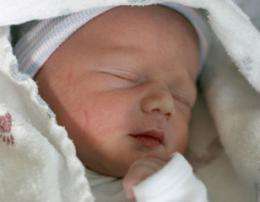
Photo by Chris Meyer, Indiana University
Today, mothers of newborns find themselves confronting a common dilemma: Should they let their babies "cry it out" when they wake up at night? Or should they rush to comfort their crying little one?
In fact, waking up in the middle of the night is the most common concern that parents of infants report to pediatricians. Now, a new study from Temple psychology professor Marsha Weinraub gives parents some scientific facts to help with that decision.
The study, published in Developmental Psychology, supports the idea that a majority of infants are best left to self-soothe and fall back to sleep on their own.
"By six months of age, most babies sleep through the night, awakening their mothers only about once per week. However, not all children follow this pattern of development," said Weinraub, an expert on child development and parent-child relationships.
For the study, Weinraub and her colleagues measured patterns of nighttime sleep awakenings in infants ages six to 36 months. Her findings revealed two groups: sleepers and transitional sleepers.
"If you measure them while they are sleeping, all babies—like all adults—move through a sleep cycle every 1 1/2 to 2 hours where they wake up and then return to sleep," said Weinraub. "Some of them do cry and call out when they awaken, and that is called 'not sleeping through the night.'"
For the study, Weinraub's team asked parents of more than 1,200 infants to report on their child's awakenings at 6, 15, 24 and 36 months. They found that by six months of age, 66 percent of babies—the sleepers—did not awaken, or awoke just once per week, following a flat trajectory as they grew. But a full 33 percent woke up seven nights per week at six months, dropping to two nights by 15 months and to one night per week by 24 months.
Of the babies that awoke, the majority were boys. These transitional sleepers also tended to score higher on an assessment of difficult temperament which identified traits such as irritability and distractibility. And, these babies were more likely to be breastfed. Mothers of these babies were more likely to be depressed and have greater maternal sensitivity.
The findings suggest a couple of things, said Weinraub. One is that genetic or constitutional factors such as those that might be reflected in difficult temperaments appear implicated in early sleep problems. "Families who are seeing sleep problems persist past 18 months should seek advice," Weinraub said.
Another takeaway is that it is important for babies to learn how to fall asleep on their own. "When mothers tune in to these night time awakenings and/or if a baby is in the habit of falling asleep during breastfeeding, then he or she may not be learning to how to self-soothe, something that is critical for regular sleep," she said.
According to Weinraub, the mechanism by which maternal depression is connected to infant awakenings is an area that would benefit from further research. On the one hand, Weinraub said, it's possible that mothers who are depressed at six and 36 months may have been depressed during pregnancy and that this prenatal depression could have affected neural development and sleep awakenings. At the same time, it's important to recognize that sleep deprivation can, of course, exacerbate maternal depression, she said.
"Because the mothers in our study described infants with many awakenings per week as creating problems for themselves and other family members, parents might be encouraged to establish more nuanced and carefully targeted routines to help babies with self-soothing and to seek occasional respite," said Weinraub.
"The best advice is to put infants to bed at a regular time every night, allow them to fall asleep on their own and resist the urge to respond right away to awakenings."
Journal reference:
Developmental Psychology
Provided by
Temple University
-
Sleep disruption for breastfed babies is temporary
Oct 17, 2011 |
not rated yet |
0
-
Depressed moms' behavior may play role in infants' sleep problems
Apr 17, 2012 |
not rated yet |
0
-
Maternal caffeine intake doesn't affect infant sleep: study
Apr 02, 2012 |
not rated yet |
0
-
Sleep, baby, sleep: parents' behavior has direct impact on children's slumber
Apr 08, 2008 |
not rated yet |
0
-
Parents spending any part of the night with their infants report poor sleep
Jun 09, 2008 |
not rated yet |
0
-
Motion perception revisited: High Phi effect challenges established motion perception assumptions
Apr 23, 2013 |
3 / 5 (2) |
2
-
Anything you can do I can do better: Neuromolecular foundations of the superiority illusion (Update)
Apr 02, 2013 |
4.5 / 5 (11) |
5
-
The visual system as economist: Neural resource allocation in visual adaptation
Mar 30, 2013 |
5 / 5 (2) |
9
-
Separate lives: Neuronal and organismal lifespans decoupled
Mar 27, 2013 |
4.9 / 5 (8) |
0
-
Sizing things up: The evolutionary neurobiology of scale invariance
Feb 28, 2013 |
4.8 / 5 (10) |
14
-
How can there be a term called "intestinal metaplasia" of stomach
7 hours ago
-
Pressure-volume curve: Elastic Recoil Pressure don't make sense
May 18, 2013
-
If you became brain-dead, would you want them to pull the plug?
May 17, 2013
-
MRI bill question
May 15, 2013
-
Ratio of Hydrogen of Oxygen in Dessicated Animal Protein
May 13, 2013
-
Alcohol and acetaminophen
May 13, 2013
- More from Physics Forums - Medical Sciences
More news stories
Teens exposed to schoolmate's death by suicide much more likely to consider or attempt suicide
Youth who had a schoolmate die by suicide are significantly more likely to consider or attempt suicide, according to a study in published in CMAJ (Canadian Medical Association Journal). This effect can last 2 years or mo ...
Psychology & Psychiatry
1 hour ago |
not rated yet |
0
Genetic predictors of postpartum depression uncovered
Johns Hopkins researchers say they have discovered specific chemical alterations in two genes that, when present during pregnancy, reliably predict whether a woman will develop postpartum depression.
Psychology & Psychiatry
9 hours ago |
not rated yet |
0
|
Mediterranean diet seems to boost ageing brain power
A Mediterranean diet with added extra virgin olive oil or mixed nuts seems to improve the brain power of older people better than advising them to follow a low-fat diet, indicates research published online in the Journal of ...
Psychology & Psychiatry
19 hours ago |
2 / 5 (1) |
2
The incidence of eating disorders is increasing in the UK
More people are being diagnosed with eating disorders every year and the most common type is not either of the two most well known—bulimia or anorexia—but eating disorders not otherwise specified (eating disorders that ...
Psychology & Psychiatry
19 hours ago |
not rated yet |
0
Practice makes perfect? Not so much
Turns out, that old "practice makes perfect" adage may be overblown. New research led by Michigan State University's Zach Hambrick finds that a copious amount of practice is not enough to explain why people ...
Psychology & Psychiatry
20 hours ago |
3.3 / 5 (12) |
0
|
B vitamins could delay dementia
(Medical Xpress)—Despite spending billions of dollars on research and development, drug companies have been unable to come up with effective treatments for dementia and Alzheimer's Disease (AD). Now, A. ...
Enrichment therapy effective among children with autism, study finds
Children with autism showed significant improvement after six months of simple sensory exercises at home using everyday items such as scents, spoons and sponges, according to UC Irvine neurobiologists.
Poliovirus vaccine trial shows early promise for recurrent glioblastoma
An attack on glioblastoma brain tumor cells that uses a modified poliovirus is showing encouraging results in an early study to establish the proper dose level, researchers at Duke Cancer Institute report.
'Doctor shopping' by obese patients negatively affects health
Overweight and obese patients are significantly more likely than their normal-weight counterparts to repeatedly switch primary care doctors, a practice that disrupts continuity of care and leads to more emergency room visits, ...
Aggressive behavior linked specifically to secondhand smoke exposure in childhood
Children who are exposed to secondhand smoke in early childhood are more likely to grow up to physically aggressive and antisocial, regardless of whether they were exposed during pregnancy or their parents have a history ...
If you can remember it, you can remember it wrong
(Medical Xpress)—Native peoples in regions where cameras are uncommon sometimes react with caution when their picture is taken. The fear that something must have been stolen from them to create the photo ...
Jan 02, 2013
Rank: 5 / 5 (1)
And still only a provisional answer.
Every few years the pendulum of behavioral psychology opinion reverses itself: "let them cry themselves to sleep/comfort them, comfort them/let them cry themselves to sleep" --what kind of effect must this be having upon our children's development?
I would really be worried if I didn't already know that the dilemma is usually resolved by the eventual crash of even the most well-meaning of parental units after a more-or-less extended period of sleep deprivation.
Ultimately, it is more a test of the endurance(fitness?) of the parentals than a question of childrearing.
Jan 02, 2013
Rank: 1 / 5 (2)
Jan 02, 2013
Rank: not rated yet
My eldest daughter was perhaps closer to a 'norm' waking every couple of hours or so but didn't require much comforting to return to sleep. Sleeping most of the night after just a few months.
Next, my son, who practically brought himself into the world by dropping into my arms in the kitchen while we were waiting for an ambulance, would sleep so soundly that we were worried about 'cot death'. As far as I know now in his 40's he is still sleeps 'like a log'.
My youngest daught was the exact opposite and would cry much of the day and most of the night. We had visits from social services because neighbours were afraid of ill treatment, several medical examinations prove negative so she was healthy. Finally, screaming 'red in the face', we rushed her to our (female) MD who thought it may be meningitis. However, during the examination the Doctor cradled my daughter and walked into the 'children's' room(cont.)
Jan 02, 2013
Rank: 1 / 5 (1)
Jan 02, 2013
Rank: not rated yet
...into the 'children's' room with us following behind...the crying stopped. My daughter seemed interested in certain items so before going home we went to local toy shop and bought acouple of similar items. That was it! No more (abnormal) crying from then on.
Years later it was shown that my daught was 'mentally sensitive' to her surroundings. In fact it turned out to be more detailed but this is not the place to discuss that; suffice to say that my daughter is now a happy mother with a family of her own so all turned out well in the end.
Jan 02, 2013
Rank: not rated yet
Jan 03, 2013
Rank: 2.3 / 5 (3)
Jan 03, 2013
Rank: 1 / 5 (2)
For my 4 kids, did a bit of both. They all are growing up fine.
Jan 04, 2013
Rank: 1 / 5 (1)
Jan 04, 2013
Rank: 1 / 5 (2)
Jan 04, 2013
Rank: 5 / 5 (1)
Science not required.
Jan 04, 2013
Rank: 2 / 5 (4)
Think I'm Joking. Who would have thought 15 years ago, government will regulate how much soda pop you could buy, and that mothers will be arm twisted to breast feed their children.
I say, let parents do what they think is best and keep government out of family decisions.
Jan 06, 2013
Rank: not rated yet
You can try to 'spoil' an infant or newborn.
You will not succeed.
The label 'self sooth' - in this research/case/study is as far removed from science as a lobotomy to alleviate a headache.
Marsha Weinraub, without disrespect I call BS on this.
@rynox
Kudos.