Brain structure of infants predicts language skills at one year
January 22, 2013 by Molly Mcelroy in Psychology & Psychiatry
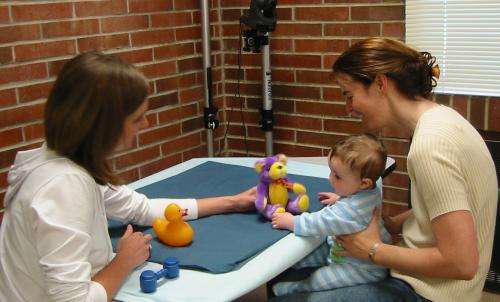
A 1 year old baby participates in a language test at UW’s Institute for Learning & Brain Sciences.
(Medical Xpress)—Using a brain-imaging technique that examines the entire infant brain, researchers have found that the anatomy of certain brain areas – the hippocampus and cerebellum – can predict children's language abilities at 1 year of age.
The University of Washington study is the first to associate these brain structures with future language skills. The results are published in the January issue of the journal Brain and Language.
"The brain of the baby holds an infinite number of secrets just waiting to be uncovered, and these discoveries will show us why infants learn languages like sponges, far surpassing our skills as adults," said co-author Patricia Kuhl, co-director of the UW's Institute for Learning & Brain Sciences.
Children's language skills soar after they reach their first birthdays, but little is known about how infants' early brain development seeds that path. Identifying which brain areas are related to early language learning could provide a first glimpse of development going awry, allowing for treatments to begin earlier.
"Infancy may be the most important phase of postnatal brain development in humans," said Dilara Deniz Can, lead author and a UW postdoctoral researcher. "Our results showing brain structures linked to later language ability in typically developing infants is a first step toward examining links to brain and behavior in young children with linguistic, psychological and social delays."
In the study, the researchers used magnetic resonance imaging to measure the brain structure of a mix of 19 boys and girls at 7 months of age. The researchers used a measurement called voxel-based morphometry to determine the concentration of gray matter, consisting of nerve cells, and of white matter, which make up the network of connections throughout the brain.
The study is the first to relate the outcomes of this whole-brain imaging technique to predict future ability in infants. The whole-brain approach freed the researchers from having to select a few brain regions for study ahead of time, ones scientists might have expected to be involved based on adult data.
Five months later, when the children were about 1 year old they returned to the lab for a language test. This test included measures of the children's babbling, recognition of familiar names and words, and their ability to produce different types of sounds.
"At this age, children typically don't say many words," Deniz Can said. "So we rely on babbling and the ability to comprehend language as a sign of early language mastery."
Infants with a greater concentration of gray and white matter in the cerebellum and the hippocampus showed greater language ability at age 1. This is the first study to identify a relationship between language and the cerebellum and hippocampus in infants. Neither brain area is well-known for its role in language: the cerebellum is typically linked to motor learning, while the hippocampus is commonly recognized as a memory processor.
"Looking at the whole brain produced a surprising result and scientists live for surprises. It wasn't the language areas of the infant brain that predicted their future linguistic skills, but instead brain areas linked to motor abilities and memory processing," Kuhl said. "Infants have to listen and memorize the sound patterns used by the people in their culture, and then coax their own mouths and tongues to make these sounds in order join the social conversation and get a response from their parents."
The findings could reflect infants' abilities to master the motor planning for speech and to develop the memory requirements for keeping the sound patterns in mind.
"The brain uses many general skills to learn language," Kuhl said. "Knowing which brain regions are linked to this early learning could help identify children with developmental disabilities and provide them with early interventions that will steer them back toward a typical developmental path."
More information: www.sciencedirect.… 934X12002040
Journal reference:
Brain and Language
Provided by
University of Washington
-
Study links bilingual babies' vocabulary to early brain differentiation
Aug 29, 2011 |
not rated yet |
0
-
While in womb, babies begin learning language from their mothers
Jan 02, 2013 |
not rated yet |
0
-
Language learning influenced by genes
Feb 11, 2011 |
not rated yet |
0
-
Language learning makes the brain grow
Oct 08, 2012 |
not rated yet |
0
-
Children with brain injuries have problems with story-telling
Jul 26, 2010 |
not rated yet |
0
-
Motion perception revisited: High Phi effect challenges established motion perception assumptions
Apr 23, 2013 |
3 / 5 (2) |
2
-
Anything you can do I can do better: Neuromolecular foundations of the superiority illusion (Update)
Apr 02, 2013 |
4.5 / 5 (11) |
5
-
The visual system as economist: Neural resource allocation in visual adaptation
Mar 30, 2013 |
5 / 5 (2) |
9
-
Separate lives: Neuronal and organismal lifespans decoupled
Mar 27, 2013 |
4.9 / 5 (8) |
0
-
Sizing things up: The evolutionary neurobiology of scale invariance
Feb 28, 2013 |
4.8 / 5 (10) |
14
-
Why is zone 1 in liver more prone to ischemic injury?
7 hours ago
-
How can there be villous adenoma in colon, if there are no villi there
May 22, 2013
-
How can there be a term called "intestinal metaplasia" of stomach
May 21, 2013
-
Pressure-volume curve: Elastic Recoil Pressure don't make sense
May 18, 2013
-
If you became brain-dead, would you want them to pull the plug?
May 17, 2013
-
MRI bill question
May 15, 2013
- More from Physics Forums - Medical Sciences
More news stories
Anxious men fare worse during job interviews, study finds
Nervous about that upcoming job interview? You might want to take steps to reduce your jitters, especially if you are a man.
Psychology & Psychiatry
1 minute ago |
not rated yet |
0
Are kids who take music lessons different from other kids?
(Medical Xpress)—Research by U of T Mississauga psychology professor Glenn Schellenberg reveals that two key personality traits – openness-to-experience and conscientiousness—predict better than IQ ...
Psychology & Psychiatry
2 hours ago |
not rated yet |
0
|
Parents can help preteens with abduction concerns
Parents naturally are concerned for their children's safety, particularly when there is news of a child abduction that happens close to home. Finding the balance between emotions and the "teachable moment" as parents talk ...
Psychology & Psychiatry
2 hours ago |
not rated yet |
0
Ireland needs real-time database for teen and young adult suicides
A new report on suicide in Ireland shows that suicide cases experienced a significant number (and intensity) of life events in the 6 months prior to their death.
Psychology & Psychiatry
2 hours ago |
not rated yet |
0
Depression linked to telomere enzyme, aging, chronic disease
(Medical Xpress)—The first symptoms of major depression may be behavioral, but the common mental illness is based in biology—and not limited to the brain.
Psychology & Psychiatry
3 hours ago |
5 / 5 (2) |
0
|
Researchers suggest boosting body's natural flu killers
A known difficulty in fighting influenza (flu) is the ability of the flu viruses to mutate and thus evade various medications that were previously found to be effective. Researchers at the Hebrew University of Jerusalem have ...
Second-generation TAVI device—Lotus Valve—shows good performance in REPRISE II
22 May 2013, Paris, France: The Lotus Valve, a second-generation transcatheter aortic valve implantation (TAVI) device, was successfully implanted in all of the first 60 patients in results from REPRISE II reported at EuroPCR ...
Major human drug trial underway for Alzheimer's
A potentially ground-breaking human drug trial is currently underway, which aims to discover whether blood pressure medication can slow or halt the progression of Alzheimer's Disease (AD). This is the latest ...
Pay attention: How we focus and concentrate
Scientists at Newcastle University have shed new light on how the brain tunes in to relevant information.
New discovery in fight against deadly meningococcal disease
Professor Michael Jennings, Deputy Director of the Institute for Glycomics at Griffith University, was part of an international team that discovered the previously unknown pathway of how the bacterium colonizes people.
Study reveals active site of enzyme linked to stuttering
(Medical Xpress)—Scientists from the Joint Center for Structural Genomics (JCSG) at SLAC National Accelerator Laboratory have determined the 3-D structure of the chemically active part of an enzyme involved ...