DNA-repairing protein may be key to preventing recurrence of some cancers
January 28, 2013 in Cancer

DNA-repairing protein may be key to preventing recurrence of some cancers

Enlarge

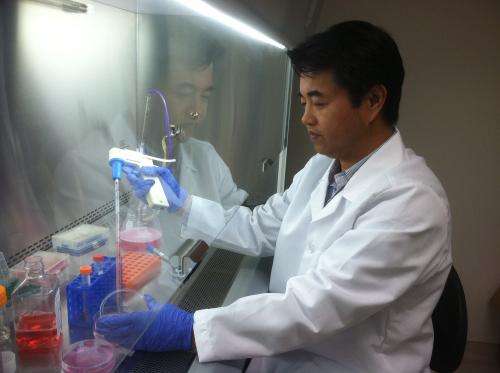
Dr. Zhao works in his lab at the Burnett School of Biomedical Sciences at the UCF College of Medicine. Credit: University of Central Florida

Just as the body can become resistant to antibiotics, certain methods of killing cancer tumors can end up creating resistant tumor cells. But a University of Central Florida professor has found a protein present in several types of cancer, including breast and ovarian cancer, which could be helpful in preventing tumors from coming back.

The protein, KLF8, appears to protect tumor cells from drugs aimed at killing them and even aid the tumor cells' ability to regenerate.

"All cells have a mechanism," explained Jihe Zhao, a medical doctor and researcher who in the past few months has published several articles related to the protein in the and Oncogene, among others. "That's why we survive constant threats. But KLF8 is overexpressed in specific cancers, such as and ovarian cancer. The thought is that if we can stop it from switching on, we may be able to stop the tumors from coming back as part of therapy. We still need to do a lot more research, but it is plausible."

There are between 2.5 million and 2.7 million women who have breast cancer in the United States and 10 to 20 percent will experience a recurrence, according to the . Current treatment options, depending on the stage of cancer, include surgical removal followed by chemotherapy using a combination of cancer killing drugs. Each year about 22,200 women are also diagnosed with ovarian cancer.

DNA damage-based chemotherapies depend on failure of cancer cells to repair the DNA damage and subsequent cell death, according to the journal article. Aberrant high levels of DNA repair function in the cells likely increase not only the resistance of the cells to such therapies but also the malignancy of the cells due to improper DNA repair-mediated genomic and chromosomal instability.

In the study, Zhao's team tested one specific cancer-fighting drug used in the treatment of breast cancer to determine the role of the protein.

"Indeed, our results have clearly linked the KLF8-promoted DNA repair to the cell resistance to doxorubicin-induced cell death," Zhao said. "It remains to be determined whether KLF8 plays a similar role in repairing DNA damage caused by other types of genotoxic agents such as DNA alkylating agents and ionizing radiation."

Even so, the results suggest that in addition to enhancing the drug resistance of the , KLF8 could play a role in disturbing genomic integrity through its aberrant DNA repair function and subsequently contribute to aggressive progression of cancer.

More information: http://www.jbc.org/content/287/52/43720 and http://www.nature.com/onc/journal/vaop/ncurrent/full/onc2012545a.html

Journal reference: Journal of Biological Chemistry search and more info website Oncogene search and more info website

Provided by University of Central Florida search and more info website

5 /5 (4 votes)  

Rank 5 /5 (4 votes)
Relevant PhysicsForums posts

More news stories

ASCO: combo antibody therapy effective for melanoma

(HealthDay)—Concurrent use of two immune checkpoint antibodies—ipilimumab and nivolumab—may be effective for the treatment of advanced melanoma, according to a proof-of-principal study presented in ...

Cancer created 14 hours ago | popularity not rated yet | comments 0

Risk factors ID'd for poor cutaneous cell CA outcomes

(HealthDay)—The risks of metastasis and death associated with cutaneous squamous cell carcinoma (CSCC) are low, but significant, and risk factors for poor outcome include tumor diameter, invasion beyond ...

Cancer created 15 hours ago | popularity not rated yet | comments 0 | with audio podcast

Physical & emotional impairments common, often untreated in people with cancer

A new review finds cancer survivors suffer a diverse and complex set of impairments, affecting virtually every organ system. Writing in CA: A Cancer Journal for Clinicians, Julie Silver, M.D., associate professor at Harvar ...

Cancer created 19 hours ago | popularity not rated yet | comments 0

Calif. doc with 'cancer cure' gets 14 years prison (Update)

(AP)—A California doctor has been sentenced to 14 years in federal prison for bilking her patients out of more than $1 million by promising that an herbal supplement could cure late-stage cancer and other diseases.

Cancer created 20 hours ago | popularity not rated yet | comments 0

New protein-targeting drug shows promise in early trial for patients with high-risk CLL

A new oral targeted drug, idelalisib (GS-1101), has the potential to stave off the need for additional treatments for relapsed or treatment-resistant chronic lymphocytic leukemia (CLL), according to a study led in part by ...

Cancer created 21 hours ago | popularity not rated yet | comments 0 | with audio podcast


AIDS science at 30: 'Cure' now part of lexicon

Big names in medicine are set to give an upbeat assessment of the war on AIDS on Tuesday, 30 years after French researchers identified the virus that causes the disease.

For combat veterans suffering from post-traumatic stress disorder, 'fear circuitry' in the brain never rests

Chronic trauma can inflict lasting damage to brain regions associated with fear and anxiety. Previous imaging studies of people with post-traumatic stress disorder, or PTSD, have shown that these brain regions can over-or ...

Melon focus headband turns to Kickstarter for rollout plans

(Medical Xpress)—What if the quality of your work depends more on your focus on the piano keys or canvas or laptop than your musical or painting or computing skills? If target users can be convinced, they ...

Temporal processing in the olfactory system

The neural machinery underlying our olfactory sense continues to be an enigma for neuroscience. A recent review in Neuron seeks to expand traditional ideas about how neurons in the olfactory bulb might encode information about ...

Now we know why old scizophrenia medicine works on antibiotics-resistant bacteria

In 2008 researchers from the University of Southern Denmark showed that the drug thioridazine, which has previously been used to treat schizophrenia, is also a powerful weapon against antibiotic-resistant bacteria such as ...

Individuals who drink heavily and smoke may show 'early aging' of the brain

Treatment for alcohol use disorders works best if the patient actively understands and incorporates the interventions provided in the clinic. Multiple factors can influence both the type and degree of neurocognitive abnormalities ...