US Marines studying mindfulness-based training
The U.S. Marine Corps, known for turning out some of the military's toughest warriors, is studying how to make its troops even tougher through meditative practices, yoga-type stretching and exercises based on mindfulness.
Marine Corps officials say they will build a curriculum that would integrate mindfulness-based techniques into their training if they see positive results from a pilot project. Mindfulness is a Buddhist-inspired concept that emphasizes active attention on the moment to keep the mind in the present.
Facing a record suicide rate and thousands of veterans seeking treatment for post-traumatic stress, the military has been searching for ways to reduce strains on service members burdened with more than a decade of fighting in Iraq and Afghanistan.
Marine Corps officials are testing a series of brain calming exercises called "Mindfulness-Based Mind Fitness Training" that they believe could enhance the performance of troops, who are under mounting pressures from long deployments and looming budget cuts expected to slim down forces.
"Some people might say these are Eastern-based religious practices but this goes way beyond that," said Jeffery Bearor, the executive deputy of the Marine Corps training and education command at its headquarters in Quantico, Virginia. "This is not tied to any religious practice. This is about mental preparation to better handle stress."
The School Infantry-West at Camp Pendleton will offer the eight-week course starting Tuesday to about 80 Marines.
The experiment builds on a 2011 study involving 160 Marines who were taught to focus their attention by concentrating on their body's sensations, including breathing, in a period of silence. The Marines practiced the calming methods after being immersed in a mock Afghan village with screaming actors and controlled blasts to expose them to combat stress. Naval Health Research Center scientist Douglas C. Johnson, who is leading the research, monitored their reactions by looking at blood and saliva samples, images of their brains and problem-solving tests they took.
Another 160 other Marines went through the mock village with no mindfulness-based training, acting as the control group. Results from the 2011 study are expected to be published this spring.
The latest study by Johnson will compare three groups of Marines, whose biological reactions will be also monitored. One group of about 80 will receive mindfulness-based training. Another of equal size will be given mental resilience training based on sports psychology techniques. The third one will act as a control group.
Results from that study are expected in the fall, Marine Corps officials said.
Marine Corps officials decided to extend the experiment to shore up evidence that the exercises help the brain better react to high-stress situations and recover more quickly from those episodes.
"If indeed that proves to be the case, then it's our intention to turn this into a training program where Marines train Marines in these techniques," Bearor said. "We would interject this into the entry level training pipeline—we don't know where yet—so every Marine would be trained in these techniques."
The idea is to give Marines a tool so they can regulate their own stress levels before they lead to problem behavior: "We have doctors, counselors, behavioral health scientists, all sorts of people to get help for Marines who have exhibited stress type symptoms but what can we do before that happens? How do we armor Marines up so they are capable of handling stress?" Bearor said.
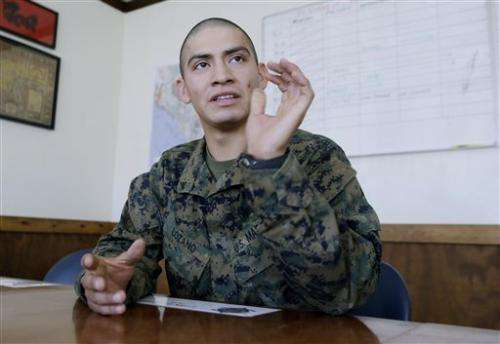
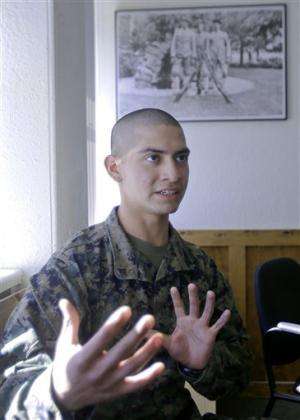
Lance Cpl. Carlos Lozano participated in the 2011 study, taking the course during his pre-deployment training that also included catapulting from a helicopter in a simulated raid and enduring booming explosions in a mock Afghan village.
Lozano said he and fellow Marines were skeptical at first. Some wondered why their rigorous combat training was being interrupted by a class asking the warfighters to sit in silence and stare at their combat boots, becoming aware of how their feet touched the classroom floor.
"I didn't want to do it," the 21-year-old from Denver said.
But the exercises—also done while standing, stretching and lying down—had an effect, he said. He felt more relaxed and upbeat.
"Mindfulness-based Mind Fitness Training" or "M-Fit" was designed by former U.S. Army Capt. Elizabeth Stanley, a professor at Georgetown University who found relief doing yoga and meditation for her PTSD.
Stanley, who is also involved in studies for the Army, said the techniques can help warfighters think more clearly under fire when they are often forced to make quick decisions that could mean life or death, and help them reset their nervous systems after being in combat.
Maj. Gen. Melvin Spiese said he was convinced after looking at the scientific research and then taking the course.
While teaching troops to shoot makes them a better warfighter, teaching mindfulness makes them a better person by helping them to decompress, which could have lasting effects, he said.
"As we see the data supports it, it makes perfect sense that this is what we should be doing," said the 58-year-old outgoing general, sitting in his office adorned with pictures of war and a 1903 rifle. "It's like doing pushups for the brain."
Copyright 2013 The Associated Press. All rights reserved. This material may not be published, broadcast, rewritten or redistributed.


