New pill holds promise for fewer side effects in treating leukemia
January 7, 2013
by Bob Yirka
in Cancer
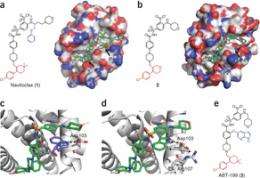
Discovery of ABT-199. Credit: Nature Medicine (2013) doi:10.1038/nm.3048
(Medical Xpress)—An international team of researchers has developed a new anti-cancer drug that holds promise as a therapy that fights cancer while causing fewer side effects than current medicines. The work done by the group – mainly in the US and Australia – and the results they've achieved are described in an article published by the team in Nature Medicine.
The pill, known as ABT-199, works by attacking a key BCL-2 protein that cancer cells use to ward off the beneficial effects of traditional chemotherapy. BCL-2 proteins, known as pro-survival proteins, inhibit the therapeutic effects of chemotherapy which lead to a requirement for large doses and resultant negative side effects such as nausea and hair loss. In this new study, during trials in a medical care facility in Melbourne, Australia, a single ABT-199 pill was found to "dramatically" reduce the number of leukemia cells in the blood after just an eight hour period while causing few side effects.
BCL-2 (B-cell lymphoma 2) is one of the originally discovered members of the BCL-2 group of cell-death regulator proteins and is evident in the BCL2 gene. It has been seen in a number of cancers and has also been linked to some mental illnesses and autoimmune diseases. When present in cancer, it is believed to work as an inhibitor, providing resistance against cancer treating drugs. The goal of this new work was to develop a drug that would eliminate or reduce the presence of the protein in cancerous cells which would allow chemotherapy to do its job.
One of the main hurdles the team had to overcome was to find a substance that would inhibit the growth of BCL-2 without disturbing the growth of BCL-XL – a protein necessary for platelet development. Because the two are so similar, prior efforts to curb the deleterious protein, generally resulted in harming the helpful one. As trials have continued, it appears the team has overcome this problem as the team reports there have thus far been no adverse impact on BCL-XL levels as tumors have been reduced in patients.
The team came up with the formula for the new pill by studying existing anti-BCL drugs – gradually weeding out the ones that harmed BCL-XL. They report that trials with three patients show that the new pill demonstrates a promising new therapy for treating several types of cancers while simultaneously reducing negative side effects.
More information: ABT-199, a potent and selective BCL-2 inhibitor, achieves antitumor activity while sparing platelets, Nature Medicine (2013) doi:10.1038/nm.3048
Abstract
Proteins in the B cell CLL/lymphoma 2 (BCL-2) family are key regulators of the apoptotic process. This family comprises proapoptotic and prosurvival proteins, and shifting the balance toward the latter is an established mechanism whereby cancer cells evade apoptosis. The therapeutic potential of directly inhibiting prosurvival proteins was unveiled with the development of navitoclax, a selective inhibitor of both BCL-2 and BCL-2–like 1 (BCL-XL), which has shown clinical efficacy in some BCL-2–dependent hematological cancers. However, concomitant on-target thrombocytopenia caused by BCL-XL inhibition limits the efficacy achievable with this agent. Here we report the re-engineering of navitoclax to create a highly potent, orally bioavailable and BCL-2–selective inhibitor, ABT-199. This compound inhibits the growth of BCL-2–dependent tumors in vivo and spares human platelets. A single dose of ABT-199 in three patients with refractory chronic lymphocytic leukemia resulted in tumor lysis within 24 h. These data indicate that selective pharmacological inhibition of BCL-2 shows promise for the treatment of BCL-2–dependent hematological cancers.
Journal reference:
Nature Medicine
© 2013 Medical Xpress
-
New use for a cell toxin found to inhibit survival proteins in cancer cells
Jul 11, 2007 |
not rated yet |
0
-
New agents show promise for treating aggressive breast cancers
Jul 18, 2011 |
not rated yet |
0
-
Marked for destruction: Newly developed compound triggers cancer cell death
May 24, 2012 |
not rated yet |
0
-
Overcoming tumor resistance to anti-cancer agent TRAIL
Mar 22, 2010 |
not rated yet |
0
-
New therapeutic target for melanoma identified
Apr 16, 2009 |
not rated yet |
0
-
Motion perception revisited: High Phi effect challenges established motion perception assumptions
Apr 23, 2013 |
3 / 5 (2) |
2
-
Anything you can do I can do better: Neuromolecular foundations of the superiority illusion (Update)
Apr 02, 2013 |
4.5 / 5 (11) |
5
-
The visual system as economist: Neural resource allocation in visual adaptation
Mar 30, 2013 |
5 / 5 (2) |
9
-
Separate lives: Neuronal and organismal lifespans decoupled
Mar 27, 2013 |
4.9 / 5 (8) |
0
-
Sizing things up: The evolutionary neurobiology of scale invariance
Feb 28, 2013 |
4.8 / 5 (10) |
14
-
Why is zone 1 in liver more prone to ischemic injury?
3 hours ago
-
How can there be villous adenoma in colon, if there are no villi there
23 hours ago
-
How can there be a term called "intestinal metaplasia" of stomach
May 21, 2013
-
Pressure-volume curve: Elastic Recoil Pressure don't make sense
May 18, 2013
-
If you became brain-dead, would you want them to pull the plug?
May 17, 2013
-
MRI bill question
May 15, 2013
- More from Physics Forums - Medical Sciences
More news stories
American cancer society celebrates 100 years of progress
(HealthDay)—The American Cancer Society, which is celebrating on Wednesday a century of fighting a disease once viewed as a death sentence, is making a pledge to put itself out of business.
Cancer
13 hours ago |
not rated yet |
0
CT detects twice as many lung cancers as X-ray at initial screening exam
National Lung Screening Trial (NLST) investigators also conclude that the 20 percent reduction in lung cancer mortality with low-dose computed tomography (LDCT) versus chest X-ray (CXR) screening previously reported in the ...
Cancer
13 hours ago |
not rated yet |
0
Research offers promising new approach to treatment of lung cancer
Researchers have developed a new drug delivery system that allows inhalation of chemotherapeutic drugs to help treat lung cancer, and in laboratory and animal tests it appears to reduce the systemic damage ...
Cancer
17 hours ago |
not rated yet |
0
|
Study details genes that control whether tumors adapt or die when faced with p53 activating drugs
When turned on, the gene p53 turns off cancer. However, when existing drugs boost p53, only a few tumors die – the rest resist the challenge. A study published in the journal Cell Reports shows how: tumors that live even i ...
Cancer
17 hours ago |
not rated yet |
0
|
Small increase in cancer risk following CT scans in childhood and adolescence
Study leader, Professor John Mathews from the University of Melbourne said this small increase in cancer risk must be weighed against the undoubted benefits from CT scans in diagnosing and monitoring disease.
Cancer
21 hours ago |
not rated yet |
0
US teen birth rate drops to record low
US teen births have dropped to a record low, but the country still has one of the highest rates among developed nations, the US Centers for Disease Control and Prevention said Thursday.
Slowing the aging process—only with antibiotics
Swiss scientists reveal the mechanism responsible for aging hidden deep within mitochondria—and dramatically slow it down in worms by administering antibiotics to the young.
Researchers complete largest genetic sequencing study of human disease
Researchers from Queen Mary, University of London have led the largest sequencing study of human disease to date, investigating the genetic basis of six autoimmune diseases.
Brain can be trained in compassion, study shows
Until now, little was scientifically known about the human potential to cultivate compassion—the emotional state of caring for people who are suffering in a way that motivates altruistic behavior.
Rate of bicycle-related fatalities significantly lower in states with helmet laws
Existing research shows that bicyclists who wear helmets have an 88 percent lower risk of brain injury, but researchers at Boston Children's Hospital found that simply having bicycle helmet laws in place showed a 20 percent ...
Having both migraines, depression may mean smaller brain
(HealthDay)—Migraines and depression can each cause a great deal of suffering, but new research indicates the combination of the two may be linked to something else entirely—a smaller brain.