Transmission of tangles in Alzheimer's mice provides more authentic model of tau pathology
January 15, 2013 in Neuroscience
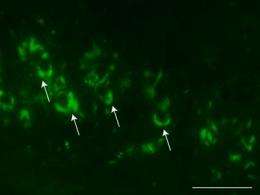
These are neurons filled with tangles (arrows) in medial region of hippocampus one month after injection of synthetic tau fibrils into the hippocampus. Scale = 50um. Credit: Michiyo Iba, Ph.D., Perelman School of Medicine, University of Pennsylvania
Brain diseases associated with the misformed protein tau, including Alzheimer's disease and frontotemporal lobar degeneration with tau pathologies, are characterized by neurofibrillary tangles (NFTs) comprised of pathological tau filaments. Tau tangles are also found in progressive supranuclear palsy, cortical basal degeneration and other related tauopathies, including chronic traumatic encephalopathy due to repetitive traumatic brain injuries sustained in sports or on the battle field.
By using synthetic fibrils made from pure recombinant protein, Penn researchers provide the first direct and compelling evidence that tau fibrils alone are entirely sufficient to recruit and convert soluble tau within cells into pathological clumps in neurons, followed by transmission of tau pathology to other inter-connected brain regions from a single injection site in an animal model of tau brain disease.
The laboratory of senior author Virginia M.-Y. Lee, Ph.D., MBA, director of the Center for Neurodegenerative Disease Research and professor of Pathology and Laboratory Medicine at the Perelman School of Medicine, University of Pennsylvania, published their findings in the Journal of Neuroscience this week.
"Our new model of tau pathology spread provides an explanation to account for the stereotypical progression of Alzheimer's and other related tauopathies by implicating the cell-to-cell transmission of pathological tau in this process," says Lee.
Young mice overexpressing mutant human tau were injected with synthetic preformed tau fibrils. These fibrils were assembled from recombinant full-length tau or truncated tau containing four microtubule-binding repeats. The synthetic tau fibrils caused rapid induction of NFT-like inclusions in the brains of the mice. These inclusions then propagated from injected sites to connected brain regions in a dose- and time-dependent manner.
Interestingly, injection of the synthetic tau fibrils into either the hippocampus or the striatum and cortex led to distinctly different patterns of spreading, which is reflective of their functional connectivities. The simplest explanation for this phenomenon is that the injected pathological tau is taken up by the processes of normal neurons where it then corrupts the tau in these nerve cells followed by the transport of the corrupted tau along processes where it is released, taken up by other neurons. Then the cycle repeats itself over and over again, thereby driving disease progression, say the researchers.
What's more, unlike tau pathology that spontaneously develops in older Alzheimer's mice, the inclusions induced by the synthetic tau injections in the younger mice more closely resembled Alzheimer's tangles in their physical and biochemical make-up.
The study demonstrates that synthetic tau fibrils alone are capable of inducing authentic NFT-like tau clumps and initiating spreading of tau pathology in an Alzheimer's mouse model.
The team is now conducting studies to identify monoclonal antibodies for passive immunotherapies related to tau pathologies.
"We are also exploring the mechanisms of spreading and the relationship of tau tangles with senile plaques," says Lee. "We believe that this newly described transmission model may more faithfully recapitulate human Alzheimer's pathogenesis than the conventional transgenic mouse models of overexpressing mutant genes that develop aggregates. Exploring if this injection-transmission model is more appropriate for the progression of Alzheimer's, as well as Parkinson's, is another priority."
Journal reference:
Journal of Neuroscience
Provided by
University of Pennsylvania School of Medicine
-
Anti-tau drug improves cognition, decreases tau tangles in Alzheimer's disease models
Jul 19, 2012 |
not rated yet |
0
-
Study suggests another avenue for detecting Alzheimer's disease
Apr 01, 2011 |
not rated yet |
0
-
Alzheimer's protein detected in brain fluid of healthy mice
Sep 21, 2011 |
not rated yet |
0
-
Untangling the mysteries of Alzheimer's
Feb 02, 2012 |
not rated yet |
0
-
Acetylation may contribute to dementia and Alzheimer's disease
Sep 22, 2010 |
not rated yet |
0
-
Motion perception revisited: High Phi effect challenges established motion perception assumptions
Apr 23, 2013 |
3 / 5 (2) |
2
-
Anything you can do I can do better: Neuromolecular foundations of the superiority illusion (Update)
Apr 02, 2013 |
4.5 / 5 (11) |
5
-
The visual system as economist: Neural resource allocation in visual adaptation
Mar 30, 2013 |
5 / 5 (2) |
9
-
Separate lives: Neuronal and organismal lifespans decoupled
Mar 27, 2013 |
4.9 / 5 (8) |
0
-
Sizing things up: The evolutionary neurobiology of scale invariance
Feb 28, 2013 |
4.8 / 5 (10) |
14
-
How can there be a term called "intestinal metaplasia" of stomach
6 hours ago
-
Pressure-volume curve: Elastic Recoil Pressure don't make sense
May 18, 2013
-
If you became brain-dead, would you want them to pull the plug?
May 17, 2013
-
MRI bill question
May 15, 2013
-
Ratio of Hydrogen of Oxygen in Dessicated Animal Protein
May 13, 2013
-
Alcohol and acetaminophen
May 13, 2013
- More from Physics Forums - Medical Sciences
More news stories
Waiting for a sign? Researchers find potential brain 'switch' for new behavior
You're standing near an airport luggage carousel and your bag emerges on the conveyor belt, prompting you to spring into action. How does your brain make the shift from passively waiting to taking action when ...
Neuroscience
14 minutes ago |
not rated yet |
0
|
If you can remember it, you can remember it wrong
(Medical Xpress)—Native peoples in regions where cameras are uncommon sometimes react with caution when their picture is taken. The fear that something must have been stolen from them to create the photo ...
Neuroscience
1 hour ago |
2 / 5 (1) |
0
|
Study shows where scene context happens in our brain
In a remote fishing community in Venezuela, a lone fisherman sits on a cliff overlooking the southern Caribbean Sea. This man –– the lookout –– is responsible for directing his comrades on the water, ...
Neuroscience
3 hours ago |
4 / 5 (1) |
0
|
Clouds in the head
Many brain researchers cannot see the forest for the trees. When they use electrodes to record the activity patterns of individual neurons, the patterns often appear chaotic and difficult to interpret.
Neuroscience
5 hours ago |
not rated yet |
0
New theory offers clues to vital 'repair and maintenance' role of sleep
(Medical Xpress)—We spend about a third of our life asleep, but why we need to do so remains a mystery. In a recent publication, researchers at University of Surrey and University College London suggest a new hypothesis, ...
Neuroscience
6 hours ago |
not rated yet |
0
Estimates reveal low population immunity to new bird flu virus H7N9 in humans
The level of immunity to the recently circulating H7N9 influenza virus in an urban and rural population in Vietnam is very low, according to the first population level study to examine human immunity to the virus, which was ...
Finding a family for a pair of orphan receptors in the brain
Researchers at Emory University have identified a protein that stimulates a pair of "orphan receptors" found in the brain, solving a long-standing biological puzzle and possibly leading to future treatments for neurological ...
Common food supplement fights degenerative brain disorders
Widely available in pharmacies and health stores, phosphatidylserine is a natural food supplement produced from beef, oysters, and soy. Proven to improve cognition and slow memory loss, it's a popular treatment for older ...
Glaucoma drug can cause droopy eyelids
Prostaglandin analogues (PGAs), drugs which lower intraocular pressure, are often the first line of treatment for people with glaucoma, but their use is not without risks. PGAs have long been associated with blurred vision, ...
Teens exposed to schoolmate's death by suicide much more likely to consider or attempt suicide
Youth who had a schoolmate die by suicide are significantly more likely to consider or attempt suicide, according to a study in published in CMAJ (Canadian Medical Association Journal). This effect can last 2 years or mo ...
Most elite athletes believe doping substances are effective in improving performance
Most elite athletes consider doping substances "are effective" in improving performance, while recognising that they constitute cheating, can endanger health and entail the obvious risk of sanction. At the same time, the ...