Modeling Alzheimer's disease using iPSCs
February 21, 2013 in Alzheimer's disease & dementia
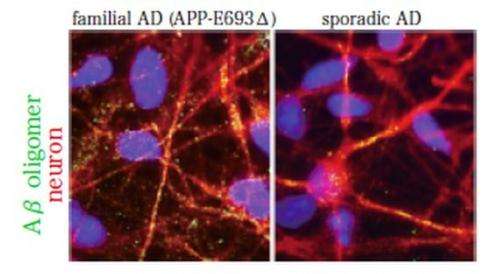
This shows amyloid beta oligomers in neurons from a familial AD (APP-E693 delta) (left) and from a sporadic AD patient (right). Credit: Courtesy of Dr. Haruhisa Inoue's laboratory
Working with a group from Nagasaki University, a research group at the Center for iPS Cell Research and Application (CiRA) at Japan's Kyoto University has announced in the Feb. 21 online publication of Cell Stem Cell has successfully modeled Alzheimer's disease (AD) using both familial and sporadic patient-derived induced pluripotent stem cells (iPSCs), and revealed stress phenotypes and differential drug responsiveness associated with intracellular amyloid beta oligomers in AD neurons and astrocytes.
In a study published online in Cell Stem Cell, Associate Professor Haruhisa Inoue and his team at CiRA and a research group led by Professor Nobuhisa Iwata of Nagasaki University generated cortical neurons and astrocytes from iPSCs derived from two familial AD patients with mutations in amyloid precursor protein (APP), and two sporadic AD patients. The neural cells from one of the familial and one of the sporadic patients showed endoplasmic reticulum (ER)-stress and oxidative-stress phenotypes associated with intracellular amyloid beta oligomers. The team also found that these stress phenotypes were attenuated with docosahexaenoic acid (DHA) treatment. These findings may help explain the variable clinical results obtained using DHA treatment, and suggest that DHA may in fact be effective only for a subset of patients.
Using both familial and sporadic AD iPSCs, the researchers discovered that pathogenesis differed between individual AD patients. For example, secreted amyloid beta 42 levels were depressed in familial AD with APP E693 delta mutation, elevated in familial AD with APP V717L mutation, but normal in sporadic AD.
"This shows that patient classification by iPSC technology may contribute to a preemptive therapeutic approach toward AD,'' said Inoue, a principal investigator at CiRA who is also a research director for the CREST research program funded by the Japan Science and Technology Agency. "Further advances in iPSC technology will be required before large-scale analysis of AD patient-specific iPSCs is possible.''
More information: Kondo et al. "Modeling Alzheimer's disease using iPSCs reveals stress phenotypes associated with intracellular amyloid beta and differential drug responsiveness.''
Journal reference:
Cell Stem Cell
Provided by
Kyoto University
-
A drug-screening platform for ALS
Aug 02, 2012 |
not rated yet |
0
-
Mechanism explains calcium abnormalities in Alzheimer's brain
Jun 25, 2008 |
not rated yet |
0
-
Alzheimer's neurons induced from pluripotent stem cells
Jan 25, 2012 |
not rated yet |
0
-
Impaired energy metabolism linked with initiation of plaques in Alzheimer's brain
Dec 24, 2008 |
not rated yet |
0
-
Bypassing stem cells, scientists make neurons directly from human skin
Aug 04, 2011 |
not rated yet |
0
-
Motion perception revisited: High Phi effect challenges established motion perception assumptions
Apr 23, 2013 |
3 / 5 (2) |
2
-
Anything you can do I can do better: Neuromolecular foundations of the superiority illusion (Update)
Apr 02, 2013 |
4.5 / 5 (11) |
5
-
The visual system as economist: Neural resource allocation in visual adaptation
Mar 30, 2013 |
5 / 5 (2) |
9
-
Separate lives: Neuronal and organismal lifespans decoupled
Mar 27, 2013 |
4.9 / 5 (8) |
0
-
Sizing things up: The evolutionary neurobiology of scale invariance
Feb 28, 2013 |
4.8 / 5 (10) |
14
-
How many joules expended for a push up?
3 hours ago
-
force to keep the folding doors
3 hours ago
-
Confusion regarding direction of kinetic friction on inclined plane.
4 hours ago
-
Mage hand
10 hours ago
-
Sphygmomonometers energy...storage?
12 hours ago
-
How does momentum, inertia and drag affect the motion of an object?
15 hours ago
- More from Physics Forums - Classical Physics
More news stories
Study identifies new approach to improving treatment for MS and other conditions
(Medical Xpress)—Working with lab mice models of multiple sclerosis (MS), UC Davis scientists have detected a novel molecular target for the design of drugs that could be safer and more effective than current FDA-approved ...
Alzheimer's disease & dementia
21 hours ago |
5 / 5 (2) |
0
|
Nonmelanoma skin cancer tied to lower Alzheimer's risk
(HealthDay)—Older individuals with nonmelanoma skin cancer (NMSC) seem to have a significantly reduced risk of developing Alzheimer's disease (AD), according to a study published online May 15 in Neurology.
Alzheimer's disease & dementia
May 16, 2013 |
5 / 5 (1) |
0
Skin cancer may be linked to lower risk of Alzheimer's disease
People who have skin cancer may be less likely to develop Alzheimer's disease, according to new research published in the May 15, 2013, online issue of Neurology®, the medical journal of the American Academy of Neurology. The li ...
Alzheimer's disease & dementia
May 15, 2013 |
5 / 5 (1) |
0
|
Alzheimer's markers predict start of mental decline
(Medical Xpress)—Scientists at Washington University School of Medicine in St. Louis have helped identify many of the biomarkers for Alzheimer's disease that could potentially predict which patients will develop the disorder ...
Alzheimer's disease & dementia
May 14, 2013 |
3 / 5 (1) |
0
|
Scientists develop drug that slows Alzheimer's in mice
A drug developed by scientists at the Salk Institute for Biological Studies, known as J147, reverses memory deficits and slows Alzheimer's disease in aged mice following short-term treatment. The findings, ...
Alzheimer's disease & dementia
May 13, 2013 |
4.2 / 5 (5) |
0
|
New research identifies risks, interventions for children's GI health
An increasing number of U.S. children are experiencing gastrointestinal issues that require interventions to resolve, according to research presented at Digestive Disease Week (DDW).
US psychiatry gets makeover in new manual
The latest makeover to a massive psychiatric tome honored by some, reviled by others and even called the "Bible" of mental disorders is being released Saturday with a host of new changes.
New case of SARS-like virus in Saudi: ministry
A new case of the deadly coronavirus has been detected in Saudi Arabia where 15 people have already died after contracting it, the health ministry announced on Saturday on its Internet website.
AIDS science at 30: 'Cure' now part of lexicon
Big names in medicine are set to give an upbeat assessment of the war on AIDS on Tuesday, 30 years after French researchers identified the virus that causes the disease.
New colonoscope provides ground-breaking view of colon
A ground-breaking advance in colonoscopy technology signals the future of colorectal care, according to research presented today at Digestive Disease Week(DDW). Additional research focuses on optimizing the minimal withdrawal ...
For combat veterans suffering from post-traumatic stress disorder, 'fear circuitry' in the brain never rests
Chronic trauma can inflict lasting damage to brain regions associated with fear and anxiety. Previous imaging studies of people with post-traumatic stress disorder, or PTSD, have shown that these brain regions can over-or ...