Bacteria producing nitric oxide extend life in roundworms
February 14, 2013 in Medical research

A little molecule's remarkable feat -- prolonging life

Enlarge

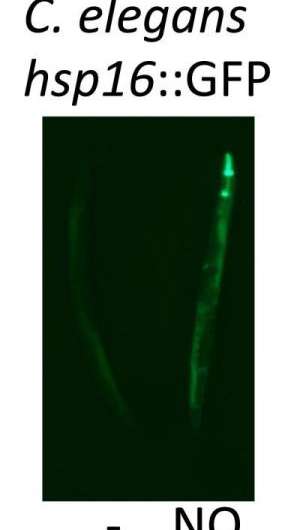
This depicts the worm glowing fluorescence in response to NO. It expresses one of the stress/anti-aging genes, hsp16, in response to nitric oxide. Credit: Evgeny Nudler, Ph.D.

Nitric oxide, the versatile gas that helps increase blood flow, transmit nerve signals, and regulate immune function, appears to perform one more biological feat— prolonging the life of an organism and fortifying it against environmental stress, according to a new study.

The study reveals that a called Caenorhabditis elegans, an animal widely used in laboratory studies of aging, lives significantly longer when fed bacteria capable of manufacturing . The tantalizing observation points to one of the mechanisms by which the microbiome, the trillions of inhabiting our bodies, may play a vital role in our health.

Our own nitric oxide levels decrease as we get older, a decline that may contribute to normal aging, says Evgeny Nudler, PhD, the Julie Wilson Anderson Professor of Biochemistry at NYU Langone Medical Center, who led the new study. Supplemental bacteria, he speculates, might provide a healthy boost by supplying humans with some of the missing compound.

"In worms, we now know that bacteria can use nitric oxide not only to their own advantage but also to provide their host with a beneficial response, and the same thing could be true in a ," says Dr. Nudler. "It may well be the case that our commensal bacteria control some of our genes, at least in the gut, to protect those cells against stress and age-related decline." Commensal bacteria provide a benefit to the organisms they colonize.

Although humans and many other organisms have the enzyme needed to produce nitric oxide, C. elegans does not. Instead, Dr. Nudler and his team report in the February 14th online issue of Cell that the worm can "hijack" the compound from the soil-dwelling bacterium that is not only a favored food but also a common colonist within its gut. This resourcefulness, Dr. Nudler says, partially explains why worms fed B. subtilis live roughly 50 percent longer than counterparts fed Escherichia coli, which does not produce the compound.

In the new study, the average C. elegans lifespan increased by nearly 15 percent, to about two weeks, when researchers fed the worms nitric oxide-producing B. subtilis bacteria, compared to worms fed mutant B. subtilis with a deleted nitric oxide production gene. The research group also used fluorescent sensors to show that C. elegans does not make its own nitric oxide gas. When the worms were fed normal B. subtilis bacteria, however, the fluorescent signal appeared in their guts.

Fluorescent labeling and other tests also demonstrated that B. subtilis-derived nitric oxide penetrated the worms' tissues, where it activated a set of 65 genes. Some had been previously implicated in stress resistance, immune response, and increased lifespan, though others have unknown functions. Importantly, the researchers showed that two well-known regulatory proteins were essential for activating all of the genes.

"What we found is that nitric oxide gas produced in inside the worms diffuses into the worm tissue and activates a very specific set of genes acting through two master regulators, hsf-1 and daf-16, resulting in a high resistance to stress and a longer life," Dr. Nudler says. "It's striking that a small molecule produced by one organism can dramatically affect the physiology and even lifespan of another organism through direct cell signaling."

As part of nitric oxide's expansive repertoire, Dr. Nudler's lab previously showed how dangerous pathogens can exploit the molecule to fight off antibiotics. Despite its versatility, the new research suggests that nitric oxide is only one of multiple beneficial molecules produced by B. subtilis, Dr. Nudler says. His lab plans to look more closely at other potential mechanisms by which can promote health and longevity, using the powerful and easily manipulated C. elegans system as a model.

Journal reference: Cell search and more info website

Provided by New York University School of Medicine search and more info website

5 /5 (1 vote)  

Rank 5 /5 (1 vote)
Relevant PhysicsForums posts

More news stories

How healthy are you for your age?

On May 22, JoVE will publish details of a technique to measure the health of human genetic material in relation to a patient's age. The method is demonstrated by the laboratory of Dr. Gil Atzmon at New York's Albert Einste ...

Medical research created 15 minutes ago | popularity not rated yet | comments 0

A molecular explanation for age-related fertility decline in women

(Medical Xpress)—Scientists supported by the National Institutes of Health have a new theory as to why a woman's fertility declines after her mid-30s. They also suggest an approach that might help slow ...

Medical research created 1 hour ago | popularity not rated yet | comments 0 | with audio podcast

Medical researchers discover new ways to target, develop and design drugs to prevent and treat viral infection

Researchers at the University of Alberta have discovered a new drug target, developed a new drug and identified a new way to design drugs—all of which could be a winning combination in the battle against viruses.

Medical research created 2 hours ago | popularity 4 / 5 (1) | comments 0 | with audio podcast

Targeting the X-factor to tackle cardiovascular disease

New research at The University of Nottingham aimed at preventing harmful blood clots associated with heart disease and stroke has recently received a major funding boost from the British Heart Foundation.

Medical research created 2 hours ago | popularity not rated yet | comments 0

Italy approves law on controversial stem cell therapy

Italian lawmakers on Wednesday gave their final approval to a law that allows limited use of a controversial type of stem cell therapy which has been condemned by many scientists but has given hope to families of terminally-ill ...

Medical research created 2 hours ago | popularity 5 / 5 (1) | comments 1


Addiction to unhealthy foods could help explain the global obesity epidemic

Research presented today shows that high-fructose corn syrup can cause behavioural reactions in rats similar to those produced by drugs of abuse such as cocaine. These results, presented by addiction expert Francesco Leri, ...

Study shows low rate of late lumen loss with bioresorbable DESolve device

The DESolve bioresorbable coronary scaffold system achieves good efficacy and safety with low rates of late lumen loss and major coronary adverse events at six months, show first results from the pivotal DESolve Nx trial ...

Study finds COPD is over-diagnosed among uninsured patients

More than 40 percent of patients being treated for COPD at a federally funded clinic did not have the disease, researchers found after evaluating the patients with spirometry, the diagnostic "gold standard" for chronic obstructive ...

Registry questions superiority of bivalirudin over heparin

Results from a large observational study reported at EuroPCR 2013 today question whether bivalirudin is superior to heparin in the absence of GPIIb/IIIa blockade, showing similar 30-day mortality in patients with non-ST segment ...

New blood-thinner measures may cut medication errors

Blood thinners are the preferred treatment option to prevent heart attacks, blood clots and stroke, but they are not without risk, and not just because of their side effects. These high-risk drugs, known as anticoagulants, ...

Small increase in cancer risk following CT scans in childhood and adolescence

Study leader, Professor John Mathews from the University of Melbourne said this small increase in cancer risk must be weighed against the undoubted benefits from CT scans in diagnosing and monitoring disease.