Study shows that diet of resistant starch helps the body resist colorectal cancer
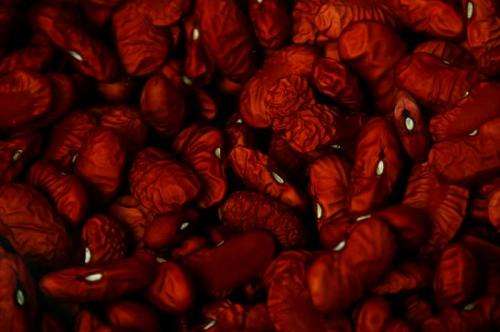
Janine Higgins, PhD, shows that foods high in resistant starch, like these beans, can protect against colorectal cancer. Credit: Flickr/Bohman.
(Medical Xpress)—As the name suggests, you can't digest resistant starch so it ends up in the bowel in pretty much the same form it entered your mouth. As unlovely as that seems, once in the bowel this resistant starch does some important things, including decreasing bowel pH and transit time, and increasing the production of short-chain fatty acids. These effects promote the growth of good bugs while keeping bad bugs at bay. A University of Colorado Cancer Center review published in this month's issue of the journal Current Opinion in Gastroenterology shows that resistant starch also helps the body resist colorectal cancer through mechanisms including killing pre-cancerous cells and reducing inflammation that can otherwise promote cancer.
"Resistant starch is found in peas, beans and other legumes, green bananas, and also in cooked and cooled starchy products like sushi rice and pasta salad. You have to consume it at room temperate or below – as soon as you heat it, the resistant starch is gone. But consumed correctly, it appears to kill pre-cancerous cells in the bowel," says Janine Higgins, PhD, CU Cancer Center investigator and associate professor of Pediatrics at the University of Colorado School of Medicine.
Higgins describes studies showing that rats fed resistant starch show decreased numbers and sizes of lesions due to colorectal cancer, and an increased number of cells that express the protein IL-10, which acts to regulate the body's inflammatory response.
"Resistant starch may also have implications for the prevention of breast cancer," Higgins says. "For example, if you let rats get obese, get them to lose the weight, and then feed half of the rats a diet high in resistant starch – these rats don't gain back the weight as fast as rats fed a regular, digestible starch diet. This effect on obesity may help to reduce breast cancer risk as well as having implications for the treatment of colorectal cancer."
"There are a lot of things that feed into the same model of resistant starch as a cancer-protective agent," Higgins says. "Much of this information currently comes from rodent models and small clinical trials but the evidence is encouraging." On the table now is a menu of benefits and while it's just now being studied which benefits, exactly, will pan out as mechanisms of cancer prevention, one thing is clear: resistant starch should be on the menu.
More information: journals.lww.com/c… _for.15.aspx
Journal reference:
Current Opinion in Gastroenterology
Provided by
University of Colorado Denver
-
Resistant starch may offer potential to help protect against bowel cancer
Apr 26, 2012 |
not rated yet |
0
-
Spuds that like you -- in your summer salad
Jun 25, 2007 |
not rated yet |
0
-
Starch intake may influence risk for breast cancer recurrence
Dec 09, 2011 |
not rated yet |
0
-
Drinking green tea with starchy food may help lower blood sugar spikes
Nov 09, 2012 |
not rated yet |
0
-
Enzyme in saliva helps regulate blood glucose
Apr 04, 2012 |
not rated yet |
0
-
Motion perception revisited: High Phi effect challenges established motion perception assumptions
Apr 23, 2013 |
3 / 5 (2) |
2
-
Anything you can do I can do better: Neuromolecular foundations of the superiority illusion (Update)
Apr 02, 2013 |
4.5 / 5 (11) |
5
-
The visual system as economist: Neural resource allocation in visual adaptation
Mar 30, 2013 |
5 / 5 (2) |
9
-
Separate lives: Neuronal and organismal lifespans decoupled
Mar 27, 2013 |
4.9 / 5 (8) |
0
-
Sizing things up: The evolutionary neurobiology of scale invariance
Feb 28, 2013 |
4.8 / 5 (10) |
14
-
Why is zone 1 in liver more prone to ischemic injury?
18 hours ago
-
How can there be villous adenoma in colon, if there are no villi there
May 22, 2013
-
How can there be a term called "intestinal metaplasia" of stomach
May 21, 2013
-
Pressure-volume curve: Elastic Recoil Pressure don't make sense
May 18, 2013
-
If you became brain-dead, would you want them to pull the plug?
May 17, 2013
-
MRI bill question
May 15, 2013
- More from Physics Forums - Medical Sciences
More news stories
Research identifies a way to make cancer cells more responsive to chemotherapy
Breast cancer characterized as "triple negative" carries a poor prognosis, with limited treatment options. In some cases, chemotherapy doesn't kill the cancer cells the way it's supposed to. New research from Western University ...
Cancer
4 hours ago |
5 / 5 (2) |
0
Mayo Clinic genomic analysis lends insight to prostate cancer
Mayo Clinic researchers have used next generation genomic analysis to determine that some of the more aggressive prostate cancer tumors have similar genetic origins, which may help in predicting cancer progression. The findings ...
Cancer
4 hours ago |
not rated yet |
0
When oxygen is short, EGFR prevents maturation of cancer-fighting miRNAs
Even while being dragged to its destruction inside a cell, a cancer-promoting growth factor receptor fires away, sending signals that thwart the development of tumor-suppressing microRNAs (miRNAs) before it's dissolved, researchers ...
Cancer
5 hours ago |
not rated yet |
0
|
Improved chemo regimen for childhood leukemia may offer high survival, no added heart toxicity
Treating pediatric leukemia patients with a liposomal formulation of anthracycline-based chemotherapy at a more intense-than-standard dose during initial treatment may result in high survival rates without causing any added ...
Cancer
9 hours ago |
not rated yet |
0
Protein preps cells to survive stress of cancer growth and chemotherapy
Scientists have uncovered a survival mechanism that occurs in breast cells that have just turned premalignant-cells on the cusp between normalcy and cancers-which may lead to new methods of stopping tumors.
Cancer
10 hours ago |
not rated yet |
0
|
Controlling mood through the motions of mitochondria
(Medical Xpress)—Regulating the distribution of power in neurons is done by a system that makes the national electric grid look simple by comparison. Each neuron has several thousand mitochondria confined ...
Multiple research teams unable to confirm high-profile Alzheimer's study
Teams of highly respected Alzheimer's researchers failed to replicate what appeared to be breakthrough results for the treatment of this brain disease when they were published last year in the journal Science.
Scientists discover molecule triggers sensation of itch
Scientists at the National Institutes of Health report they have discovered in mouse studies that a small molecule released in the spinal cord triggers a process that is later experienced in the brain as ...
Motion quotient: IQ predicted by ability to filter motion (w/ video)
A brief visual task can predict IQ, according to a new study. This surprisingly simple exercise measures the brain's unconscious ability to filter out visual movement. The study shows that individuals whose ...
Researchers find common childhood asthma unconnected to allergens or inflammation
Little is known about why asthma develops, how it constricts the airway or why response to treatments varies between patients. Now, a team of researchers at Weill Cornell Medical College, Columbia University Medical Center ...
Diabetes' genetic underpinnings can vary based on ethnic background, studies say
Ethnic background plays a surprisingly large role in how diabetes develops on a cellular level, according to two new studies led by researchers at the Stanford University School of Medicine.