A glimpse inside the control centres of cell communication
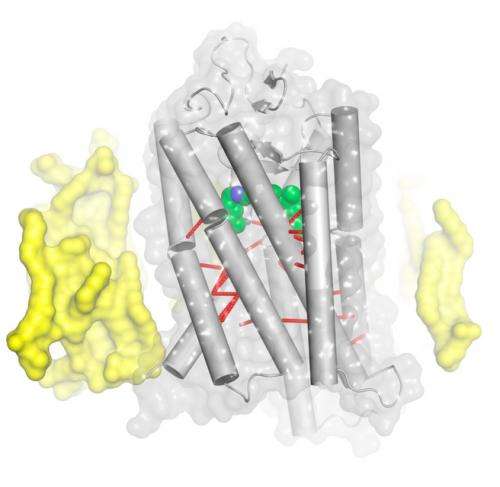
Researchers detect characteristic constructional features in a family of sensors that process signals in the human body and control physiological processes.
The cells within the human body continually communicate with one another in order to fulfil their various tasks. For that purpose, they are equipped with sensors with which they receive signals from their environment. Sensors on cell surfaces are known as receptors. Numerous processes taking place within our body – such as sight, smell or taste – are performed by an important family of receptors known as G protein-coupled receptors (GPCR). Other receptors that belong to this group are those that control emotions and those that contribute to our reaction to fear and stress.
Researchers at the Paul Scherer Institute, together with colleagues from Great Britain, have now analysed the structures of GPCRs and compared them with one another. From this, they have discovered stabilising frameworks of fine struts present in all receptors and therefore characteristic of the architecture of the entire GPCR family. In addition, they have also found a universal connector for docking molecules in the binding pockets of these receptors. Knowledge of this constructional feature, which has been conserved over the course of evolution, can be of significant assistance in the development of new pharmaceuticals. The scientists have reported on their results in a review article in the renowned scientific journal Nature.
Receptors are complex biomolecules composed of proteins that are embedded in the outer shell of a cell – the cell membrane. These consist of thousands of atoms and have a defined spatial structure that determines their function. As the effective control centres of cell communication, they recognise stimuli or messenger substances that bind to the cell from outside and change the receptors to transmit the information about the incoming signals into the interior of the cell. The family of G protein-coupled receptors (GPCRs) contains about 800 related sensors that perform the most varied tasks within the body: They process light, smell and taste stimuli, transmit the effect of numerous hormones, including adrenaline and histamine, and recognise brain messenger substances such as dopamine and serotonin.
Whenever a messenger substance becomes bound to the GPCR meant for it the biomolecule becomes activated. It changes its shape in such a way that a so-called G protein molecule can dock onto it inside the cell. The binding of the G protein to the receptor initiates a cascade of biochemical events that lead to different responses according to cell type.
Molecular signature of the GPCR family
Over the past 20 years, the determination of the structure of GPCRs has taken great steps forward, so that until now the detailed structures of 17 important receptors in this family have been solved. GPCRs generally consist of a total of seven rod-like molecular components that are joined together and that reach from the outside to the inside of the cell. Within this construct, small electrostatic and hydrophobic forces ensure that contacts are formed between neighbouring molecular rods that hold the nano-machine together.
Researchers at the Paul Scherrer Institute and the MRC Laboratory of Molecular Biology at Cambridge (UK) have now managed to analyze all known GPCR structures at the atomic level and determine the exact positions of contact for each of the components that form the individual molecular rods. Subsequently, the scientists compared the data they had gathered and were able to identify 24 common contacts that appear in all the receptor structures they had examined, and that always occupy the same key positions in the molecule. "One can imagine these contacts as a framework of fine struts that has been conserved throughout the course of evolution and is characteristic of the architecture of the entire GPCR family", explains Xavier Deupi, structural biologist at the Laboratory for Biomolecular Research at PSI.
The researchers also discovered similarities in the binding pockets of various GPCRs. Here, however, they focused on contacts between receptors and the ligands connected to them, i.e. the signal molecules that dock onto the binding pockets. "The binding pockets of various receptors differ greatly, depending on the size and shape of the ligands. Nevertheless, we were able to identify a type of universal connector deep down on the base of pocket. This connector covered four positions in the protein that together invariably formed four contacts to the ligand – independent of how the individual ligand is constituted", explains Deupi. Because the universal connector is preserved in all receptors, the scientists believe that this region of the binding pocket plays a decisive role in the activation of GPCRs.
Comparative analysis of protein structures
For their investigations, the researchers developed a method that enabled the information about the spatial structure of proteins to be reduced to the pattern of the contacts within the molecule. In order to be able to compare the patterns obtained, they applied the method of network analysis that bio-information specialists routinely use for studying interactions within biological networks. "This approach enabled us for the first time to objectively observe related receptor structures and filter out similarities. Naturally, contacts emerged that were already known and, in this way, we were able to validate the method. The remaining contacts – far more than half of them – we have effectively newly discovered, including contacts between the universal connectors and ligands", says Gebhard Schertler, head of the Biology and Chemistry Department at PSI.
Starting point for developing new medications
GPCRs are involved in quite a number of processes in the body. They act as light sensors in our eyes, make the senses of smell and taste possible, govern how we react to fear and stress and regulate our emotions. This is why the GPCR family is of great interest for pharmaceutical research. "A better understanding of receptor structures and the knowledge of their constructional characteristics will, on the one hand, lead to a better understanding of fundamental vital processes. On the other hand, the results will create a basis for computer-assisted development of new substances. Our results can help, for example, to build better models of GPCRs of those receptors whose spatial structure is still not known", explains Deupi.
About half of all medications available today operate by binding to a GPCR and influencing how it functions. Well-known examples of these are the familiar beta blockers, which control blood pressure, anti-inflammatory substances such as anti-histamines, various psychotropic medications and drugs for treating migraine.
More information:
Venkatakrishnan, A. et al. Molecular signatures of G-protein-coupled receptors, Nature 494, 185–194 (14 February 2013).
doi: 10.1038/nature11896


