Reassuring evidence: Anticancer drug does not accelerate tumor growth after treatment ends
February 7, 2013 in Cancer

Reassuring evidence: Anticancer drug does not accelerate tumor growth after treatment ends

Enlarge

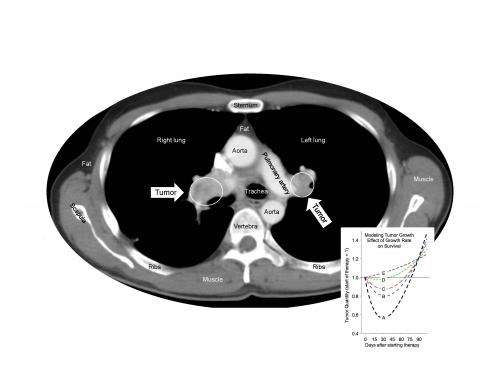
Studies in animals have raised concerns that tumors may grow faster after the anticancer drug sunitinib is discontinued. But oncologists and physicists who collaborated to analyze data from the largest study of patients with kidney cancer convincingly demonstrate that such tumor acceleration does not occur in humans. The findings, publishing online on Feb. 7th in the Cell Press journal Cell Reports, suggest that sunitinib does not cause lingering risks for patients after their treatment ends. Credit: Cell Reports, Blagoev et al.

Studies in animals have raised concerns that tumors may grow faster after the anticancer drug sunitinib is discontinued. But oncologists and physicists who collaborated to analyze data from the largest study of patients with kidney cancer convincingly demonstrate that such tumor acceleration does not occur in humans. The findings, publishing online on February 7th in the Cell Press journal Cell Reports, suggest that sunitinib does not cause lingering risks for patients after their treatment ends.

"We were able to demonstrate that this applied across all patients and that those who had the greatest benefit from the drug while it was administered retained this benefit," says senior author Dr. Tito Fojo, of the at the National Institutes of Health.
Reassuring evidence: Anticancer drug does not accelerate tumor growth after treatment ends
Enlarge

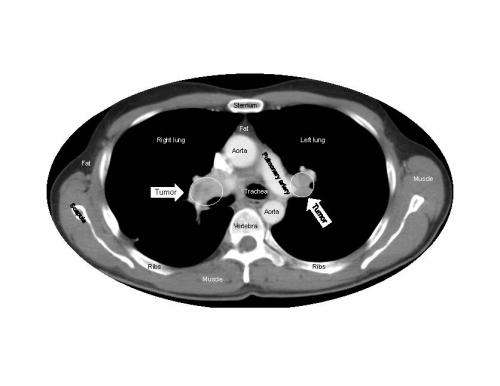
Studies in animals have raised concerns that tumors may grow faster after the anticancer drug sunitinib is discontinued. But oncologists and physicists who collaborated to analyze data from the largest study of patients with kidney cancer convincingly demonstrate that such tumor acceleration does not occur in humans. The findings, publishing online on Feb. 7th in the Cell Press journal Cell Reports, suggest that sunitinib does not cause lingering risks for patients after their treatment ends. Credit: Cell Reports, Blagoev et al.

Sunitinib, which is approved around the world for the treatment of several different cancers, works by targeting proteins on the blood vessels that feed tumors. Animal studies have suggested that treatment with sunitinib may induce changes in or adaptations within tumors themselves that could promote and spread.

When Dr. Fojo and his colleagues analyzed more than 10,000 data points from the pivotal randomized phase 3 clinical trial that led to sunitinib's approval, the evidence clearly showed that no matter how long patients took sunitinib, it was not harmful, did not accelerate , and did not shorten survival after treatment ended. During treatment, the drug slowed tumor growth and prolonged the patients' survival.

"Last year, I was approached by two patients who had grave concerns about taking sunitinib due to an article conducted in animals. I realized that if clinical data exist that refute basic science, they must be published," recalls Dr. Fojo.

The researchers' findings indicate that sunitinib can benefit patients without altering after the drug is stopped. "We hope this can be generalized to similar drugs but recognize that further studies will be needed," says first author Dr. Krastan Blagoev of the National Science Foundation. "Nevertheless, other drugs also approved worldwide for a variety of cancers—including sorafenib, pazopanib, and axitinib—are similar to sunitinib, and this will give some reassurances that one need not expect things to get worse after such drugs are discontinued."

More information: Cell Reports, Blagoev et al.: "Sunitinib Does Not Accelerate Tumor Growth in Patients with Metastatic Renal Cell Carcinoma." dx.doi.org/10.1016… .2013.01.015

Journal reference: Cell Reports search and more info website

Provided by Cell Press search and more info website

not rated yet  

Rank not rated yet
Relevant PhysicsForums posts

More news stories

Poliovirus vaccine trial shows early promise for recurrent glioblastoma

An attack on glioblastoma brain tumor cells that uses a modified poliovirus is showing encouraging results in an early study to establish the proper dose level, researchers at Duke Cancer Institute report.

Cancer created 26 minutes ago | popularity not rated yet | comments 0

Racial disparities in the surgical management of non-small cell lung cancer

The surgical management of non-small cell lung cancer (NSCLC) in U.S. hospitals varies widely depending on the race of the patient, according to a new study.

Cancer created 4 hours ago | popularity not rated yet | comments 0

Treatment with A1-PI slows the progression of emphysema in Alpha-1 antitrypsin deficiency

Treatment with an Alpha-1 proteinase inhibitor (A1-PI), a naturally occurring protein that protects lung tissue from breakdown and protects the lung's elasticity, is effective in slowing the progression of emphysema in patients ...

Cancer created 4 hours ago | popularity not rated yet | comments 0

New tumour-killer shows great promise in suppressing cancers

Scientists from Nanyang Technological University (NTU) and Lund University, Sweden, have bioengineered a novel molecule which has been proven to successfully kill tumour cells.

Cancer created 4 hours ago | popularity 5 / 5 (1) | comments 0

New factor to control oncogene-induced senescence

An article published on the journal Nature describes the major role that Pyruvate dehydrogenase (PDH) —an enzyme of cellular energy metabolism— plays in the regulation of the cellular senescence induce ...

Cancer created 5 hours ago | popularity not rated yet | comments 0


B vitamins could delay dementia

(Medical Xpress)—Despite spending billions of dollars on research and development, drug companies have been unable to come up with effective treatments for dementia and Alzheimer's Disease (AD). Now, A. ...

Enrichment therapy effective among children with autism, study finds

Children with autism showed significant improvement after six months of simple sensory exercises at home using everyday items such as scents, spoons and sponges, according to UC Irvine neurobiologists.

'Doctor shopping' by obese patients negatively affects health

Overweight and obese patients are significantly more likely than their normal-weight counterparts to repeatedly switch primary care doctors, a practice that disrupts continuity of care and leads to more emergency room visits, ...

Aggressive behavior linked specifically to secondhand smoke exposure in childhood

Children who are exposed to secondhand smoke in early childhood are more likely to grow up to physically aggressive and antisocial, regardless of whether they were exposed during pregnancy or their parents have a history ...

If you can remember it, you can remember it wrong

(Medical Xpress)—Native peoples in regions where cameras are uncommon sometimes react with caution when their picture is taken. The fear that something must have been stolen from them to create the photo ...

Insight into the dazzling impact of insulin in cells

Australian scientists have charted the path of insulin action in cells in precise detail like never before. This provides a comprehensive blueprint for understanding what goes wrong in diabetes.