Researchers show that in some cases, what looks like Lyme could be completely different illness transmitted by same bug
March 4, 2013 by Lindsey Konkel, Tufts University in Diseases, Conditions, Syndromes
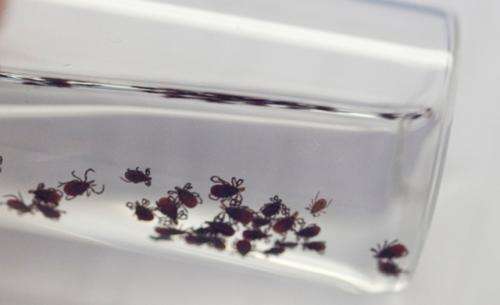
The research raises the question of whether patients with atypical Lyme disease—those who have symptoms but whose blood doesn’t test positive for Lyme—may actually be infected with B. miyamotoi, the newly identified bacteria. Credit: Kelvin Ma
Under the microscope, Sam Telford surveyed the tiny, spiral bacteria floating in spinal fluid taken from an 80-year-old woman. They looked very similar to the spirochete bacteria that can cause Lyme disease. But in fact, he had discovered yet another public health threat—a brand new disease that people can get from the same ticks that transmit the Lyme bacteria.
"We've known that this bacteria existed in the Northeast in deer ticks, but there was little data linking it to human disease" until now, says Telford, an expert on tick-borne diseases and a professor in the Department of Infectious Diseases and Global Health at the Cummings School of Veterinary Medicine. "We just needed the right patient to confirm the presence of the disease."
That patient was the elderly woman, who lived on a farm in New Jersey. Over four months, she had experienced progressive mental decline, becoming increasingly confused. Her gait grew wobbly, and she didn't have much of an appetite. Her immune system was compromised from a previous bout with cancer, so her doctors drew spinal fluid in the hopes of finding out what was going on.
When technicians at a commercial diagnostic laboratory saw the mysterious spiral bacteria, they sent the sample for further testing to Telford, whose laboratory serves as a reference center for unusual zoonotic infections, those that pass between animals and humans.
Telford and Heidi Goethert, J93, a microbiologist at the Cummings School, sequenced the spirochete DNA, and identified it as Borrelia miyamotoi, which was first found in ticks in Japan in 1995 and is closely related to the bacteria that causes Lyme disease. Previous human cases of B. miyamotoi infections were found in Russia in 2011.

Sam Telford walks through the grounds of the Cummings School with a cloth used to collect ticks. Credit: Kelvin Ma
The Tufts scientists reported the first U.S. case of human B. miyamotoi infection in the New England Journal of Medicine in January. (The woman was treated with antibiotics and has since recovered.)
The B. miyamotoi bacteria may be an under-recognized source of human disease, especially in regions such as the northeastern United States, where Lyme disease is prevalent, say Telford and his coauthors.
There's controversy in the scientific and medical communities about whether a person can test negative for Lyme and still have Lyme, says Telford. This latest research raises the question of whether patients with atypical Lyme disease—those who have symptoms but whose blood doesn't test positive for Lyme—may actually be infected with B. miyamotoi, he says. Both are treated with the same course of antibiotics.
While an estimated 12 to 18 percent of coastal New Englanders have been infected with the Lyme bacteria, called Borrelia burgdorferi, only between 1 and 3 percent of people have likely been infected with its lesser-known cousin, B. miyamotoi, researchers at Yale reported in a correspondence that accompanied the Tufts study in NEJM. (The Yale team is led by Peter J. Krause, M71, and also includes Timothy J. Lepore, M70.)
Not all deer ticks carry B. miyamotoi, just like they don't all carry the Lyme-causing bacteria. Previous surveys of ticks suggest the new bacterium appears to be much less common—roughly 10 percent as prevalent—than the one that causes Lyme, according to Telford. While to date there has only been one confirmed case of human infection in the U.S., researchers have known for some time that the ticks carry these bacteria. Telford says they suspected that people were being infected with it, but [proof was lacking]. They were waiting for the right patient to come along.
This new disease, which has yet to be named, is the fifth known human infection to come from deer ticks in the Northeast, after Lyme, babesiosis, ehrlichiosis and deer tick virus.
Ticks are notorious transmitters of infectious disease around the globe. Their indiscriminate dining habits (they don't seem to care what animals they feed on) and the relatively large amount of blood they consume (200 times their own body weight) make ticks great at picking up pathogens and spreading them.
"Lyme disease alone is enough of an argument to take action to reduce risks, let alone four other infections. In some New England communities, as many as a third of residents have been exposed to at least one tick borne infection," says Telford, who suggests that public education about tick-borne diseases and reducing deer herds, while controversial, may be a good places to start.
More information: www.nejm.org/doi/f… 39#t=article
Journal reference:
New England Journal of Medicine
Source:
Tufts University
-
New tick-borne disease discovered
Sep 20, 2011 |
not rated yet |
0
-
Deer ticks carry yet another bacterial threat
Jan 16, 2013 |
not rated yet |
0
-
Lyme Disease 'App' For iPhone Developed by Yale School of Public Health
May 04, 2010 |
not rated yet |
0
-
Survey of pet dogs indicates Lyme disease risk much greater than previous estimates suggest
Jan 25, 2012 |
not rated yet |
0
-
Lyme rash reappearance probably signals new infection, study says
Nov 15, 2012 |
not rated yet |
0
-
Motion perception revisited: High Phi effect challenges established motion perception assumptions
Apr 23, 2013 |
3 / 5 (2) |
2
-
Anything you can do I can do better: Neuromolecular foundations of the superiority illusion (Update)
Apr 02, 2013 |
4.5 / 5 (11) |
5
-
The visual system as economist: Neural resource allocation in visual adaptation
Mar 30, 2013 |
5 / 5 (2) |
9
-
Separate lives: Neuronal and organismal lifespans decoupled
Mar 27, 2013 |
4.9 / 5 (8) |
0
-
Sizing things up: The evolutionary neurobiology of scale invariance
Feb 28, 2013 |
4.8 / 5 (10) |
14
-
Classical and Quantum Mechanics via Lie algebras
Apr 15, 2011
- More from Physics Forums - Independent Research
More news stories
Researchers find genetic risk factor for pulmonary fibrosis
A paper recently published in the New England Journal of Medicine and co-written by physicians and scientists at the University of Colorado School of Medicine finds that an important genetic risk factor for pulmonary fibros ...
Diseases, Conditions, Syndromes
6 hours ago |
not rated yet |
0
Biomarkers discovered for inflammatory bowel disease
Using the Department of Defense Serum Repository (DoDSR), University of Cincinnati (UC) researchers have identified a number of biomarkers for inflammatory bowel disease (IBD), which could help with earlier diagnosis and ...
Diseases, Conditions, Syndromes
6 hours ago |
not rated yet |
0
CDC says high number of public pools contain microbes
(HealthDay)—Three-quarters of public schools in the metro Atlanta area contain microbes, including bacteria indicating the presence of fecal matter, according to research published in the May 17 issue of ...
Diseases, Conditions, Syndromes
7 hours ago |
not rated yet |
0
Study examines outbreak of spinal infections in Michigan
(HealthDay)—Factors such as increased case finding may explain why Michigan had half of the total spinal infections associated with contaminated methylprednisolone acetate in the recent fungal meningitis ...
Diseases, Conditions, Syndromes
7 hours ago |
not rated yet |
0
World not ready for mass flu outbreak, WHO says
The world is unprepared for a massive virus outbreak, the deputy chief of the World Health Organization warned Tuesday, amid fears that H7N9 bird flu striking China could morph into a form that spreads easily among people.
Diseases, Conditions, Syndromes
7 hours ago |
not rated yet |
0
If you can remember it, you can remember it wrong
(Medical Xpress)—Native peoples in regions where cameras are uncommon sometimes react with caution when their picture is taken. The fear that something must have been stolen from them to create the photo ...
B vitamins could delay dementia
(Medical Xpress)—Despite spending billions of dollars on research and development, drug companies have been unable to come up with effective treatments for dementia and Alzheimer's Disease (AD). Now, A. ...
Reducing caloric intake delays nerve cell loss
Activating an enzyme known to play a role in the anti-aging benefits of calorie restriction delays the loss of brain cells and preserves cognitive function in mice, according to a study published in the May ...
New sleeping pill poised to hit US markets
An experimental sleeping pill from US drug company Merck is effective at helping people fall and stay asleep, according to reviewers at the US Food and Drug Administration, which could soon approve the new drug.
Insight into the dazzling impact of insulin in cells
Australian scientists have charted the path of insulin action in cells in precise detail like never before. This provides a comprehensive blueprint for understanding what goes wrong in diabetes.
Antidepressant reduces stress-induced heart condition
A drug commonly used to treat depression and anxiety may improve a stress-related heart condition in people with stable coronary heart disease, according to researchers at Duke Medicine.