Solving the 'Cocktail Party Problem': How we can focus on 1 speaker in noisy crowds
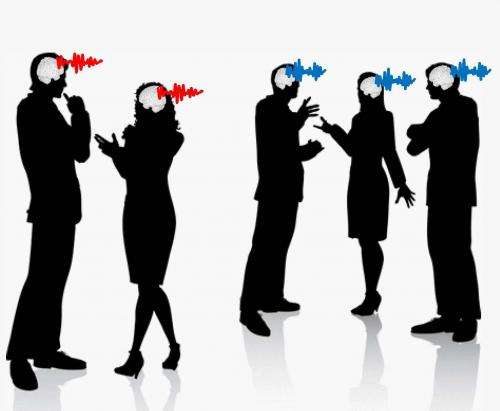
This is a cartoon illustrating the idea that at a cocktail party the brain activity synchronizes to that of an attended speaker, effectively putting them on the same wavelength. Credit: Neuron, Zion-Golumbic et al.
In the din of a crowded room, paying attention to just one speaker's voice can be challenging. Research in the March 6 issue of the Cell Press journal Neuron demonstrates how the brain hones in on one speaker to solve this "Cocktail Party Problem."
Researchers discovered that brain waves are shaped so that the brain can selectively track the sound patterns from the speaker of interest and at the same time exclude competing sounds from other speakers. The findings could have important implications for helping individuals with a range of deficits such as those associated with attention deficit hyperactivity disorder, autism, and aging.
"In hearing, there is no way to 'close your ear,' so all the sounds in the environment are represented in the brain, at least at the sensory level," explains senior author Dr. Charles Schroeder, of Columbia University's Department of Psychiatry. "While confirming this, we also provide the first clear evidence that there may be brain locations in which there is exclusive representation of an attended speech segment, with ignored conversations apparently filtered out." In this way, when concentrating hard on such an "attended" speaker, one is barely, if at all, aware of ignored speakers.
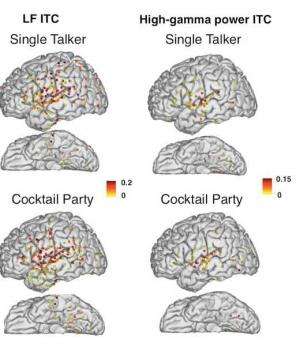
Location of sites with signifcant LF phase-ITC (left) and HG power-ITC (right) in both conditions. The colors of the dots represent the ITC value at each site Credit: Neuron, Zion-Golumbic et al.
Using direct recording of brain activity in surgical epilepsy patients, who were listening to natural spoken sentences, Dr. Schroeder and Dr. Elana Zion Golumbic, also of Columbia University, and their colleagues from New York University, University of Maryland, and Hillside-Long Island Jewish found two types of effects. In and near auditory cortex, brain signals reflect both attended and ignored speech, but attended speech generates higher signal amplitudes. However, in regions of the brain involved in "higher-order processing," such as language and attention control, representation of attended speech was clear, while that of ignored speech was not detectable. Remarkably, the selective, higher-order representation is progressively refined as a sentence unfolds."Most studies use very simplified, unnatural stimuli to study the Cocktail Party Problem—like brief beeps, or even brief phrases—whereas we were able show that with appropriate techniques, we could study this problem using natural speech," says Dr. Schroeder. "This will stimulate future research to continue the study of this and related issues under rich, natural conditions. Just as importantly, the ability to directly analyze widespread brain activity patterns in surgical epilepsy patients provides an unprecedented opportunity to firmly connect the work on the Brain Activity Map at the model systems level in mice, songbirds, and nonhuman primates to the study of capacities like language and music, that may be uniquely human."
More information: Neuron, Zion-Golumbic et al.: "Mechanisms Underlying Selective Neuronal Tracking of Attended Speech at a 'Cocktail Party'." dx.doi.org/10.1016… .2012.12.037
Journal reference:
Neuron
Provided by
Cell Press
-
New study sheds light on how selective hearing works in the brain
Apr 18, 2012 |
not rated yet |
0
-
Brain 'talks over' boring speech quotes
Mar 26, 2012 |
not rated yet |
0
-
Where the brain makes sense of speech
Dec 19, 2007 |
not rated yet |
0
-
Zeroing in on the brain's speech 'receiver'
Jun 20, 2007 |
not rated yet |
0
-
Brain 'hears' voices when reading direct speech
Jul 26, 2011 |
not rated yet |
0
-
Motion perception revisited: High Phi effect challenges established motion perception assumptions
Apr 23, 2013 |
3 / 5 (2) |
2
-
Anything you can do I can do better: Neuromolecular foundations of the superiority illusion (Update)
Apr 02, 2013 |
4.5 / 5 (11) |
5
-
The visual system as economist: Neural resource allocation in visual adaptation
Mar 30, 2013 |
5 / 5 (2) |
9
-
Separate lives: Neuronal and organismal lifespans decoupled
Mar 27, 2013 |
4.9 / 5 (8) |
0
-
Sizing things up: The evolutionary neurobiology of scale invariance
Feb 28, 2013 |
4.8 / 5 (10) |
14
-
How can there be a term called "intestinal metaplasia" of stomach
17 hours ago
-
Pressure-volume curve: Elastic Recoil Pressure don't make sense
May 18, 2013
-
If you became brain-dead, would you want them to pull the plug?
May 17, 2013
-
MRI bill question
May 15, 2013
-
Ratio of Hydrogen of Oxygen in Dessicated Animal Protein
May 13, 2013
-
Alcohol and acetaminophen
May 13, 2013
- More from Physics Forums - Medical Sciences
More news stories
Reducing caloric intake delays nerve cell loss
Activating an enzyme known to play a role in the anti-aging benefits of calorie restriction delays the loss of brain cells and preserves cognitive function in mice, according to a study published in the May ...
Neuroscience
7 hours ago |
5 / 5 (3) |
0
|
B vitamins could delay dementia
(Medical Xpress)—Despite spending billions of dollars on research and development, drug companies have been unable to come up with effective treatments for dementia and Alzheimer's Disease (AD). Now, A. ...
Neuroscience
10 hours ago |
4.9 / 5 (9) |
0
|
Waiting for a sign? Researchers find potential brain 'switch' for new behavior
You're standing near an airport luggage carousel and your bag emerges on the conveyor belt, prompting you to spring into action. How does your brain make the shift from passively waiting to taking action when ...
Neuroscience
11 hours ago |
5 / 5 (1) |
0
|
If you can remember it, you can remember it wrong
(Medical Xpress)—Native peoples in regions where cameras are uncommon sometimes react with caution when their picture is taken. The fear that something must have been stolen from them to create the photo ...
Neuroscience
12 hours ago |
4.2 / 5 (5) |
0
|
Study shows where scene context happens in our brain
In a remote fishing community in Venezuela, a lone fisherman sits on a cliff overlooking the southern Caribbean Sea. This man –– the lookout –– is responsible for directing his comrades on the water, ...
Neuroscience
14 hours ago |
4 / 5 (1) |
0
|
Insight into the dazzling impact of insulin in cells
Australian scientists have charted the path of insulin action in cells in precise detail like never before. This provides a comprehensive blueprint for understanding what goes wrong in diabetes.
New sleeping pill poised to hit US markets
An experimental sleeping pill from US drug company Merck is effective at helping people fall and stay asleep, according to reviewers at the US Food and Drug Administration, which could soon approve the new drug.
Antidepressant reduces stress-induced heart condition
A drug commonly used to treat depression and anxiety may improve a stress-related heart condition in people with stable coronary heart disease, according to researchers at Duke Medicine.
Drugs found to both prevent and treat Alzheimer's disease in mice
Researchers at USC have found that a class of pharmaceuticals can both prevent and treat Alzheimer's Disease in mice.
Enrichment therapy effective among children with autism, study finds
Children with autism showed significant improvement after six months of simple sensory exercises at home using everyday items such as scents, spoons and sponges, according to UC Irvine neurobiologists.
Study finds vitamin C can kill drug-resistant TB (w/ video)
In a striking, unexpected discovery, researchers at Albert Einstein College of Medicine of Yeshiva University have determined that vitamin C kills drug-resistant tuberculosis (TB) bacteria in laboratory culture. The finding ...
