Study explains why men are at higher risk for stomach cancer
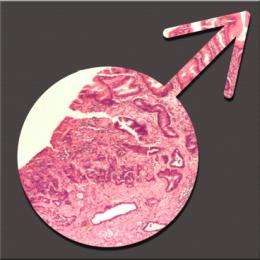
Several types of cancer, including stomach, liver and colon, are far more common in men than in women. Some scientists have theorized that differences in lifestyle, such as diet and smoking, may account for the discrepancy, but growing evidence suggests that the differences are rooted in basic biological differences between men and women.
Adding to that evidence, a new study from MIT shows that treating male mice with estrogen dramatically lowers their rates of stomach cancer — specifically, cancers caused by chronic infection by the bacterium Helicobacter pylori.
The paper, which recently appeared online in the journal Cancer Prevention Research, also describes in new detail how estrogen protects against gastric cancer, which could help scientists find better drug targets against the disease.
It’s unlikely that doctors would treat men with estrogen, but the researchers believe their work could lead to treatments that mimic estrogen’s cancer-suppressing effects. “If we can narrow in on which estrogen effect is causing this protection, we can come up with a better therapy,” says Alexander Sheh, a postdoc in MIT’s Division of Comparative Medicine (DCM) and lead author of the paper.
A global problem
Gastric cancer is the second-leading cause of cancer deaths worldwide, and people infected with H. pylori are much more likely to develop gastric cancer than uninfected people. More than 50 percent of the world’s population is infected, though most do not experience any symptoms.
H. pylori infection provokes an immune response that keeps the infection under control but can lead to gastritis, a chronic inflammation of the stomach that is conducive to the development of gastric cancer.
Several studies have suggested that estrogen protects women from this kind of inflammation. Women with delayed menopause and increased fertility have a lower risk of gastric cancer, and drugs that block estrogen activity, such as the breast cancer drug Tamoxifen, are linked to higher rates of gastric cancer in women.
Recent studies from the lab of James Fox, MIT professor of biological engineering and director of DCM, showed that female mice with their ovaries removed — so they could no longer produce estrogen — lost their protection from gastric cancer. In another study, Fox gave estrogen to male mice soon after birth, and showed that it prevented the development of gastritis and precancerous gastric lesions.
In the new study, of which Fox is senior author, the researchers waited until the mice had already developed gastritis before giving them estrogen. The mice in the study were genetically engineered to produce large amounts of gastrin, a hormone that promotes acid production and proliferation of the cells that line the stomach. Such mice typically develop cancer within 20 months.
H. pylori infection speeds up that cancer progression, to about seven months. As in humans, males are much more likely than females to develop gastric cancer.
At age 24 weeks, 16 weeks after being infected with H. pylori, male mice in this study were treated with estrogen, Tamoxifen, both or neither. Female mice were treated with Tamoxifen or nothing. The researchers expected that Tamoxifen would undo the protective effects of estrogen, in both male and female mice.
However, among the male mice, all three treated groups — estrogen, Tamoxifen or both — were protected from gastric cancer. In fact, none of those mice developed cancer, even though they all had gastritis before receiving treatment. Forty percent of the untreated mice developed gastric cancer.
Among the female mice, those who received Tamoxifen showed no differences from the untreated mice. That surprising finding suggests that in the stomach, Tamoxifen may mimic estrogen’s effects, rather than blocking them.
Genetic answers
The new study offers strong experimental validation of the idea that estrogen is responsible for the gender differences seen in gastric cancer, says Keith Wilson, professor of pathology, microbiology and immunology at Vanderbilt University Medical Center. “There’s been a lot of vague information out there that female sex hormones may be protective in inflammatory states, but in this study, they were able to give proof of principle showing a strong protective effect against cancer,” Wilson says.
To figure out how estrogen and Tamoxifen protect against gastric cancer, the MIT researchers examined which genes were overexpressed in the treated mice. They identified about 60 genes, most of which are involved in cell movement and/or cancer growth. Of these candidates, they decided to focus on CXCL1, a signaling protein that is involved in cell movement and recruitment of immune cells.
The human analogue of CXCL1 is IL-8, which is often part of the immune response to H. pylori. The researchers believe that chronic H. pylori infection stimulates production of CXCL1 (or IL-8 in humans), which attracts immune cells such as neutrophils and macrophages. This promotes inflammation, eventually leading to gastritis and cancer.
Estrogen somehow interferes with the recruitment or activity of those immune cells. The researchers are now trying to figure out in more detail how this happens, by studying mice that are missing the gene for CXCL1. They are also interested in developing molecules that inhibit CXCL1 activity.
This story is republished courtesy of MIT News (web.mit.edu/newsoffice/), a popular site that covers news about MIT research, innovation and teaching.


