Brain electrical activity spurs insulation of brain's wiring
August 11, 2011 in Medical research
Brain electrical activity spurs insulation of brain's wiring

Enlarge

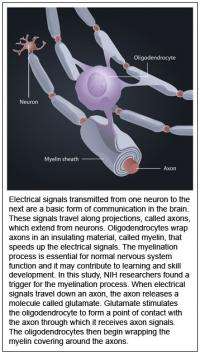
(Medical Xpress) -- Researchers at the National Institutes of Health have discovered in mice a molecular trigger that initiates myelination, the process by which brain cell networks are reinforced with an insulating material called myelin that speeds their ability to transmit messages.

The myelination process is an essential part of . Myelin formation is necessary for to communicate and it may contribute to development of skills and learning.

The researchers showed that an passing through a brain cell (neuron) results in the brain cell releasing the molecule glutamate. Glutamate, in turn, triggers another type of brain cell, called an oligodendrocyte, to form a point of contact with the neuron. Signals transmitted through this contact point stimulate the oligodendrocyte to make myelin protein and begin the process of myelination. In this process, the oligodendrocyte wraps myelin around axons— the long, cable-like projections that extend from each neuron. The myelination process is analogous to wrapping electrical tape around bare wires.

Electrical signals transmitted from one neuron to the next are a basic form of communication in the brain. The myelin layers that oligodendrocytes wrap around neurons boost these signals so that they travel 50 times faster than before.

The study was conducted by Hiroaki Wake, Philip R. Lee, and R. Douglas Fields of the Nervous System Development and Plasticity Section of the NIH’s Eunice Kennedy Shriver National Institute of Child Health and Human Development (NICHD). Their findings appear online in Science Express.

“Insulation begins to form on axons in the late stages of fetal development, but the process continues through childhood, adolescence, and into early adulthood,” said Dr. Fields, the study’s senior author. “For example, infants cannot hold up their heads or walk until the appropriate motor axons become myelinated, and the frontal lobes of the brain, responsible for judgment and higher-level complex reasoning, are not fully myelinated until the early twenties.”

Understanding how oligodendrocytes generate and help repair myelin could provide insight into how only the appropriate axons in the brain become insulated during development as people acquire skills, with the eventual goal of helping them do so more efficiently, Dr. Fields explained. Similarly, understanding the myelination process could lead to insights into disorders like multiple sclerosis, in which myelin is either damaged or destroyed. Moreover, understanding myelination may allow researchers to speed myelination— and repair— of axons recovering from injury.

Throughout the brain, oligodendrocytes and neurons exist side by side. The researchers placed mouse and myelin-making oligodendrocytes together in a dish and stimulated the nerve cells with electrical pulses. After three weeks, they found that the nerve cells were wrapped in a myelin covering.

In a separate culture of neurons and oligodendrocytes, the researchers blocked the release of the molecule glutamate, a neurotransmitter. Neurotransmitters make it possible for signals to pass between cells. When glutamate release was blocked, very little myelin coating formed. Further experiments showed that after the electrical pulses and the release of glutamate, nerve cells and the neighboring oligodendrocytes began sending chemical signals back and forth. Then the oligodendrocytes started to make the used to form the myelin sheath. Specifically, receptors on the cell membrane of oligodendrocytes detect glutamate released by the axon, and this triggers the formation of what the researchers termed specialized adhesive signaling junctions—points of contact between oligodendrocytes and axons that enable signals to be passed between the cells. Then the oligodentrocytes began depositing myelin on electrically active axons, but not on axons that were not electrically active.

“This shows that that are transmitting electrical signals will become preferentially insulated by ,” Dr. Fields said.

In a previous study, Dr. Fields and his coauthors found that electrical activity in neurons stimulates other cells, called astrocytes, that also are involved in the myelination process.

Provided by National Institutes of Health

5 /5 (5 votes)  

Filter


Move the slider to adjust rank threshold, so that you can hide some of the comments.


Display comments: newest first

hush1
Aug 12, 2011

Rank: not rated yet
Insulation begins to form on axons in the late stages of fetal development, but the process continues through childhood, adolescence, and into early adulthood, said Dr. Fields, the studys senior author.

To the team and their research: Kudos.
Which areas of the brain's neurons are myelinated first?

Depending on the period of gestation in fetal development, the myelination follows the areas of the brain subjected first and repeatedly to 'external' stimuli (present in the womb) send as signals to the brain to 'prep' that which is essential to a newborn's survival: the sensory functions.

The hypothesis is: brain associated areas of sound and touch are the first to exhibit myelination during fetal development.

In jest - Hire me if I am right, fire me if I am wrong.
Rank 5 /5 (5 votes)
Relevant PhysicsForums posts
  • A question about drug tolerance
    createdMay 23, 2012
  • Poor nutrition leading to overeating?
    createdMay 23, 2012
  • Math and dyslexia?
    createdMay 21, 2012
  • portable metabolism meter?
    createdMay 21, 2012
  • Rare medical conditions on 20/20 tonight
    createdMay 18, 2012
  • "Good" Cholesterol in Doubt
    createdMay 17, 2012
  • More from Physics Forums - Medical Sciences

More news stories

Implantable pain disk may help those with cancer

An estimated 3.5 million cancer patients around the globe are in severe pain from their disease, but many get no relief.

Medical research created 8 hours ago | popularity not rated yet | comments 0 | with audio podcast

Energy levels link sleep control mechanisms

Sleep, or lack of it, can determine level of cognitive performance which is linked with accidents as well as increased risk of serious health problems. Links between cell energy levels, gene transcription ...

Medical research created 10 hours ago | popularity not rated yet | comments 0

Researchers identify key brain cell in antidepressant action

(Medical Xpress) -- Antidepressant medications such as Prozac have helped improve mood and lessen anxiety in millions of people with major depression. But scientists know surprisingly little about how these drugs work.

Medical research created 10 hours ago | popularity not rated yet | comments 0 | with audio podcast

Rockefeller scientists pioneer new method to determine mechanisms of drug action

(Medical Xpress) -- Knowing that a drug works is great. Knowing how it works is a luxury. And until now, determining a drug’s mechanism of action has been a tedious and difficult process for scientists.

Medical research created 10 hours ago | popularity not rated yet | comments 0 | with audio podcast

Like curry? New biological role identified for compound used in ancient medicine

Scientists have just identified a new reason why some curry dishes, made with spices humans have used for thousands of years, might be good for you.

Medical research created 18 hours ago | popularity 4.3 / 5 (7) | comments 1 | with audio podcast


Tongue analysis software uses ancient Chinese medicine to warn of disease

For 5,000 years, the Chinese have used a system of medicine based on the flow and balance of positive and negative energies in the body. In this system, the appearance of the tongue is one of the measures used to classify ...

Of mice and mental models: Neuroscientific implications of risk-optimized behavior in the mouse

(Medical Xpress) -- Regardless of an organism’s biological complexity, every encephalized animal continuously makes under-informed behavioral choices that can have serious consequences. Despite its ubiquity, ...

Skp2 activates cancer-promoting, glucose-processing Akt

HER2 and its epidermal growth factor receptor cousins mobilize a specialized protein to activate a major player in cancer development and sugar metabolism, scientists report in the May 25 issue of Cell.

Early physical therapist treatment associated with reduced risk of healthcare utilization and reduced overall healthcare

A new study published in Spine shows that early treatment by a physical therapist for low back pain (LBP), as compared to delayed treatment, was associated with reduced risk of subsequent healthcare utilization and lower ...

Cancer may require simpler genetic mutations than previously thought

Chromosomal deletions in DNA often involve just one of two gene copies inherited from either parent. But scientists haven't known how a deletion in one gene from one parent, called a "hemizygous" deletion, can contribute ...

Inherited DNA change explains overactive leukemia gene

A small inherited change in DNA is largely responsible for overactivating a gene linked to poor treatment response in people with acute leukemia.